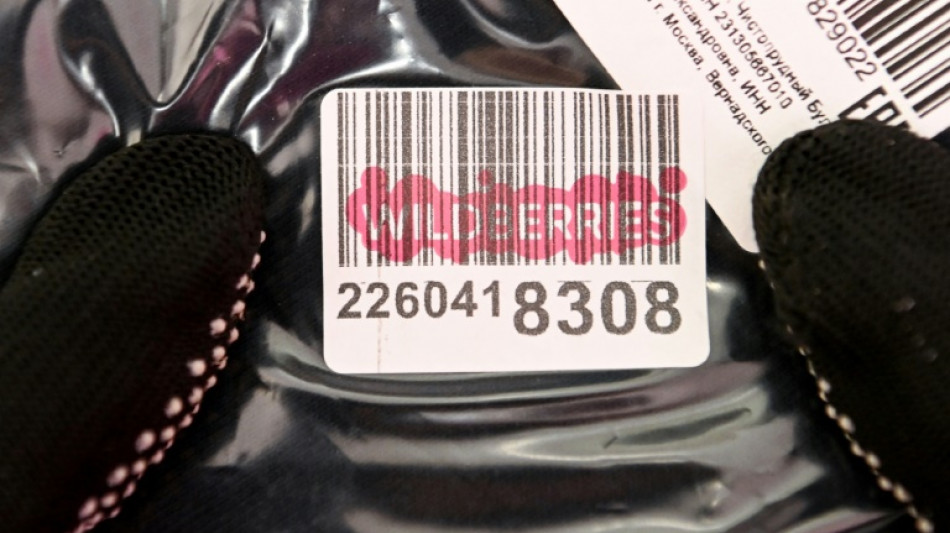
Barcode turns 50 but its days might be numbered / Photo: © AFP/File

 NFL Giants obtain QB McCarthy from Vikings
 Deal for evicted Spanish pensioner as PM seeks new housing law

 Clippers apologize, warn fans of 'challenges' after Leonard scandal

 Turkish comedian convicted for Erdogan 'insult' freed pending appeal

 Trump announces 'biggest' US steel plant in battleground Iowa

 Olise wonder strike gives Zidane's France win in Belgium

 US stocks fall, bond yields rise as Middle East war drags on
 Trump denies offering to sell arms to China's Xi

 Wemby ready for NBA Spurs to move rivals in climb to top

 Ukraine to postpone some spending amid delays in aid: PM

 Tuchel says Czech Republic game 'not yet a must-win'
 MaXhosa puts South Africa on the Paris fashion map

 Rose, Scott among 2027 World Golf Hall of Fame finalists
 Brunson says NBA champion Knicks can't get satisfaction
 France puts out largest wildfire since 1949

 Real Madrid's Perez summoned over Barcelona referee payments comments
 Oil takes off again, Wall Street dips after Trump rejects Iran truce offer

 AlgoQuant Asset Management Selects Liquid Mercury to Enhance Digital Asset Trading Infrastructure

 UK to reopen refugee resettlement scheme to push 'safe' migration

 Pope urges Europe to help combat 'lies and deceit' in world affairs
 Iranian lawyer Nasrin Sotoudeh wins Council of Europe's rights prize
 French far-right's Bardella denies alleged 2013 antisemitic comments

 Oil up, Wall Street dips after Trump rejects Iran truce offer

 Gakpo withdraws from Netherlands squad

 SpaceX puts Starship megarocket in orbit for first time

The patch of irregular vertical lines that revolutionised checking out at the supermarket and facilitated the globalisation of retail is turning 50.
But as the barcode celebrates its birthday on Monday, its days might be numbered as it faces competition from the younger QR code, the information-filled squares used in smartphones.
The trademark beep as a product is scanned is heard about six billion times per day across the world as around 70,000 items are sold each second.
It has become so integrated in the shopping experience that it is easy to forget how much the technology revolutionised retail by speeding up the checkout process and giving retailers the ability to trace products and better manage inventory.
The barcode not only identifies a product, but "gives professionals in stores access to other functionalities", said Laurence Vallana, head of France de SES-Imagotag, a company that specialises in electronic tagging.
- Chewing gum to fruit -
Barcodes were initially patented by Norman Joseph Woodland and Bernard Silver in the United States in 1952.
But it wasn't until nearly two decades later, in 1971, that US engineer George Laurer perfected the technology and moves towards its commercialisation began.
On April 3, 1973 the standard to identify products was agreed by a number of large retailers and food companies. It later became known as EAN-13, which stands for European Article Number and the number of digits in the barcode.
The following year, on June 26 in the US state of Ohio, the first product was scanned: a pack of chewing gum that is now in the National Museum of American History in Washington.
Today, the non-governmental organisation Global Standard 1 manages the barcode system and counts about two million firms as members.
It provides companies with a unique "global trade item number" for each product, which is then translated into the barcode. Each firm must pay an annual fee based on their sales, up to nearly $5,000 per year.
- From bars to QRs -
But the humble barcode will soon give way to another standard developed by the organisation, said Renaud de Barbuat and Didier Veloso, the respective heads of GS1 Global and GS1 France.
The new standard, based on QR, or Quick Response code, will be introduced around 2027.
If barcodes have been compared to prison bars by critics of the over-commercialisation of society, the Chinese game Go with its white and black pieces on a square board was the inspiration for the QR code's Japanese creator, Masahiro Hara.
Developed in 1994, QR codes can hold much more information as they are read both horizontally, like barcodes, and vertically.
Instead of having to search a database for information to go along with a product, the QR code can integrate information directly, such as the composition of the product and recycling instructions.
GS1 believes moving to the QR code format allows the sharing of far more information about products as well as content, enabling new uses that will be accessible to consumers as well as retailers.
As smartphones can read QR codes, they are an easy way to send people to websites to get additional information, leading to their widespread adoption by companies, artists and even museums. They are even used by payment systems.
But barcodes are likely to remain in place for years to come as the world gradually transitions to QR codes.
T.Bondarenko--BTB