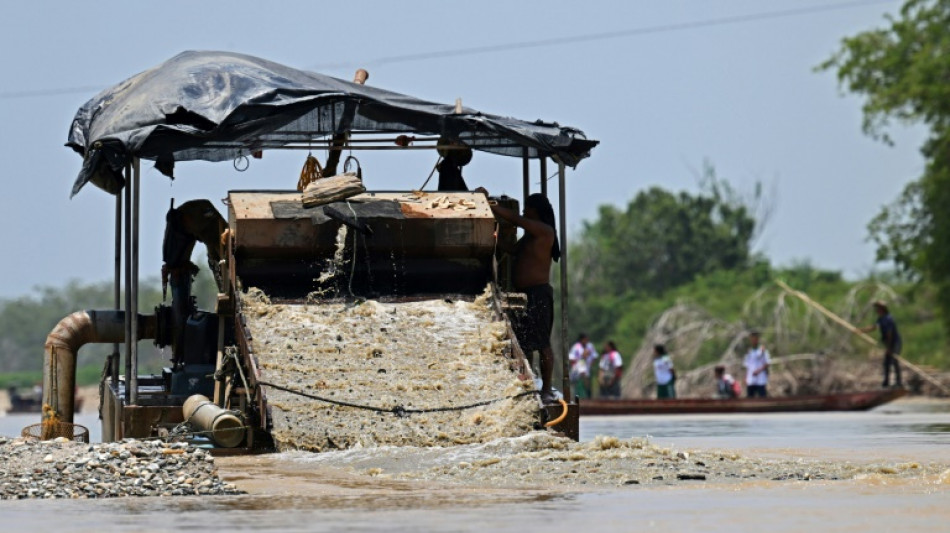
Battle in Colombia over river-wrecking gold 'dragons' / Photo: © AFP

 NFL Giants obtain QB McCarthy from Vikings

 Deal for evicted Spanish pensioner as PM seeks new housing law

 Clippers apologize, warn fans of 'challenges' after Leonard scandal

 Turkish comedian convicted for Erdogan 'insult' freed pending appeal

 Trump announces 'biggest' US steel plant in battleground Iowa

 Olise wonder strike gives Zidane's France win in Belgium

 US stocks fall, bond yields rise as Middle East war drags on

 Trump denies offering to sell arms to China's Xi

 Wemby ready for NBA Spurs to move rivals in climb to top

 Ukraine to postpone some spending amid delays in aid: PM

 Tuchel says Czech Republic game 'not yet a must-win'

 MaXhosa puts South Africa on the Paris fashion map

 Rose, Scott among 2027 World Golf Hall of Fame finalists

 Brunson says NBA champion Knicks can't get satisfaction

 France puts out largest wildfire since 1949

 Real Madrid's Perez summoned over Barcelona referee payments comments

 Oil takes off again, Wall Street dips after Trump rejects Iran truce offer
 AlgoQuant Asset Management Selects Liquid Mercury to Enhance Digital Asset Trading Infrastructure

 UK to reopen refugee resettlement scheme to push 'safe' migration

 Pope urges Europe to help combat 'lies and deceit' in world affairs

 Iranian lawyer Nasrin Sotoudeh wins Council of Europe's rights prize

 French far-right's Bardella denies alleged 2013 antisemitic comments

 Oil up, Wall Street dips after Trump rejects Iran truce offer

 Gakpo withdraws from Netherlands squad

 SpaceX puts Starship megarocket in orbit for first time
The giant skeletons of burnt and dismantled gold dredgers litter the rivers of northwest Colombia, where the government is waging a full-out war on illegal mining.
Nicknamed "dragons" by locals, the massive machines used to suck gold from riverbeds are blamed for destroying the environment and financing organized crime.
But their dismantling in a massive army operation has been met with hostility by communities who depend on mining for their daily survival.
Around El Bagre in the gold-rich Bajo Cauca region, a protest by miners that started early this month has been marked by acts of vandalism the government blamed on the Gulf Clan drug cartel for instigating.
But Luis Manuel Campo, 32, one of the miners, insisted to AFP that "we have nothing to do with criminal groups."
Campo co-owns a dredger with three other people.
"We are not hiding. We just want the persecution to stop," he said.
"We want to be formally recognized as miners so that we can work in peace, without stigma."
- New gold rush -
The names of the villages in this region such as Zaragoza and Caceres serve as a reminder of the Spanish colonizers who were already extracting gold in Bajo Cauca in the 17th century.
It became a bastion of rightwing paramilitary fighters in the 1990s, and is now a stronghold of the Gulf Clan, Colombia's most powerful cartel.
President Gustavo Petro this month called off a ceasefire with the Clan, accusing it of being behind attacks on civilians committed by protesting miners.
Criminal groups in Colombia make almost as much money from illegal mining as they do from trafficking cocaine, authorities say.
With a recent rise in gold prices, Bajo Cauca has been gripped by a new type of gold rush, with poor communities scouring the gravelly river beds with shovels, bulldozers and dredging machines.
"Apart from gold, there is nothing here," said Campo.
Locals say about 350 dredging machines are active in the region -- big and small -- on top of those operated legally by the Mineros Aluvial multinational.
- 'Profitable' -
The illegal dredgers range from simple machines with makeshift conveyer belts to larger mechanical contraptions that require several divers to guide a massive vacuum pipe under the dark water.
Then there are the "dragons" -- three-storey, 20-meter (66-foot) long boats with massive engines.
There are about two dozen of these in the Bajo Cauca region.
One "dragon" costs about half a million dollars, their owners tell AFP.
"At the current (gold) price, it is profitable," said Alex Cossio, 41, who runs one of these monsters.
One "dragon" can extract up to two kilograms (4.4 pounds) of gold per day -- worth more than $50,000, according to a police official who did not want to be named.
AFP visited a number of these beasts, including one named "Native" that has been operational for only two months in a branch of the Nechi river.
"The (army) helicopters fly over us every day, we are afraid," said Cossio, who insisted there was no link to organized crime.
"Diesel, food, logistics... We buy everything in the neighborhood, a large number of families live from our activity," he added.
AFP observed at least six "dragons" lying mutilated and burnt by the riverside, some already being repaired by their owners.
There is no official data on how many dredgers have been destroyed.
"We tried to stop them, it was terrible," said Julia Tatis, who owns a small eatery, of a raid this month on three of the machines in Nueva Esperanza, a poor hamlet on the water's edge.
"The military just arrived saying we are the Gulf Clan. And they burned everything," added dredge owner Juan Manuel Carcamo.
- Damage 'already done' -
Campo insists the dredges are working river beds "that were already exploited by Mineros 40 years ago... The damage has already been done."
Lawyer Francisco Arrieta Franco is an advocate for the miners who he describes as victims.
"It is false to say the dredges belong to the Clan," he told AFP.
"It's complicated and expensive to operate a dredger. Criminals are more interested in extortion, which is everywhere in this region."
Locals say the miners are subject to Gulf extortion rather than perpetrators of it.
In a gold shop in El Bagre, an employee warned of trouble if the government continues to "harass" the miners.
"We need these dredgers to work and to eat," shouted the employee, who did not want to be named. "They serve the whole community!"
Added a miner, also on condition of anonymity: "It is when you have an empty stomach that you are forced to do illegal things."
N.Fournier--BTB