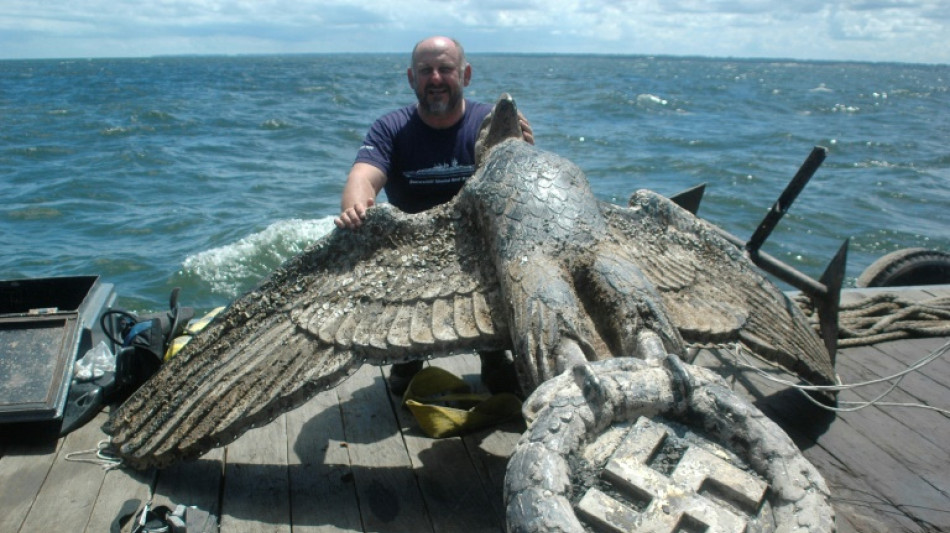
Uruguay appeals ruling ordering sale of eagle from Nazi battleship / Photo: ©

 ALIX LASERS shareholders remove Michael Sobitsch as managing director in view of the circumstances

 Progressive Vision Wins Irish Healthcare Awards 2026 Innovation Prize for Office-Based Cataract Surgery

 Eight-Year-Old Georgia Wins Penrith Valley Public Speaking Competition

 Steven Berkoff on Memory and His New Autobiography 'Shouting At Night'

 Jimmy Carr Confirms 25-Year Estrangement From Father Amid Podcast Reflections

 Arizona Superintendent Tom Horne to Leave Office, Plans Law Practice and Charter School

Uruguay has appealed a ruling ordering it to sell a bronze eagle from a sunken World War II-era German destroyer found off Montevideo 16 years ago, government sources told AFP Wednesday.
"The appeal was filed this week," defense ministry sources said.
The filing would be a final attempt by the government to seek a reversal to a 2019 ruling that the relic must be sold -- a decision affirmed in a second judgement by the Supreme Court last December.
The more than 300-kilogram (660 pound), 2-meter (6.5-foot)-tall bird, which is gripping a Nazi swastika in its talons, adorned the stern of the Admiral Graf Spee, a battleship involved in one of the first naval skirmishes of World War II.
The sculpture was found in 2006 after a 10-year hunt in the River Plate off Montevideo.
The Graf Spee's captain, Hans Langsdorff, had scuttled the destroyer on December 17, 1939, following the Battle of the River Plate.
The salvage team had signed a deal with the Uruguayan navy establishing that 50 percent of the sale of objects found in the search would become public property and the other 50 percent would go to the search's backers.
Since its discovery, the sculpture -- seen as likely to fetch a handsome sum at auction -- has been kept in a navy warehouse.
When the sale didn't come, brother financiers Alfredo and Felipe Etchegaray and diver Hector Bado -- who died in 2017 -- sued the state of Uruguay for breach of contract.
Litigation could continue for several more months following the government's appeal.
The artifact's potential sale has ruffled feathers in the German government, which fears the sculpture could be used to drum up Nazi support.
B.Shevchenko--BTB

