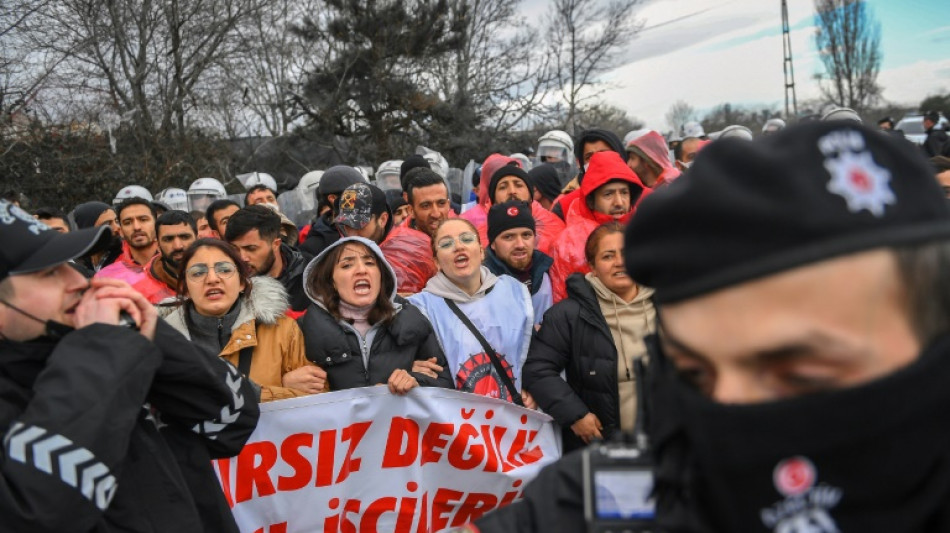
Workers across Turkey go on strike as inflation bites / Photo: ©

 ALIX LASERS shareholders remove Michael Sobitsch as managing director in view of the circumstances

 Progressive Vision Wins Irish Healthcare Awards 2026 Innovation Prize for Office-Based Cataract Surgery

 Eight-Year-Old Georgia Wins Penrith Valley Public Speaking Competition

 Steven Berkoff on Memory and His New Autobiography 'Shouting At Night'

 Jimmy Carr Confirms 25-Year Estrangement From Father Amid Podcast Reflections

 Arizona Superintendent Tom Horne to Leave Office, Plans Law Practice and Charter School

Soaring inflation in Turkey has propelled a wave of strikes unlike any the country has seen since the 1970s, as workers demand more money to counter the shrinking value of their pay.
Supermarket warehouse worker Bekir Gok was sacked this month -- alongside 256 of his colleagues -- for demanding an extra four Turkish liras (30 US cents) per hour, the equivalent of a loaf of bread.
However after the workers at the Migros supermarket chain went on strike, they won back their jobs as well as salary rises and other demands, giving inspiration to dissatisfied employees across the country.
"We were asking for the price of a loaf of bread! It's nothing compared to what we've helped them earn since the pandemic began," Gok said.
Turkey's annual inflation rate officially reached 48.7 percent in January, and workers have struggled to keep up with the sky-rocketing cost of living.
Industrial action is rare in Turkey, where the major strikes that marked the 1970s remain a distant memory for most -- a military coup in 1980 led to a crack down on union activities.
However the country has seen more than 60 strikes, factory occupations, protests and boycott calls involving at least 13,500 workers in less than two months, according to the independent Labor Studies Group.
One of the most prominent recent strikes was launched on February 1 by motorcycle couriers for the food delivery company Yemeksepeti Banabi.
"We put our own lives in danger doing this work. We're not working in a four-walled office, we deliver packages in snow and rain," said Izzet Baskin, a 27-year-old delivery worker for the company in the capital Ankara.
- 'No hope left' -
His colleague Ferhat Uyar said that "we can't think or see ahead".
"We have no hope left. We continue this resistance to try and get ahead of the issues," the 27-year-old said.
After paying his rent and energy bills, Uyar said he is unable to afford the products he delivers, such as takeaway coffee from Starbucks.
Yemeksepeti Banabi delivery couriers currently receive 4,253 liras ($305) a month, now the minimum wage after President Recep Tayyip Erdogan increased the rate by 50 percent for 2022.
But the Turk-Is union said last month the poverty level was 13,844 liras. The Banabi workers are on strike demanding less than half that figure: 5,500 liras.
German company Delivery Hero bought Yemeksepeti Banabi for $589 million in 2015.
Freight workers' union Nakliyat-Is, which is supporting the delivery workers on strike across Turkey, said nearly 100 couriers were killed in the past three months, compared with 190 deaths in all of 2020.
"These are workplaces where there is no supervision of employees' health or security," the union's Ankara representative Bayram Karkin said.
To make their demands heard, the riders -- instantly recognisable in their fluorescent pink jackets and helmets -- blocked roads with their motorcycles.
The company then made an overnight administrative change to officially register the workers under the "office" label rather than as transport workers, so they could not be members of the Nakliyat-Is union, Karkin said. There is an ongoing legal case challenging the move.
There were calls on social media for a boycott against companies accused of ignoring employee demands, and unions say Yemeksepeti Banabi saw a drop of 70 percent in orders.
The success of delivery workers at Turkish e-commerce company Trendyol has also inspired many seeking more pay.
After being offered a pay rise of 11 percent, they went on strike in late January. After three days, they accepted an increase of 39 percent.
- New worker 'spring' -
Basaran Aksu, the organising coordinator of the Umut-Sen union, said this could just be the beginning.
"The results of collective bargaining will come out soon in April or May, and we'll see a rise in concerns about livelihoods and the future. I believe this will lead to a rise in workers' movements," Aksu told AFP.
Neslihan Acar, of the DGD-Sen union which represents Migros employees, said that "workers' conditions have deteriorated with the pandemic".
Migros, which claimed the striking 257 supermarket workers had "occupied" its warehouses, welcomed back the employees in a statement after the deal was resolved on Sunday.
Aziz Celik, a labour lecturer at Kocaeli University, said workers' protests would continue for as long as the cost of living was high.
"Workers who seek to unionise in the private sector face a lot of pressure, they are sacked," Celik said.
But despite the difficult conditions, DGD-Sen's Acar was confident that change is coming.
"Anger is accumulating. The workers will create their own spring."
F.Müller--BTB

