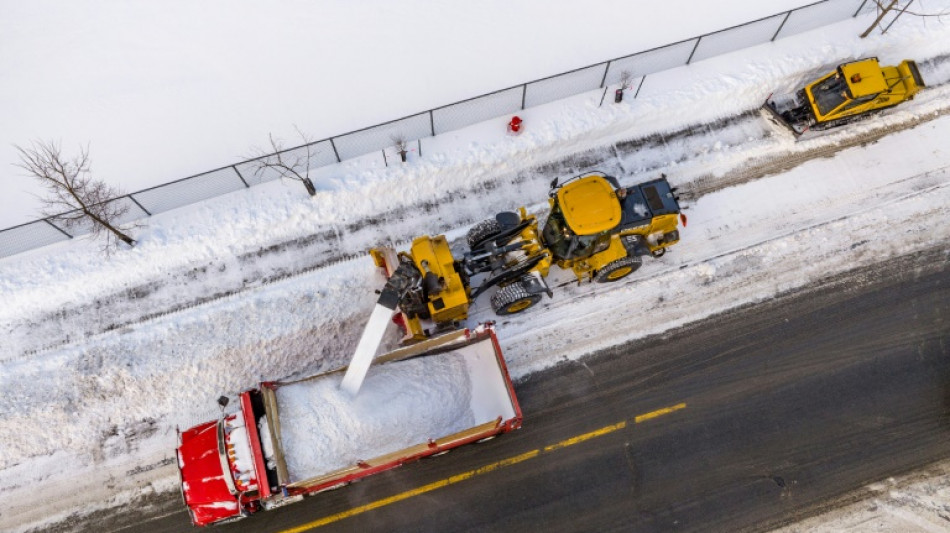
Montreal snow-clearing: good for traffic, bad for environment / Photo: © AFP

 Alex Bodi and Prof. Dr Dieter Lazik sign a contract for ALPHA WHEY and BODI Energy Drink

 Swiss reject plan to toughen neutrality: projection

 UK police call in bomb disposal team near air force base

 Bangkok floods send thousands into shelters after days of rain

 Assefa just misses women's world record at Berlin Marathon

 Dramatic winners Zimbabwe to end five-year exile by tackling DR Congo

 Pope to meet victims of clerical sex abuse on France trip

 How young is too young as child prodigies win big at Asian Games

 UK Labour party meets buoyed by Burnham but eager for concrete plans

 Thousands protest ahead of Mexican president's report on missing students

 Bangkok floods force thousands into shelters

 AI startup urges optimism from Europe despite safety fears

 'Godlike, invincible': Japan hails 11-year-old Games history-maker

 Nepal's hydropower ambitions face climate reality check

 Power cuts, rubble: millions come home to find Sudan's capital unlivable

 Internationals keep Presidents Cup lead with late fightbacks

 Tuchel to 'keep pushing' England to reach Spain's level

 Alcaraz saves match points to keep Europe ahead in Laver Cup

 Spain success driven by hunger to improve, says De La Fuente

 Lyon collapse at Stade Francais to suffer first Top 14 loss
 Oyarzabal and Spain sink England again as Modric shines for Croatia

 Housing protesters camp in central Madrid after mass demonstration

 Louise Trotter expands her palette at Bottega Veneta

 Pope prays at Lourdes after huge Paris mass

 USA trims International lead after Presidents Cup four-balls

A choreographed ballet of massive trucks, snowplows and snowblowers takes over the streets of Montreal whenever it snows, an enormous logistical effort with a significant environmental cost.
Hundreds of snow-clearing vehicles are deployed across the frigid Canadian city for 100 or more days each year on average, dusting the road with salt and belching emissions into the air.
"The snow challenge in Montreal is colossal," says city spokesperson Philippe Sabourin.
If the city's streets and sidewalks were put end to end, they would total 10,000 kilometers (6,200 miles) or the equivalent of the distance from Montreal to Beijing, he said.
Some 3,000 employees and 2,200 vehicles go into action day and night every time it snows, helping make the streets passable.
In Montreal alone, the equivalent of 150,000 tons of salt is spread on roads and sidewalks over the winter.
"It has an impact on ecosystems," Florent Barbecot, a professor of hydrogeology at the University of Quebec in Montreal, told AFP.
"We have seen for a few years the level of salt which is rising a little bit everywhere in the environment."
Some of it stays on the roads, dries and evaporates when temperatures warm, "ending up in the atmosphere... which will affect future precipitation," he said.
The city recognizes that salt is bad for the environment, but despite ongoing research, no effective substitute has been found.
It is "a material that does us a great service," by lowering the freezing temperature of ice and melting icy patches, Sabourin explained.
With almost two meters (six feet) of snowfall in Montreal each year, the city simply cannot go without massive snow management.
- People 'not happy' -
As a substitute, "we tried coffee grinds, it smelled good, but it was not a success," Sabourin added.
Beetroot juice has also been tried, which is less corrosive than salt, "but it stained floors a lot, people were not happy," he said.
Until the late 1990s, snow soiled by waste and pollution was dumped directly into the St. Lawrence River, before the practice was banned.
Some of it is now poured into snow chutes connected to the sewer system.
But the majority (75 percent) is stored in quarries, where the snow is piled high. One mound on the city's south side stretches the width of several football fields and rises ten storeys high.
At the foot, trucks appear tiny in comparison as they dump snow, most of it looking more grey than white.
In a few months, the spring thaw will melt the snow, and waste and gravel will be separated from the water, which is treated before being discharged into the river.
- 'Societal choice' -
According to Barbecot, the city should simply use less salt, but that would require changing "the way we live" by limiting urban sprawl and driving less.
"That's a societal choice," he said.
In the streets, locals do not seem ready to embrace such a massive shift.
According to Charles Drolet, who was working behind the wheel of a city snowblower, residents mostly just want to see more frequent ploughing of streets.
For resident Francine Lalonde, salting roads and snow removal "is a necessary evil," despite the negative environmental impacts.
E.Schubert--BTB