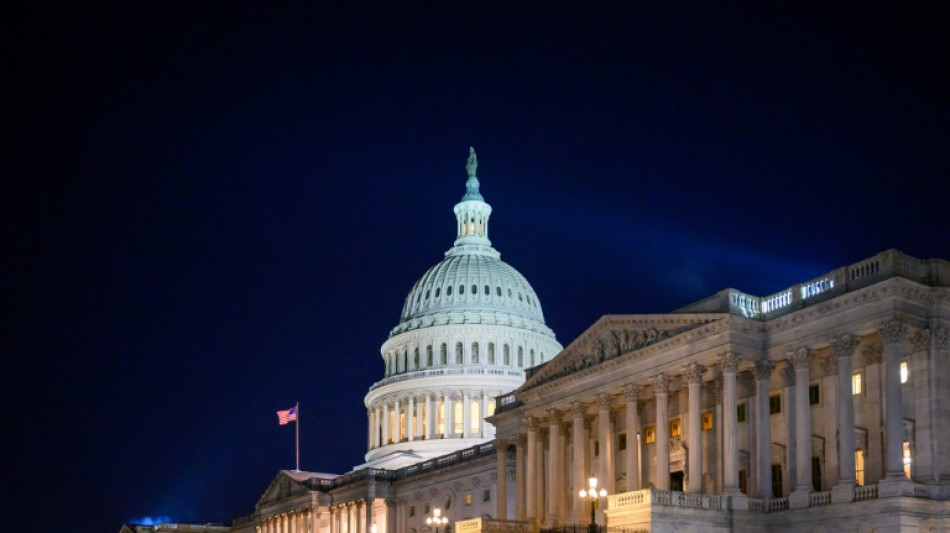
What does hitting the debt ceiling mean for the US? / Photo: © AFP/File

 Alex Bodi and Prof. Dr Dieter Lazik sign a contract for ALPHA WHEY and BODI Energy Drink

 Swiss reject plan to toughen neutrality: projection

 UK police call in bomb disposal team near air force base

 Bangkok floods send thousands into shelters after days of rain

 Assefa just misses women's world record at Berlin Marathon

 Dramatic winners Zimbabwe to end five-year exile by tackling DR Congo

 Pope to meet victims of clerical sex abuse on France trip

 How young is too young as child prodigies win big at Asian Games

 UK Labour party meets buoyed by Burnham but eager for concrete plans

 Thousands protest ahead of Mexican president's report on missing students

 Bangkok floods force thousands into shelters

 AI startup urges optimism from Europe despite safety fears

 'Godlike, invincible': Japan hails 11-year-old Games history-maker

 Nepal's hydropower ambitions face climate reality check

 Power cuts, rubble: millions come home to find Sudan's capital unlivable

 Internationals keep Presidents Cup lead with late fightbacks

 Tuchel to 'keep pushing' England to reach Spain's level

 Alcaraz saves match points to keep Europe ahead in Laver Cup

 Spain success driven by hunger to improve, says De La Fuente

 Lyon collapse at Stade Francais to suffer first Top 14 loss
 Oyarzabal and Spain sink England again as Modric shines for Croatia

 Housing protesters camp in central Madrid after mass demonstration

 Louise Trotter expands her palette at Bottega Veneta

 Pope prays at Lourdes after huge Paris mass

 USA trims International lead after Presidents Cup four-balls

The United States hit its borrowing cap of $31.4 trillion in January, prompting the start of measures to avoid a default as Democrats and Republicans head towards another clash on raising or suspending the country's debt limit.
The policy tussle comes to the fore later Wednesday when President Joe Biden and Republican Speaker of the House Kevin McCarthy meet at the White House. McCarthy is demanding steep budget cuts in exchange for raising the debt ceiling.
Amid the high-stakes brinksmanship, Treasury Secretary Janet Yellen said her department would turn to resources from two funds for retirees as part of the "extraordinary measures" it started using to give the government some room to continue to function.
Here is what you need to know about the situation:
- Is the US in default? -
The short answer is no.
The debt limit is a legally established maximum on how much the United States can borrow to pay the government's bills, for everything from social welfare programs to salaries for the military.
Once the ceiling is reached, the Treasury begins to draw down cash balances and use accounting techniques that allow the government to continue operations, said Mickey Levy of Berenberg Capital Markets.
The threat of a default surfaces once these temporary measures are exhausted, which the Treasury said is likely around mid-year.
"The period of time that extraordinary measures may last is subject to considerable uncertainty," warned Yellen in a letter on January 19.
- How serious could this be? -
Failing to raise the debt limit once temporary measures are exhausted would have dire economic consequences, according to the Treasury, as it would lead the government to an unprecedented default.
There could be a shutdown of some government functions, and even approaching a breach of the limit could roil markets.
For now markets have remained calm, with Edward Moya of trading platform OANDA noting the process regularly "goes down to the wire."
A default would hurt the United States' credibility and global standing, and investors could ask for higher interest rates to lend money to the government, adding to authorities' payments.
Not meeting the government's obligations "would be catastrophic for America's working families and lead to higher costs," warned Senate Majority Leader Chuck Schumer last month.
- Why is there gridlock? -
Congressional lawmakers have found themselves gridlocked over raising the debt limit, an issue that has increasingly sparked contentious debate in recent years.
Republicans, who control the House of Representatives, are calling for spending cuts in exchange for support in raising the debt ceiling.
But President Joe Biden has said he would not negotiate with Republicans who threaten to use the debt problem for leverage, saying it should not be "political football."
Speaker McCarthy, for his part, called it "a sign of arrogance if you say you wouldn't even discuss it."
The situation points to a heightened chance of an extended standoff. The government has previously come close to a default over gridlocks on funding.
- Is a default likely? -
"The probability of government default on its debt is close to nil," Levy said. But the battle over raising the limit could become protracted.
Since 1960, Congress has acted 78 times to permanently raise, temporarily extend, or revise the definition of the debt limit. This has happened under both Republican and Democratic presidents.
Even if political maneuvering brings a partial government shutdown, "various budgetary work-arounds will allow the government to continue servicing its debt, conducting basic services including defense, and providing funding for Social Security and entitlement programs," Levy said.
- What is the Treasury doing? -
The Treasury said it would be unable to fully invest a portion of the Civil Service Retirement and Disability Fund, with a "debt issuance suspension period" to last until early June.
Treasury will also halt additional investments of amounts credited to the Postal Service Retiree Health Benefits Fund, Yellen added.
But she stressed "federal retirees and employees will be unaffected by these actions" and the funds will be "made whole" once the impasse is over.
There have been calls to end the legal limit in recent years, with analysts calling the brinksmanship unnecessary.
N.Fournier--BTB