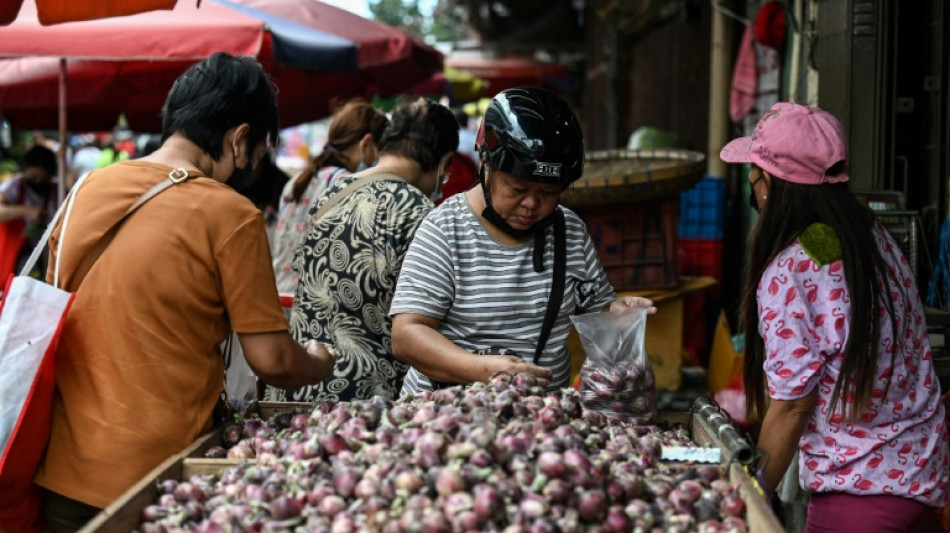
Eye-watering onion prices make Philippine staple a luxury / Photo: © AFP

 Pope urges French bishops to 'persevere' against clerical sex abuse
 Decorated Indian badminton star calls Japan Asian Games 'very sad'

 Asian Games chiefs say lessons learned over accommodation

 UK's PM urges 'calm' as thousands seek to thwart flashpoint N.Ireland parade

 Thousands seek to thwart disputed N.Ireland flashpoint parade

 Swiss vote on what it means to be neutral

 Pope to meet with victims of clerical sex abuse during France trip
 Iran stands firm on Hormuz plan after US rejection
 Madrid protest camp grows after eviction outrage

 Italy winemakers hail bumper harvest but cut output

 Kyiv shoppers feel the pinch from Russian strikes

 Japanese anime actor fights TikTok over AI voice cloning
 Curtain falls on the romance of India's single-screen cinemas

 Smells like teen spirit as US thrash Peru 4-1

 Cavy chaos: Hundreds attend New Zealand's biggest guinea pig show

 Venezuela releases more political prisoners after opposition talks

 England's best 'for a long time' despite Spain defeat, says Kane

 Powerful storm pummels northeast US with rain, high winds

 Filmmaker Mike Leigh wins top prize at Spain festival with 'last film'

 Spain beat England in Nations League to extend unbeaten run

 Ireland squad vote to play Israel tie despite Gaza unease

 Gutsy Vollering wins cycling road race world title

 Vollering wins cycling road race world title

 Man City's meteoric rise clouded by dark shadow

 Mbappe out for two weeks or more with knee injury say Real

Even before his onions are fully grown, Philippine farmer Luis Angeles races to harvest the crop and cash in on eye-watering prices for a vegetable that has become a luxury item in the country.
Onion prices have soared in recent months, reaching as high as 800 pesos (nearly $15) a kilogram in Manila supermarkets, making them more expensive than chicken or pork.
Some restaurants have stripped the staple ingredient from dishes, while many families already grappling with the highest inflation in 14 years have stopped eating them.
To meet demand and push retail prices back below 200 pesos, the government has approved the importation of 21,000 tonnes of onions and faces calls to crack down on traders suspected of hoarding.
But prices remain stubbornly high and onion farmers like Angeles have been harvesting earlier than usual to reap the windfall.
"What is happening is historic," said Angeles, 37, as his workers pulled undersized red and white bulbs out of the soil near the northern town of Bongabon, the country's self-proclaimed "onion capital".
"This is the first time that prices have reached this level."
When he began harvesting last month, Angeles received as much as 250 pesos per kilogram for his crop.
By the time his onions reached Manila supermarket shelves, the price had more than doubled, exceeding the daily minimum wage.
"I told my family, 'Let's just smell the onion instead of eating it'," Candy Roasa, 56, said as she walked through a market in the capital where she has seen vendors selling bulbs the size of a small child's fist for as much as 80 pesos each.
As onion memes spread on social media, the humble vegetable has become a symbol of wealth in the poverty-afflicted country.
At least one bride used pricey bulbs instead of flowers for her wedding bouquet.
Philippine Airlines crew members on a recent flight from the Middle East were busted trying to smuggle a few bags of the pungent commodity through Manila's airport.
- 'Poor planning' -
It is not the first time the Philippines has experienced a shortage of a basic food staple that caused prices to spike -- sugar, salt and rice have all been hit in the past.
Poor yields, high costs, insufficient investment in irrigation and machinery, lack of access to cold storage facilities and farm-to-market roads, and crop-destroying typhoons have long impacted the sector.
Pest outbreaks as well as soaring oil and fertiliser prices since Russia invaded Ukraine last year have only added to farmers' woes.
Despite government pledges to boost domestic food production, the country relies heavily on imports to feed its growing population -- but tariffs fuel inflation.
President Ferdinand Marcos appointed himself agriculture secretary to overhaul the near-moribund industry, which accounts for about a quarter of the country's employment but only makes up 10 percent of gross domestic product.
"Our agriculture sector is significantly challenged," said Geny Lapina, agricultural economics and management professor at the University of the Philippines.
Every Filipino eats an average of 2.34 kilograms of onions per year and theoretically the country produces enough to meet the demand, official data shows.
But since the tropical climate only allows one planting per year of the rain-averse crop, stocks are consumed or spoil well before the next harvest.
The recent lifting of Covid-19 restrictions, which allowed the resumption of food-focused festivals and family gatherings for Christmas, triggered soaring demand for onions.
William Dar, who was agriculture secretary in former president Rodrigo Duterte's administration, said the shortage could have been avoided if the current government had allowed imports back in August.
"This is the net result of the poor planning," Dar told local broadcaster ABS-CBN.
There are growing concerns about future food security in the Philippines, which is ranked among the most vulnerable nations to the impacts of climate change and is plagued by poor nutrition.
The median age of farmers is 57 and the average farm plot has shrunk to around 1.3 hectares from nearly three hectares in the 1960s.
Many farmers are sharecroppers who do not own the land they till and cannot afford to make much-needed investments to improve productivity without government help.
Salvador Catelo, an agricultural economist at the University of the Philippines, said there were "lots of daunting challenges to be immediately solved".
"We have rich natural resource endowments which are absent in many countries that are performing (better) than us in terms of productivity and self-sufficiency," Catelo said.
As imported onions flow into the country, Angeles fears farm-gate prices could plummet to as low as 30 pesos per kilogram before he finishes his harvest.
"We are just trying to make our investment survive," he said.
P.Anderson--BTB