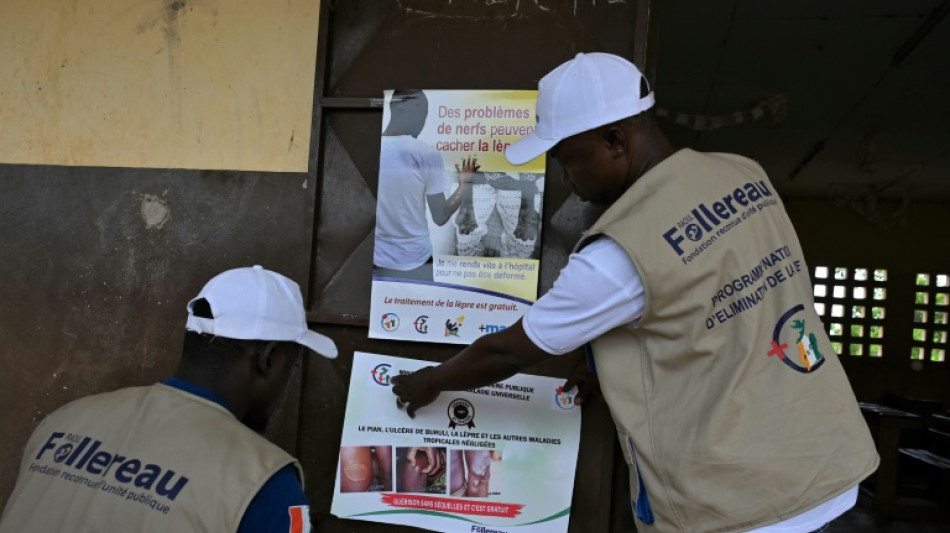
WHO urges investment in neglected tropical diseases / Photo: © AFP

 Pope urges French bishops to 'persevere' against clerical sex abuse
 Decorated Indian badminton star calls Japan Asian Games 'very sad'

 Asian Games chiefs say lessons learned over accommodation

 UK's PM urges 'calm' as thousands seek to thwart flashpoint N.Ireland parade

 Thousands seek to thwart disputed N.Ireland flashpoint parade

 Swiss vote on what it means to be neutral

 Pope to meet with victims of clerical sex abuse during France trip
 Iran stands firm on Hormuz plan after US rejection
 Madrid protest camp grows after eviction outrage

 Italy winemakers hail bumper harvest but cut output

 Kyiv shoppers feel the pinch from Russian strikes

 Japanese anime actor fights TikTok over AI voice cloning
 Curtain falls on the romance of India's single-screen cinemas

 Smells like teen spirit as US thrash Peru 4-1

 Cavy chaos: Hundreds attend New Zealand's biggest guinea pig show

 Venezuela releases more political prisoners after opposition talks

 England's best 'for a long time' despite Spain defeat, says Kane

 Powerful storm pummels northeast US with rain, high winds

 Filmmaker Mike Leigh wins top prize at Spain festival with 'last film'

 Spain beat England in Nations League to extend unbeaten run

 Ireland squad vote to play Israel tie despite Gaza unease

 Gutsy Vollering wins cycling road race world title

 Vollering wins cycling road race world title
 Man City's meteoric rise clouded by dark shadow

 Mbappe out for two weeks or more with knee injury say Real

The World Health Organization on Monday called for greater investment in combating neglected tropical diseases, which left more than 1.6 billion people, often in least-developed countries, requiring treatment in 2021.
NTDs are a diverse group of conditions, found mainly in tropical regions, that include dengue, leprosy and rabies.
They are deemed neglected diseases because they are largely overlooked and benefit from only limited funding.
The WHO said NTDs disproportionately affect the poorest, primarily in areas where water safety, sanitation and access to health care are inadequate.
Soce Fall, director of the WHO's NTDs department, said they had been neglected precisely because they did not affect developed countries.
By comparison, he cited the funding plunged into Mpox last year once it began spreading outside Africa.
"The level of investment needed -- we are far from reaching it," he told a press briefing.
"We need to protect people wherever they are, and whatever their social condition."
- Millions 'liberated' -
In 2021, around 1.65 billion people were estimated to require treatment for at least one NTD, of which 857 million were in southeast Asia and 584 million in Africa.
The figure was down by 80 million from 2020 and has fallen consistently from 2.19 billion in 2010, the WHO said in a progress report released on World NTD Day.
But 16 countries account for 80 percent of the global NTD burden. They include the Democratic Republic of Congo, Egypt, Ethiopia, India, Nigeria, Pakistan, the Philippines, and Tanzania.
As of December, 47 countries had eradicated at least one NTD, with eight certified as having eliminated one in 2022 alone.
"Around the world, millions of people have been liberated from the burden of neglected tropical diseases," said WHO director-general Tedros Adhanom Ghebreyesus.
"We still have a lot of work to do. The good news is, we have the tools and the know-how not just to save lives and prevent suffering, but to free entire communities and countries of these diseases."
- Guinea worm almost eradicated -
NTDs are caused by a variety of pathogens including viruses, bacteria, parasites, fungi and toxins.
They include bilharzia, Chagas disease, dengue, Guinea worm, sleeping sickness, leishmaniasis, leprosy, river blindness, rabies, scabies, snakebite envenoming and trachoma.
"These diseases cause devastating health, social and economic consequences, and when they aren't deadly, they very often cause life-long social stigma and consequent economic hardship," the WHO said.
Fall said leprosy persisted in 139 countries and dengue in 129, "so we are far from elimination".
Formerly endemic, Guinea worm is poised to become the second human disease in history to be eradicated, following smallpox, and the first without a medicine or vaccine.
About 3.5 million human cases occurred in 1986 -- but just 13 were recorded in 2022.
Ghanaian President Nana Akufo-Addo said the west African country had eliminated trachoma and Guinea worm, and was on the brink of doing likewise with sleeping sickness and leprosy.
"Investing in NTD elimination programmes creates a ripple effect in society. It leads to better education, health and employment outcomes. It transforms lives and our communities," he said in a statement.
"An Africa free from NTDs is possible."
J.Fankhauser--BTB