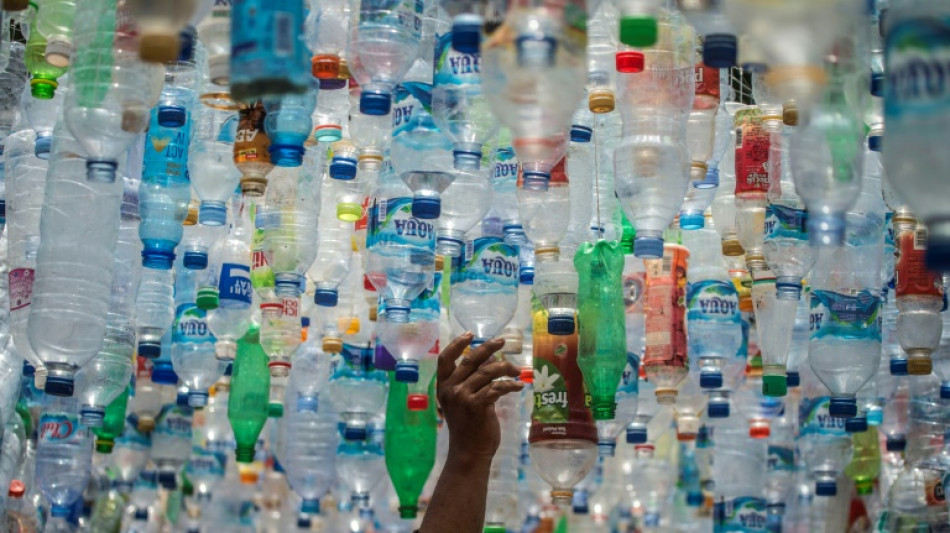
Only nine percent of plastic recycled worldwide: OECD / Photo: ©

 ALIX LASERS shareholders remove Michael Sobitsch as managing director in view of the circumstances

 Progressive Vision Wins Irish Healthcare Awards 2026 Innovation Prize for Office-Based Cataract Surgery

 Eight-Year-Old Georgia Wins Penrith Valley Public Speaking Competition

 Steven Berkoff on Memory and His New Autobiography 'Shouting At Night'

 Jimmy Carr Confirms 25-Year Estrangement From Father Amid Podcast Reflections

 Arizona Superintendent Tom Horne to Leave Office, Plans Law Practice and Charter School

Less than 10 percent of the plastic used across the world is recycled, the OECD said Tuesday, calling for "coordinated and global solutions" ahead of expected talks on an international treaty on the issue.
A new report by the Organisation for Economic Co-operation and Development report found that 460 million tonnes of plastics were used last year, the number nearly doubling since 2000.
The amount of plastic waste had more than doubled during that time to 353 million tonnes, the Paris-based OECD said.
"After taking into account losses during recycling, only nine percent of plastic waste was ultimately recycled, while 19 percent was incinerated and almost 50 percent went to sanitary landfills," it said in its Global Plastics Outlook.
"The remaining 22 percent was disposed of in uncontrolled dumpsites, burned in open pits or leaked into the environment."
The Covid-19 pandemic saw the use of plastics drop by 2.2 percent in 2020 compared to the previous year. However single-use plastics rose and overall use is "projected to pick up again" as the economy rebounds.
Plastics contributed 3.4 percent of global greenhouse emissions in 2019, 90 percent of it from "production and conversion from fossil fuels", the report said.
In the face of rampant global warming and pollution, "it will also be crucial that countries respond to the challenge with coordinated and global solutions", OECD Secretary-General Mathias Cormann said in the report.
The OECD proposed a series of "levers" to address the issue, including developing the market for recycled plastics, which only represent six percent of the total -- largely because they are more expensive.
It added that new technologies related to decreasing the environmental footprint of plastics was only 1.2 percent of all innovation concerning the product.
While calling for "a more circular plastics lifecycle", the OECD said that policies must also restrain overall consumption.
It also called for "major investments in basic waste management infrastructure", including 25 billion euros ($28 billion) a year to go towards efforts in low and middle-income countries.
The reports comes less than a week before the UN Environment Assembly begins on February 28 in Nairobi, where formal talks are expected to begin on a future plastics treaty, the scope of which is still unclear.
According to a survey published Tuesday by polling firm Ipsos for the World Wildlife Fund carried out in 28 countries, an average of 88 percent of respondents said an international treaty to combat plastic pollution was "fairly important (23 percent), "very important" (31 percent) or "essential (34 percent).
D.Schneider--BTB

