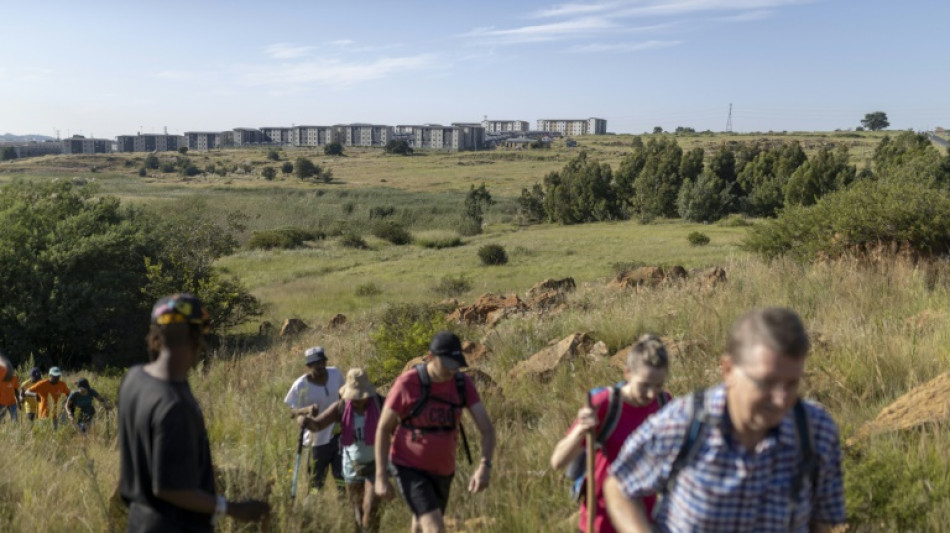
Gold mines, trash and memories: Soweto's urban hikes / Photo: © AFP

 Swiss vote on what it means to be neutral

 Pope to meet with victims of clerical sex abuse during France trip

 Iran stands firm on Hormuz plan after US rejection
 Madrid protest camp grows after eviction outrage

 Italy winemakers hail bumper harvest but cut output

 Kyiv shoppers feel the pinch from Russian strikes
 Japanese anime actor fights TikTok over AI voice cloning
 Curtain falls on the romance of India's single-screen cinemas

 Smells like teen spirit as US thrash Peru 4-1

 Cavy chaos: Hundreds attend New Zealand's biggest guinea pig show

 Venezuela releases more political prisoners after opposition talks

 England's best 'for a long time' despite Spain defeat, says Kane

 Powerful storm pummels northeast US with rain, high winds

 Filmmaker Mike Leigh wins top prize at Spain festival with 'last film'

 Spain beat England in Nations League to extend unbeaten run

 Ireland squad vote to play Israel tie despite Gaza unease
 Gutsy Vollering wins cycling road race world title

 Vollering wins cycling road race world title

 Man City's meteoric rise clouded by dark shadow

 Mbappe out for two weeks or more with knee injury say Real

 Lyon collapse away to Stade and suffer first Top 14 loss

 Russia accuses Europe of seeking to thwart Ukraine talks

 Man City chairman defiant over reported Premier League charges

 Germany ready to 'walk through fire' for Klopp, says Tah

 At least 16 killed in Russian and Ukrainian strikes

Soweto is full of gritty urban landscapes and alleys which evoke its history as one of apartheid's battlegrounds.
Yet there is also a gentler, folksier side to the vast Johannesburg township, and one that local entrepreneurs are portraying to curious tourists.
Every Sunday morning, Masike Lebele takes about 20 hikers for a walk in his childhood neighbourhood, opening their eyes to a vista where countryside, abandoned gold mines, trash and deep-rooted folk beliefs all co-exist.
"This was my playground," said Lebele, a wiry 40-year-old who wore a leopard-print shirt and a floppy hat.
"I was adventurous as a kid," he said, his eyes sharp and wearing a smile.
"We used to be little hunter-gatherers here," he said, pointing to a dam by an abandoned gold mine. "We learned to swim here."
The starting point for his walk is a "shebeen" -- a local tavern set up in a house that belonged to his grandmother.
A recent hike on the six-and-a-half-kilometre (four-mile) route began in the early morning.
For safety, a dozen friends accompanied the group.
Walkers crossed a street littered with rubbish and old tyres, where fresh fruit and snacks vendors had set up their stalls.
"This is where Soweto starts," said Lufuno Matidza, the elegant partner of the guide, wearing futuristic glasses, large earrings and bright pink lipstick.
In the distance rose the silhouette of Johannesburg's skyscrapers -- another world.
A wasteland dotted with reeds descended towards a stream.
"Sangomas" -- a Zulu word for traditional healers -- "consider this first portion a holy land," said Masike, asking hikers to speak softly.
- 'Untold stories of Soweto' -
A naked man sat quietly in the stream and six others in robes sang melodies. A little further on, three women wrapped in shawls had lit coloured candles, which melted on a rock.
The silence was broken by a cry. "What's that?" an anxious walker asked.
"It's a person roaring, reaching out to the ancestors," Matidza answered laconically, without breaking her stride.
The walk wove its way through a mountain of gold-coloured mine tailings, sometimes streaked with a chemical blue colour.
More than a century of plundering the earth for gold has left a strange but compelling legacy in Soweto.
Pollution from mine dumps is common, and erosion has created unstable galleries of compacted sand, spectacular but crumbly.
"Gold is always here," said Lebele, who said he was deeply attached to the seemingly desolate landscape.
At the exit of the ochre galleries was a plateau of yellow sand.
"This is where we became kung fu masters. Each group we came across we fought," the tattooed Lebele recalled.
The heights of the dumped spoil give a spectacular view of Soweto, divided by streets into grids of small homes.
"This is our home," said Matidza.
As the cradle of apartheid, Soweto supports a flourishing tourism industry, boasting tours of museums, shebeens and a street where two Nobel winners -- Nelson Mandela and Desmond Tutu -- used to live.
But nearly 30 years after the advent of democracy, the township is plagued by ills, ranging from poverty and unemployment to substance abuse and crime.
Christo Welgemoed, 62, who lives just 11 kilometres (six miles) from Soweto, said the hike was horizon-broadening.
"Had I not heard of this hike on a local post, I would never have come here," he told AFP.
"We usually go into nature, streams, mountains and so forth, (but) this is more of a cultural experience than normal."
Noreen Wahome, 29, a Kenyan living in Johannesburg, said she came on the walk out of her love for the "untold stories of Soweto".
Lebele said his Soweto Ndofaya Hike was booked for weeks ahead.
"People just think that mine dumps are a place of danger but... these are places of fun and exploring," he said.
L.Dubois--BTB