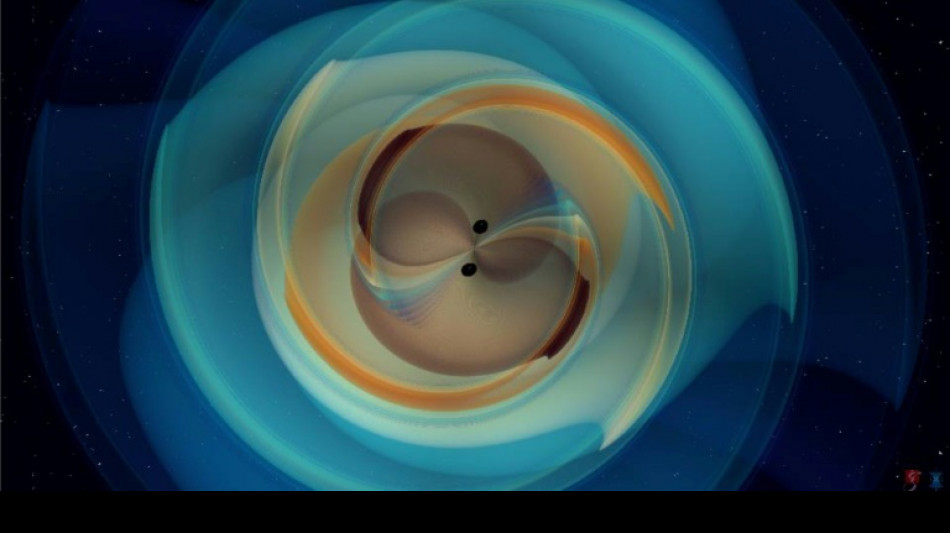
Rate of scientific breakthroughs slowing over time: study / Photo: © MAX PLANCK INSTISTUTE FOR GRAVITATIONAL PHYSICS/AFP/File

 Venezuela releases more political prisoners after opposition talks

 England's best 'for a long time' despite Spain defeat, says Kane

 Powerful storm pummels northeast US with rain, high winds

 Filmmaker Mike Leigh wins top prize at Spain festival with 'last film'

 Spain beat England in Nations League to extend unbeaten run

 Ireland squad vote to play Israel tie despite Gaza unease

 Gutsy Vollering wins cycling road race world title

 Vollering wins cycling road race world title

 Man City's meteoric rise clouded by dark shadow

 Mbappe out for two weeks or more with knee injury say Real

 Lyon collapse away to Stade and suffer first Top 14 loss

 Russia accuses Europe of seeking to thwart Ukraine talks

 Man City chairman defiant over reported Premier League charges

 Germany ready to 'walk through fire' for Klopp, says Tah

 At least 16 killed in Russian and Ukrainian strikes

 Powerful storm pummels US Northeast

 Bangkok declares disaster after homes flooded, roads submerged by heavy rain

 Norris calls for errant Colapinto to be banned for causing Baku crash

 Russell finds himself again and prepares to heap pressure on Antonelli

 South Korea hold nerve to win Asian Games basketball gold

 Russell holds off Verstappen to claim imperious victory in Baku

 Russell holds off Verstappen to win Azerbaijan Grand Prix

 India's Kohli says 2027 ODI World Cup will be his last

 Huge crowds cheer Pope Leo along Champs-Elysees ahead of Paris mass

 Putellas wants to bring 'winning culture and mentality' to London City

The rate of ground-breaking scientific discoveries and technological innovation is slowing down despite an ever-growing amount of knowledge, according to an analysis released Wednesday of millions of research papers and patents.
While previous research has shown downturns in individual disciplines, the study is the first that "emphatically, convincingly documents this decline of disruptiveness across all major fields of science and technology," lead author Michael Park told AFP.
Park, a doctoral student at the University of Minnesota's Carlson School of Management, called disruptive discoveries those that "break away from existing ideas" and "push the whole scientific field into new territory."
The researchers gave a "disruptiveness score" to 45 million scientific papers dating from 1945 to 2010, and to 3.9 million US-based patents from 1976 to 2010.
From the start of those time ranges, research papers and patents have been increasingly likely to consolidate or build upon previous knowledge, according to results published in the journal Nature.
The ranking was based on how the papers were cited in other studies five years after publication, assuming that the more disruptive the research was, the less its predecessors would be cited.
The biggest decrease in disruptive research came in physical sciences such as physics and chemistry.
"The nature of research is shifting" as incremental innovations become more common, senior study author Russell Funk said.
- Burden of knowledge -
One theory for the decline is that all the "low-hanging fruit" of science has already been plucked.
If that were the case, disruptiveness in various scientific fields would have fallen at different speeds, Park said.
But instead "the declines are pretty consistent in their speeds and timing across all major fields," Park said, indicating that the low-hanging fruit theory is not likely to be the culprit.
Instead, the researchers pointed to what has been dubbed "the burden of research," which suggests there is now so much that scientists must learn to master a particular field they have little time left to push boundaries.
This causes scientists and inventors to "focus on a narrow slice of the existing knowledge, leading them to just come up with something more consolidating rather than disruptive," Park said.
Another reason could be that "there's increasing pressure in academia to publish, publish, publish, because that's the metric that academics are assessed on," he added.
The researchers called on universities and funding agencies to focus more on quality, rather than quantity, and consider full subsidies for year-long sabbaticals to allow academics to read and think more deeply.
"We're not getting any less innovative as a species," Park emphasised, pointing to recent breakthroughs such as the use of mRNA technology in Covid-19 vaccines, or the measurement of gravity waves in 2015.
Jerome Lamy, a historian and expert in the sociology of science at France's CNRS research agency, who was not involved in the research, said it showed that "ultra-specialisation" and the pressure to publish had increased over the years.
He blamed a global trend of academics being "forced to slice up their papers" to increase their number of publications, saying it had led to "a dulling of research."
J.Horn--BTB