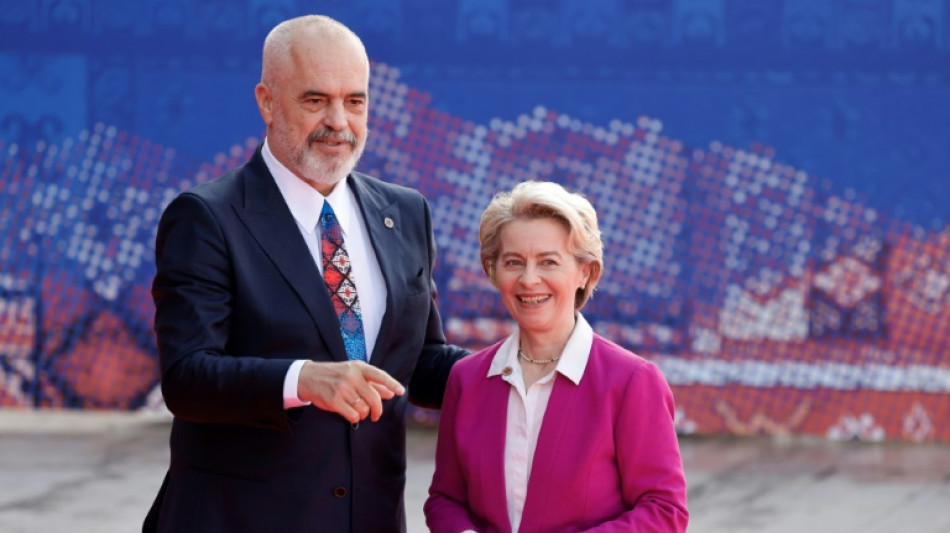
EU and the Western Balkans look to strengthen ties
/ Photo: © AFP

 South Africa's Universal Health Coverage Depends on Tackling Poverty and Inequality

 Chelsea Transfer News: Real Betis Star Jose Antonio Morante Rejects Move to Stamford Bridge

 TikTok Security Chief Advises SMBs on Free Cybersecurity Protections

 Egypt Revokes Citizenship of Brothers Anas and Tarek Habib Over Unapproved Foreign Nationality

 2027 Rivian R2 Performance vs. 2026 Jeep Recon Moab: EV Comparison Test
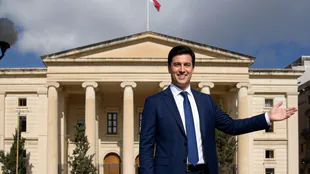
European Union and Western Balkans leaders showed willingness to strengthen ties on Tuesday, although integration of the volatile region remains a distant project.
Balkan countries, stuck in the EU waiting room for years, have often expressed their frustration with a long and demanding integration process, especially after the bloc's rapid granting of candidate status to Ukraine and Moldova.
The summit in Tirana, which includes Albania, Bosnia, Montenegro, Kosovo, North Macedonia and Serbia, focused on concrete cooperation issues.
War in Ukraine has underscored the importance for the EU to work to stabilise the Balkan region and to counter the influence of Russia as well as China, which has heavily invested in the countries' infrastructure.
"We are making history," said European Council President Charles Michel at the end of the summit, the first of its kind to be held in a country in the region.
Michel recalled a "feeling of mutual frustration, fatigue" between Brussels and the Western Balkans, but underlined that a "leap forward" was possible.
"I hope that as soon as possible there will be an effective integration of the Western Balkans. This requires courage, reforms," he said.
The EU confirmed a package of one billion euros in subsidies to help the region tackle the energy crisis, while an agreement was signed to reduce and gradually phase out roaming prices between the EU and the six Balkan countries.
Albania's Prime Minister Edi Rama, who at the end of June voiced his anger over lack of progress in the EU integration, drastically changed his tone.
The Albanian leader now promised his country's unwavering "loyalty" to the bloc, and welcomed a "awareness that the EU needs the Western Balkans as much as the Western Balkans need the EU."
In July, the EU opened accession negotiations with North Macedonia and Albania, which applied in 2005 and 2014 respectively.
Talks have also been under way for several years with Montenegro and Serbia, while, in October, Brussels recommended granting candidate status to Bosnia.
"We are deeply convinced that we belong together," said European Commission President Ursula von der Leyen.
She welcomed the clear "message of unity" sent by the summit, during which the leaders posed for the usual family photo in front of traditional and modern dance performances in the sunny Albanian capital.
- "Good signal" -
Serbian President Aleksandar Vucic also said he was "very satisfied" after the event.
"We have discussed more openly, more sincerely and more honestly than ever," he said.
The Commission reiterated its support for candidate status for Bosnia, a decision that will be taken by the European Council on December 15-16.
"I hope that a good signal will be given," said Michel.
Kosovo President Vjosa Osmani called on the EU to "move from words to deeds" by allowing her citizens to travel without visas to the bloc.
She reiterated that Kosovo would submit an official application for membership before year end.
But Kosovo's application faces major obstacles. The former Serbian province with an ethnic Albanian majority declared independence, which Belgrade does not recognise, in 2008.
EU foreign policy chief Josep Borrell said a new proposal had been submitted by the EU on Monday to Belgrade and Pristina to try to normalise their relations.
The leaders also affirmed their willingness to work together to fight illegal immigration. The Balkan route has seen a sharp increase in arrivals and is the main migratory route to the EU.
Brussels is demanding that the Balkan states align their visa policies with their own. Under European pressure, Vucic recently announced an end to visa exemptions for Tunisians and Burundians.
"It’s a matter of respect for ourselves and what we went through for ten years, suffering under the sanctions", Vucic told reporters in Tirana, evoking the sanctions imposed on the former Yugoslavia in the 1990s.
"We have seen that these sanctions do not bring anything good … and it’s not natural that we should take part in these sanctions," he said.
Y.Bouchard--BTB

