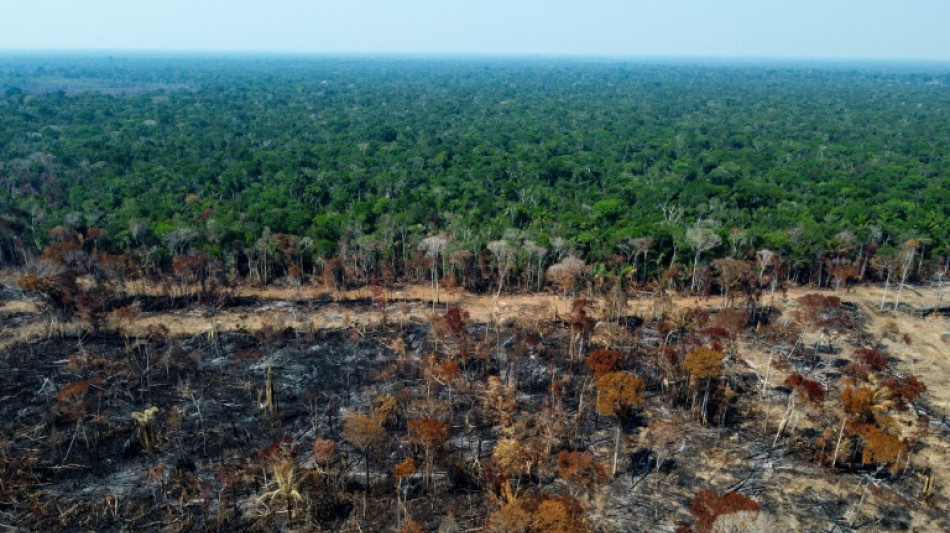
EU agrees ban on imports driving deforestation / Photo: © AFP/File

 Man City could face 'drastic' sanctions after reported guilty verdict: ex-chairman

 Furious Fury says row between rival promoters could scupper Joshua bout

 'Invincible' 223cm teen basketball player stars as China win bronze

 Tenth woman found dead in South Africa's string of killings

 Japan schoolboy, 11, wins gold while empty seats blight Asian Games

 Japan organisers 'not satisfied' as empty seats blight Asian Games

 Canals full, roads submerged as Bangkok declares flood disaster

 China, US to open AI 'communication channel' after summit

 Nepal tunnel survivor wants to help post-flood rebuild
 New China sprint star, 17, vows 'no limits' after Asian Games gold
 Japanese 11-year-old wins Asian Games eSports gold

 TikTok agrees to teen limits in US settlement following Meta

 Venezuela's oil cradle pins hopes on US energy deals

 US, China buy time with trade truce as pressure builds

 'Leo, Leo': Young Catholics give pope rockstar welcome in France

 Lula bans sports betting days ahead of Brazil's election

 Guatemala ensures survival of vulnerable 'fossil' fish
 Mancini finds positives in Italy loss, accepts fans' jeers

 Alcaraz helps Europe into Laver Cup lead

 Six missing after building collapses in historic Athens district

 Mbappe scores but suffers knee injury as Zidane gets debut France win

 Mancini's Italy return spoiled by Belgium defeat

 Rodri confident in Man City innocence despite reported charges

 Jay-Z rape accuser says she made 'false accusations'

 Senegal draw first match under Vieira and Nigeria survive scare

The European Union reached an agreement Tuesday to ban the import of products including coffee, cocoa and soy in cases where they are deemed to contribute to deforestation.
The draft law, which aims to ensure "deforestation-free supply chains" for the 27-nation EU, was hailed by environmental groups as "groundbreaking".
It requires companies importing into the EU to guarantee products are not produced on land that suffered deforestation after December 31, 2020, and that they comply with all laws of the source country.
The scope encompasses palm oil, cattle, soy, coffee, cocoa, timber and rubber as well as derived products such as beef, furniture and chocolate.
Illegal production has spurred massive deforestation in countries such as Brazil, Indonesia, Malaysia, Nigeria, the Democratic Republic of Congo, Ethiopia, Mexico and Guatemala.
The United Nations' Food and Agriculture Organization estimates that an aggregate area of land bigger than the European Union, or some 420 million hectares (more than one billion acres), has been deforested around the world over the past three decades.
The European Union is the second-biggest market for consumption of the targeted products after China.
Pascal Canfin, chairman of the European Parliament's environment committee, hailed the agreement, and how its impact would feed through to everyday items Europeans consume.
"It's the coffee we have for breakfast, the chocolate we eat, the coal in our barbecues, the paper in our books. This is radical," he said.
- 'Historic' -
The environmental lobby group Greenpeace called the draft law, agreed between the European Parliament and EU member states, "a major breakthrough".
Another, WWF, called it "groundbreaking" and "historic".
"This regulation is the first in the world to tackle global deforestation and will significantly reduce the EU's footprint on nature," the WWF said in a statement.
Both groups called on the EU to go further, by expanding the scope of the law to include savannahs, such as Brazil's Cerrado, which are also under threat by encroaching ranchers and farmers.
Greenpeace noted that financial institutions extending services to importing companies would not initially come under the new law, but that they would come under review two years later.
Both the European Council -- representing the EU countries -- and the European Parliament now have to officially adopt the agreed law. Big companies would have 18 months to comply, while smaller ones would get a longer grace period.
"The new law will ensure that a set of key goods placed on the (European Union) market will no longer contribute to deforestation and forest degradation in the EU and elsewhere in the world," the European Commission said in a statement.
"The battle for climate and biodiversity is accelerating," French President Emmanuel Macron tweeted.
- Big fines -
The parliament said in a statement that the law opened the way for technology such as satellite monitoring and DNA analysis to verify the provenance of targeted imports.
High-risk exporting countries would have nine percent of products sent to the EU checked, while lower-risk ones would have lower proportions scrutinised.
Companies found violating the law could be fined up to four percent of annual turnover in the EU.
The legislation would be reviewed one year after coming into force, to see whether it should be extended to other wooded land.
Another review at the two-year mark would have the commission considering whether to expand it to cover other ecosystems and commodities, as well as financial institutions.
J.Horn--BTB