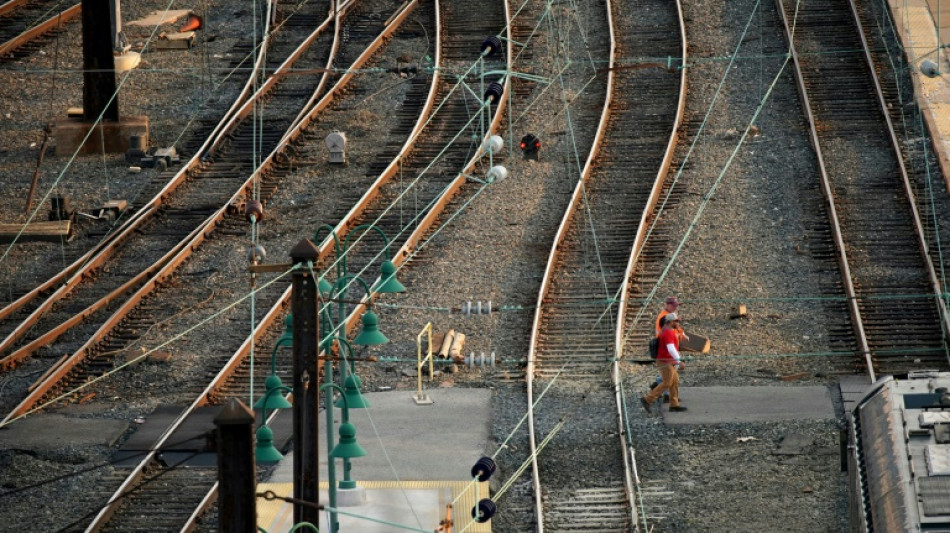
US Congress approves bill to avert major freight rail strike / Photo: © AFP/File

 Make-A-Wish Announces 2026 Starblazer Award Honorees; Allied World Becomes First Corporate Founder
 Lee-Trump Golf Diplomacy Faces Diplomatic Dilemma Ahead of G20 Summit
 Mavericks Defeat Jazz 112-100 Behind Washington’s 26 Points and Second-Half Surge

 BingX: Major Announcement of Far-Reaching Significance

 James Blunt Scores First Number One Album in 19 Years; Wife Sofia Wellesley Celebrates

 UCLA Stays Unbeaten With Ty Dieffenbach's Heroic Return Against Illinois

 Malta Court Rejects Libel Claims by Developer Kurt Buhagiar Against MEP Peter Agius
The US Congress passed legislation Thursday to avert a freight rail strike that could have been devastating for the economy, intervening to break an impasse between workers and management as the holiday season approaches.
The bill, overwhelmingly approved by the Senate Thursday after passing with a bipartisan majority in the House of Representatives a day earlier, effectively forces hold-out unions to accept a deal on higher wages, which a majority of unions already agreed to.
After the 80-15 Senate vote the measure now heads to President Joe Biden for his signature.
Under a 1926 law, Congress is empowered to resolve disputes between railroads and labor unions as part of its power to regulate commerce.
A strike would have seen almost 7,000 freight trains come to a halt, costing more than $2 billion a day, according to the American Association of Railroads.
Around 28 percent of goods transported in the country are by rail, and a large-scale strike would have had repercussions on multiple sectors.
Biden's administration had taken a hands-on approach to the long-running deadlock over a contract between organized labor and railroads, with cabinet secretaries in September taking part in all-night negotiations alongside union leaders and rail executives.
After the lengthy session, leaders from both sides announced a tentative agreement.
But since then, members of eight of the 12 rail unions approved the deal, while four voted it down.
While the House earlier backed a separate measure to add mandated paid sick time to the agreement, addressing a major sticking point identified by unions, this did not pass in the Senate on Thursday.
The Senate also failed to approve an amendment for a cooling-off period between workers and management.
But Biden told reporters Thursday that he "negotiated a contract no one else could negotiate."
"We're going to avoid the rail strike, keep the rails running, keep things moving," he added, at a news conference with French President Emmanuel Macron.
- Political risk -
The agreement includes a 24 percent pay increase for workers. However, critics in organized labor had slammed a lack of guaranteed paid sick leave, an omission seen as evidence of "unchecked corporate greed," as one leading union put it.
The failure of the agreement to win universal approval among unions had set the stage for a potential strike on December 9, putting the White House in an awkward spot.
Biden has been dubbed "Union Joe" for his strong affinity for organized labor.
The prospect of rail paralysis presented a major political risk for Biden, whose administration is already grappling with decades-high inflation and risks of a slowing economy.
A freight freeze would also have impacted passenger service because some passenger trains run on tracks owned by freight companies.
"I made it really clear. I'm going to continue to fight for paid leave for not only rail workers, but for all American workers," Biden said Thursday.
S.Keller--BTB