India's Bishnoi community, the original eco-warriors / Photo: © AFP

 Ahead of Paris mass, pope urges life together in 'dignity and peace'

 Austria 'ghetto' language classes leave children to repeat school

 S.African women runners arm themselves after string of killings

 'I felt embarrassed': Japan eSports whizz-kid, 11, wins Games gold

 Indonesia fires threatens critically-endangered orangutan: IUCN

 Bangkok declares flood disaster across city

 'World records not enough': North Korea weightlifters target Olympic gold rush

 Iran proposes Hormuz plan, Trump reportedly refuses

 El Nino rewrites the menu in the world's top restaurants

 Pope to hold giant mass on Champs-Elysees

 TikTok to pay Alabama $100 mn under pre-trial settlement

 Internationals take 7-3 Presidents Cup lead after foursomes sweep

 Brazil team returns to Colombian site of doomed jet crash

 Mbappe injured as Zidane wins on France debut, Italy lose on Mancini return

 Senegal draw in Vieira debut, Nigeria survive scare as Cape Verde crash

 U2 performs surprise 50th anniversary gigs in Dublin

 Pope calls worshippers 'saints of France' after AI warning

 US court sides with Pentagon in Anthropic AI ban

 Wall Street stocks rise, greeting optimism over possible US-Iran deal

 NFL players chief raises concerns over pitch for Maracana game

 Daytime Russian attacks kill seven in Kyiv

 Spotting AI writing: how reliable are the detectors?

 French youth await pope after AI 'paradise of machines' warning

 Man City found guilty of Premier League charges, set to appeal: reports

 Embolo follows Xhaka out of Swiss squad over fake Covid documents

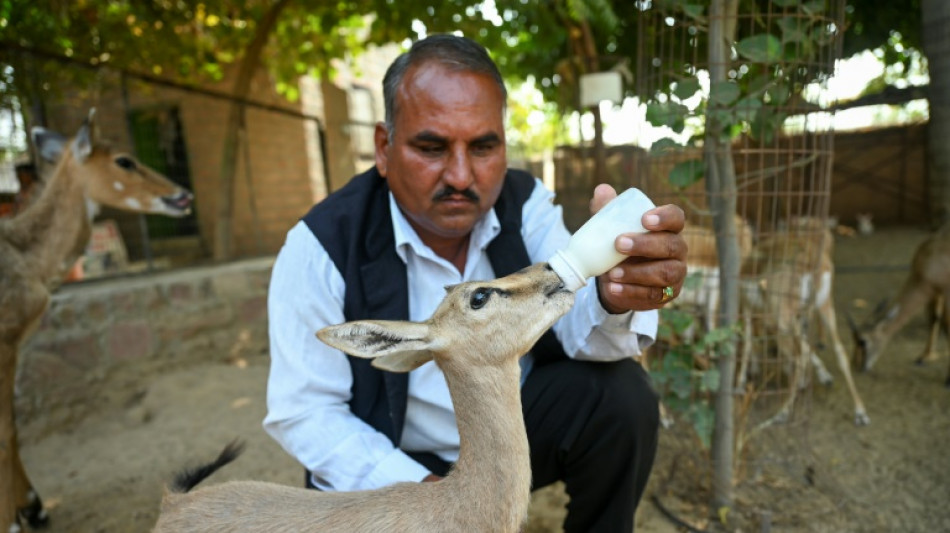
Surrounded by deer and antelopes, Ghevar Ram caressed an injured fawn at a rescue centre run by India's Bishnoi community, who have been fighting to protect the environment for more than 500 years.
Ram, a member of the Hindu sect, has devoted his life to animals, bringing those in distress to the centre and taking care of them until they are fit enough to be released back into the wild.
"I treat animals like my own children. This is what we are taught since our childhood," Ram, 45, told AFP as he bottle-fed the fawn ahead of the UN Biodiversity Conference in Montreal next week.
The Bishnois are India's original eco-warriors, willing to sacrifice themselves to protect animals and trees.
The sect, established in the 15th century by Guru Jambheshwar and which now claims about 1.5 million members, believes in the sanctity of all life, shunning meat and avoiding felling living trees.
Spread mostly in hamlets across Rajasthan, the community draws inspiration from Amrita Devi, a Bishnoi woman killed in 1730 while trying to protect a khejari -- now the state tree.
According to legend, a local king in the desert state sent his men to cut wood to fuel cement lime kilns to build his palace.
Devi rushed out of her home in a Bishnoi village to block them, clasping a tree trunk to protect it.
"Despite her pleas, the men did not stop. She then hugged a tree, but the king's men showed no mercy and chopped down the tree along with her head," said Sukhdev Godara, a retired schoolteacher, his eyes glistening with emotion.
Her last words were recorded as: "A chopped head is cheaper than a felled tree."
Other Bishnoi villagers -- beginning with Devi's three daughters -- followed suit, hugging the trees as they were decapitated.
In all, 363 Bishnoi men, women, and children were killed, their sacrifice now commemorated with a monument in the village inscribed with each of their names and topped with a statue of Amrita Devi.
- 'In harmony with nature' -
The martyr is now a hero for the likes of Sita Devi, who fuels her cooking fire with cow dung cakes rather than firewood to feed her strictly vegetarian family.
A mother of seven, she also once breastfed an orphaned antelope fawn.
"I was working in the fields when I saw a fawn being attacked by feral dogs. I rescued the fawn and brought it home," she said, dressed in a traditional long pink skirt and sparkling gold jewellery.
"I fed the fawn my own milk, and once he regained strength, I released it in the wild," she recalled with pride.
Although a subsect of Hinduism, the Bishnoi do not cremate their dead because that would mean cutting down trees to fuel the fire.
"Our guru taught us to bury our dead instead," said schoolteacher Godara.
Bishnoi men are mostly farmers and patrol the land to make sure no animal is harmed or hunted down.
Advocate Rampal Bhawad co-founded the Bishnoi Tiger Force, an environmental campaign group and anti-poaching vigilante organisation, after Bollywood superstar Salman Khan shot dead two black bucks while filming a movie in Rajasthan in 1998.
The community followed the case assiduously for 20 years until Khan was sentenced to five years in jail by a local court for violating the Wildlife Protection Act.
The penalty was later suspended on appeal, but not before Khan had spent several days in prison.
"We file police complaints and pursue cases till the guilty are punished," Bhawad told AFP.
In a world fighting the insidious effects of climate change, he said, "we should plant more and more trees.
"We should live in harmony with nature and be kind towards all living beings."
N.Fournier--BTB