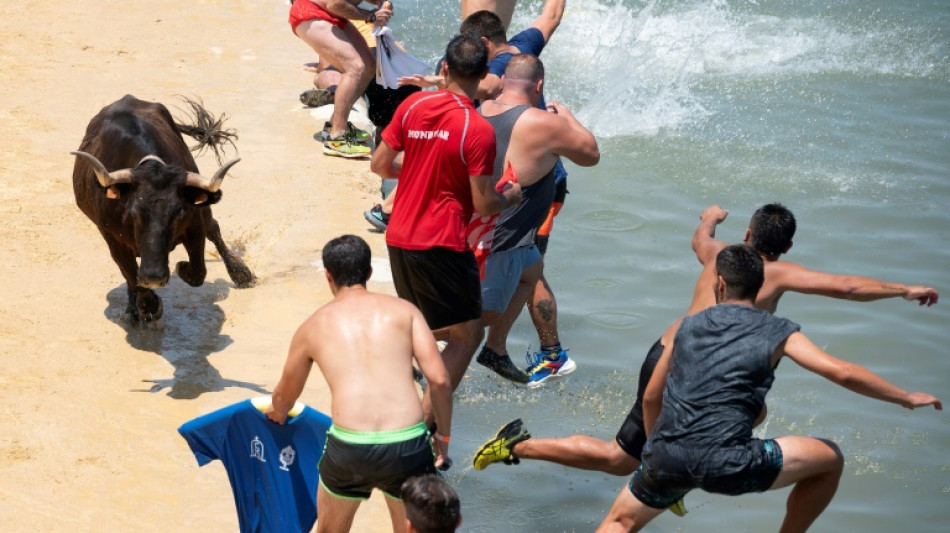
Debate flares over Spain bull-running fiestas as 10 die / Photo: © AFP/File

 Newcomers South Korea face holders Italy in Davis Cup finals

 Japan's Kojima sounds Marchand warning with Asian Games gold

 England rugby star Pollock signs new Northampton deal

 STARTRADER Expands Its Chinese Equity CFD Range with CXMT and Unitree Robotics

 MEXC Expands Opportunity Compass with Stock Trading Handbook to Help Crypto Users Build Investment Knowledge

 England paceman Wood retires from international cricket

 Magnificent Mandhana's 79 helps India to Asian Games cricket gold

 Marchand 'stressed' about racing Japanese rivals at LA Olympics
 Mobile boat clinics bring healthcare to India's remote islands

 Former India paceman Zaheer Khan named Chennai coach in IPL

 Six-year-old Chinese girl sets world record with Rubik's Cube

 Swimming prodigy Yu, 13, says 'interviews way harder than racing'

 Star coaches make their bows as Nations League returns
 Rams bounce back as Giants reel from Dart injury

 In Bangladesh, Pakistan's Jinnah photo stirs anger

 Two New Zealand naval ships transit Taiwan Strait

 Zidane gets down to work as France start new era

 Inside the Venezuelan prison meant to 'drive you insane'

 UK king braces as memoir by Diana's brother goes on sale
 No green light to lift EU sanctions on Russian oligarchs, talks to resume

 UK agrees support for Saudi in struggle with Houthis: reports

 EU foreign policy chief calls for continued sanctions on Russia

 Flights scrapped, evacuations urged as Typhoon Dujuan wallops Japan

 Fonseca to take break from tennis
 A Cuban zoo, and its animals, in epic battle for survival

Spain's controversial bull-running festivals have once again hit the headlines after a deadly summer in which at least 10 people lost their lives, exacerbating divisions over the centuries-old tradition.
Seven deaths occurred in the eastern Valencia region where the practice of releasing bulls into the streets for entertainment has sparked debate, with the other fatalities taking place in the regions of Madrid, Castilla y Leon and Navarra in the north.
This year's toll raises to more than 30 the total number of people who have been killed in Valencia's bull-running events since 2015.
This summer's victims, who died from injuries sustained while racing through the streets alongside a group of hefty bulls -- known as "bous al carrer" in Valencian -- were between the ages of 18 and 73.
Six of them were men and one was a woman -- a French woman who was the oldest victim.
They died after being gored or trampled by the bulls. Countless other people were injured, among them minors.
Bull-running events are a highlight of summer festivities across Spain, with the best known being the San Fermin festival in the northern city of Pamplona.
The idea is that a small group of bulls are let loose into a fenced-off area of the streets and hundreds of foolhardy thrill-seekers run alongside them for a few adrenaline-fuelled minutes, in a spectacle that draws thousands of spectators.
In Valencia and in southern parts of neighbouring Catalonia, such events are hugely popular and few are the villages that don't put on some sort of entertainment involving bulls barrelling through the streets.
There are also "bous a la mar" -- races to the seafront where at the end of the run, the participants vie to try and make the bulls fall into the water, most ending up there themselves.
- Political hot potato -
Experts are divided about when the practice of running the bulls began but Cuellar, a town some 150 kilometres (90 miles) north of Madrid, claims to have historical records dating back to the 13th century.
And although the exact origin of the tradition is unclear, it is thought to emerged out of the need to bring bulls from the countryside into the towns on market day when they would be be coralled through the streets with sticks.
Irrespective of how it began, it has become a political hot potato for the local authorities, which often sparks heated debate and can win or lose an election.
When the Socialists and their hard-left ally Podemos managed to take over Valencia's regional government in 2015, ousting the right-wing Popular Party, they were careful to steer well clear of the issue.
Podemos, which in Valencia is known as Compromis, is implacably opposed to any entertainment involving bulls.
"It's not a simple issue, whether you're debating or legislating... there are many sensitivities," Valencia's regional deputy leader Aitana Mas told reporters.
"At some point, it's a debate which we have to have," said Mas of the Compromis party, referring to a ban on all such activities.
"We're talking about seven lives this summer alone," she said, but adding it was also necessary to talk about "protecting animals".
But German Zaragoza, head of the region's Federation of Bull-Fighting Clubs which promotes bull-running events as the Spain's "most-traditional and authentic" fiestas, says any such move would face an uphill battle.
"They will have to take on Valencia's love for the 'bous al carrer'," he said.
"The right to access culture -- and all events featuring bulls are absolutely part of that -- is sacred within the constitution," he said in a statement.
"And neither the city councils nor the regions have the authority to ban or organise a referendum" on the fate of such events.
The right-wing Popular Party, which has a long history of supporting any bull-related festivities, pledged its support for such traditional events.
Those who question the validity of such fiestas "are attacking who we are and how we express our traditions and culture", said Marta Barrachina, a local PP leader in Valencia.
- Runners 'drunk or drugged up' -
But not all areas of Valencia feel the same, with towns like Sueca or Tavernes de la Valldigna refusing to issue permits for bull-running events this year.
And animal welfare associations have published a manifesto calling for a ban on change.org which describes bull-running events as "torture dressed up as culture and tradition" in which "abuse is more than evident".
Such spectacles often involve "these noble animals" being beaten with sticks, kicked, jerked around, insulted, humiliated and subjected to stress, it states.
And the runners "are often drunk or under the influence of drugs, with many also injured".
So far, the petition has garnered some 5,500 signatures.
E.Schubert--BTB