Self-taught Turkish 'linguist' keeps dead language alive / Photo: © AFP

 Pakistan keep England to 241 despite Duckett ton

 Ukraine war divides Bulgaria as voters elect president
 Shock and grief in a Jordanian village after church attack
 Top-ranked Rybakina crushes Fernandez to win fourth title of season

 UK PM calls for 'honest discussion' about EU free movement

 Far-right leader Le Pen kicks off tilt at French presidency amid nationwide protests

 Naomi Osaka could quit tennis if daughter asks her to

 Last MotoGP race at Phillip Island cancelled due to weather in Marquez setback

 Sri Lanka seeks faster green energy shift after oil shocks
 Riyadh airport resumes flights following Houthi attacks

 'Call of Duty' North Korea invasion edition tops sales charts in South
 Musk accuses Ukraine of violating Starlink's terms of service
 Fed expected to hold rates steady days ahead of US midterms

 More Lula, or back to the Bolsonaros? Brazil votes in cliffhanger

 Jorge Martin out of Australian MotoGP with fracture: team

 Antonelli storms to US Grand Prix pole on weekend he can take title

 Apologetic Alvarez fires Atletico to win against Deportivo

 Lens beat PFC in Ligue 1 matchday impacted by social unrest
 Valkyries hit back against Dream to level WNBA Finals

 'Fighting for our rights': Paris protesters determined to march on
 Clashes break out in Paris, other French cities amid fresh protests

 Spurs seal rare win at Chelsea as Palmer sees red

 Nearly 1,000 arrested in French protests marred by 'elevated' violence: minister
 France extends detention of suspected racist shooter

 Andrade and Nemour star as Biles cheers at world gymnastics champs
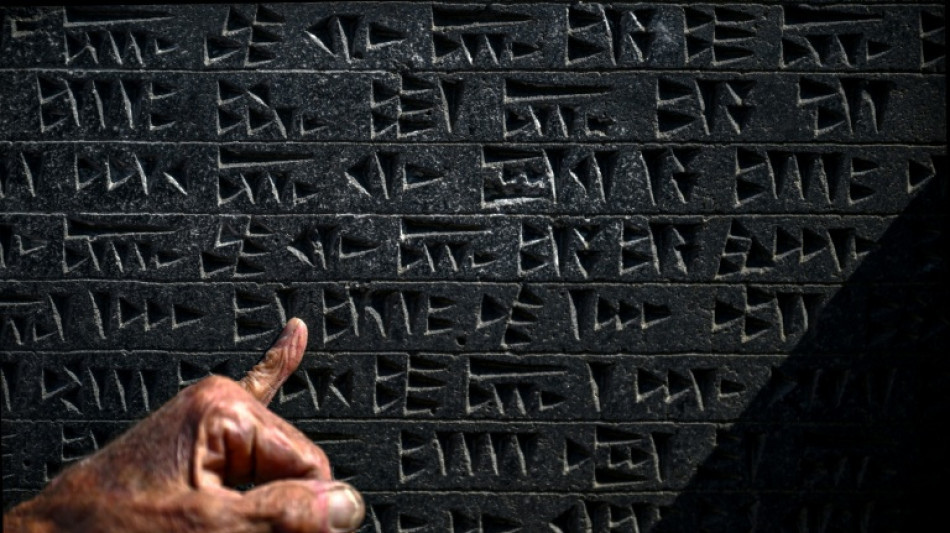
Mehmet Kusman did not spend very long at school, but he traced the ancient inscriptions chiselled into the black basalt rock and read: "Before me there was nothing. But by the power of the god Haldi I founded this city."
Kusman, 86, has dedicated his life to the fortress of Cavustepe in eastern Turkey, and to learning the language of the vanished kingdom of Urartu, to honour its forgotten gods and rulers.
Brisk of step and sharp of mind despite his years and the hot winds that whip the castle, he stood at the foundations of a temple dedicated to Haldi, the warrior god of gods. Kusman wore a cap bought in Los Angeles on which he has written "USA 2009" in the cuneiform script typical of the region's ancient civilisations.
Kusman was hired as a labourer on the Cavustepe excavations after his military service in the 1960s and there encountered his first stele.
"The inscription was very beautiful," he told AFP. But the head of the dig discouraged him from learning this "very difficult" script, which borrowed its cuneiform alphabet from Assyrian.
"His telling me 'No' hurt me," he said. "I became relentless, thinking: 'In my lifetime, I will learn it.'"
Despite a lack of formal education, Kusman began copying the inscriptions found during excavations carried out in eastern Turkey, Iran and Armenia, over which Urartu once stretched.
In three years, he said, he mastered the alphabet, but "it took me 22 years to master 650 words" of vocabulary.
- One of the last -
Academics contacted by AFP praised Kusman's enthusiasm and devotion. He has become something of a local curiosity, calling himself "one of the last seven people in Turkey to speak the Urartian language."
Erkan Konyar, professor of ancient history at Istanbul University, describes the kingdom as "one of the most powerful states of the ancient Near East, between the 9th and 7th centuries BC."
Urartu -- more recent than the great Mesopotamian kingdoms of Assyria, Sumeria and Babylon -- brought the tribal mountain communities together under a centralised state, building cities, fortresses, irrigation networks and vast food storage facilities, Konyar said.
Despite retiring in 2005, Kusman continues to watch over Cavustepe, said Konyar, a specialist on Tuspa, the kingdom's founding capital.
"For 60 years, he has lived amid the excavations and introduced thousands of visitors to the history of Urartu."
But Konyar is careful to qualify Kusman's claims to speak the language. In fact, historians do not really know how it was pronounced, he said.
"The available inscriptions allow us to understand it up to a certain point, but we lack vocabulary and texts," he said. "Only the meaning of certain words is known with certainty. So no one can claim to speak Urartian."
"Even in the time of Urartu, people did not speak this language; it was only written," said Mehmet Isikli, director of the Department of Near Eastern Archaeology at Ataturk University in Erzurum.
- 'Grandson of the Urartians' –
Kusman's passion for the language has made him a local celebrity. His lectures have taken him "to America, five times, to Germany, the Netherlands, Belgium," he said, reeling off the list with a touch of showmanship.
"Now, I'm thinking of going to Japan," he added.
Isikli is excavating the fortress of Ayanis, the last of the great strongholds built in the kingdom before it collapsed, 35 kilometres (22 miles) north of Van, with a commanding view of the lake.
"Our excavations may tell us something about the end of Urartu," he said, noting that researchers have found "the traces of a very powerful earthquake."
Isikli admits to a certain respect for the old guardian.
"I admire him," he added. "He has worked hard and brought Urartian culture to light.
"Mehmet Kusman provides a sort of publicity for Urartu, but it has nothing to do with academic work: he knows only a few alphabetical signs, or a few letters, and some very, very general information about them."
In his small stone hut at the entrance to the Cavustepe site, Kusman is undaunted by the doubters.
"I am a descendant of the Urartians, their grandson," he said. "They disappeared, but look, they are not all dead," he declared, as he stood to welcome visitors.
C.Koch--VB