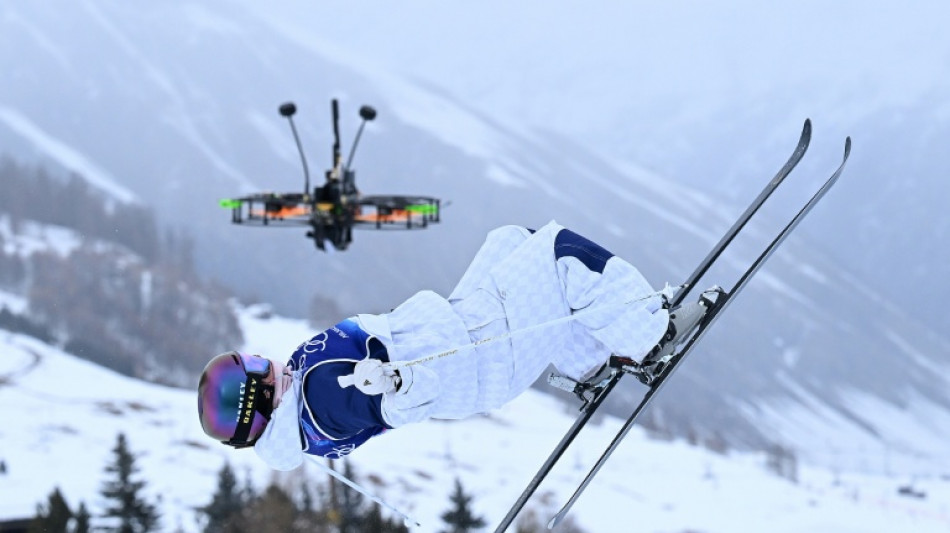
New drones provide first-person thrill to Olympic coverage / Photo: © AFP

 Marchand 'stressed' about racing Japanese rivals at LA Olympics
 Mobile boat clinics bring healthcare to India's remote islands
 Former India paceman Zaheer Khan named Chennai coach in IPL
 Six-year-old Chinese girl sets world record with Rubik's Cube
 Swimming prodigy Yu, 13, says 'interviews way harder than racing'
 Star coaches make their bows as Nations League returns
 Rams bounce back as Giants reel from Dart injury
 In Bangladesh, Pakistan's Jinnah photo stirs anger

 Two New Zealand naval ships transit Taiwan Strait
 Zidane gets down to work as France start new era
 Inside the Venezuelan prison meant to 'drive you insane'

 UK king braces as memoir by Diana's brother goes on sale
 No green light to lift EU sanctions on Russian oligarchs, talks to resume
 UK agrees support for Saudi in struggle with Houthis: reports

 EU foreign policy chief calls for continued sanctions on Russia

 Flights scrapped, evacuations urged as Typhoon Dujuan wallops Japan

 Fonseca to take break from tennis
 A Cuban zoo, and its animals, in epic battle for survival

 Infantino proposes consulting federations to reform FIFA
 El Nino weather pattern enters record territory: scientist
 OpenAI calls for US to lead global effort on AI standards

 South African ostriches plucked alive for luxury fashion: report

 US networks halt Trump coverage in revolt over White House ban

 Paramount settles with US states to clear Warner Bros. mega-merger

 Climate crisis a job for world leaders, not just activists: UK FM

Whether chasing skiers as they fly down the mountain or tracking the luge as it tears around bends, new drone-mounted cameras are offering Winter Olympics viewers a wild ride.
So-called "first person view" (FPV) drones have made their Winter Games debut this year, with 15 deployed across the Milan-Cortina events, offering an exhilarating experience.
Traditional drones, which have been used in live broadcasting for more than a decade, are piloted by an operator looking up at the machine.
But FPVs are piloted by a driver wearing goggles and holding a controller, allowing incredibly precise guidance.
The downside for TV viewers is the constant buzzing, which disrupts the stillness of the mountains.
But many athletes say they are not bothered -- even when it looks from afar like the drones are getting too close.
"I saw on the replay that I nearly got hit by it but I wasn't aware of it while I was doing it," Australian snowboarder Ally Hickman told 7News.
- Pretty cool -
The drones are particularly useful on the sliding track -- for luge, bobsleigh and skeleton -- where they help avoid having cameras positioned at every turn.
German luger Felix Loch, a triple gold medallist competing in his fifth Olympics, said he had no problem with the drones.
"No, you don’t notice something like that," he told AFP's German sports subsidiary SID, praising the use of the technology.
"They're definitely different images. It really looks pretty cool. You have to say, it’s really, really a nice thing what the guys are doing there," he said.
German alpine skier Emma Aicher, the 22-year-old who has won two silver medals at the Milan-Cortina Games, also said the drones didn't affect her concentration as she shot down the piste.
"For us, it's really cool footage. I don't notice the drone, it's so far away," she said.
Yiannis Exarchos, the head of Olympic Broadcasting Services (OBS), who supply the images to the broadcasters for Olympics, said they had worked with athletes in designing the system.
"We didn't want this to become a factor affecting them. We wanted this to become a factor enhancing them," he told reporters on Wednesday.
Drone cameras made their debut in the Winter Games in Sochi, Russia, in 2014, while FPV were first introduced in Paris in 2024, providing live images of mountain biking.
Exarchos said that technology had moved on hugely.
Now, it is possible to "achieve safely speeds like some of the athletes do. A few years ago this was not possible", he told reporters.
- Fast and noisy -
The noise depends on the size of the propeller, which in turn depends on how fast they are going, according to one expert involved in the Olympics who asked not to be named due to commercial confidentiality.
Each drone is custom built, with the smallest measuring just ten centimetres (four inches) and weighing less than 250 grams (half a pound).
"If you are going to chase something super fast, you go for a small system that is super powerful -- and that’s going to be really noisy," he told AFP.
One issue for operators during the Olympics is the cold, which drains the batteries quickly, according to another drone operator.
"There's a constant change of battery, every race," he told AFP.
H.Weber--VB