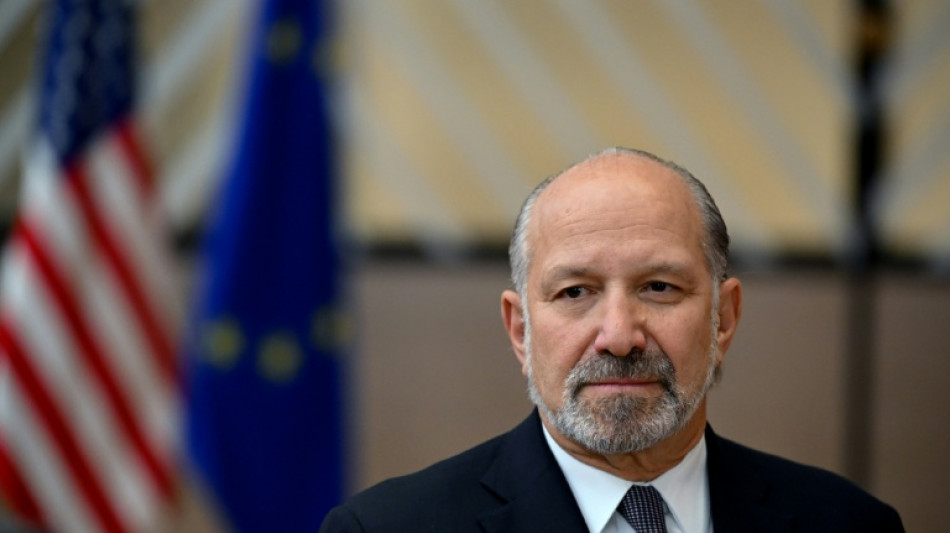
US tells EU to rethink tech rules to secure lower steel duties / Photo: © AFP

 South African voters report smoother local election but declining IEC trust

 Dolly Parton museum and Nashville hotel open after singer’s death

 George and Amal Clooney attend New York political-comedy reading

 British buyers pay substantial premiums for period-home appearance

 Thomas Markle released to house arrest after child-abuse-image charge

 Dawn of War 4 developers chose Adeptus Mechanicus for tactical variety

 Italy face unbeaten South Africa in Turin Nations Championship match

 ChatGPT interactive interface feature tested across six custom tools

 Freshways milk-price cut deepens pressure on UK dairy farms

 Labour and National remain virtually tied as New Zealand vote count advances

 The Good Daughter adapts Karin Slaughter thriller with Rose Byrne and Meghann Fahy

 Heavy-lift drone evacuates wounded Ukrainian soldier from frontline kill zone

 Morrison says West Brom recovered after pressure from successive derby losses

 Britain considers 2027 state visit for Ukraine’s Zelensky

 Arizona Democrats Secure Historic Trifecta with New Legislative Leadership

 Carney Welcomes U.S. Trade Reversal After Democratic Midterm Victory

 Armenian FM Discusses EU Accountability for Palestinian Rights in Madrid

 Trump and Vance Pursue Secret Diplomacy with Iran Amid Military Pressure

 Classic Car Values Surge: De Tomaso Vallelunga Leads 190% Gain

 Microsoft Ends Oracle AI Computing Rental Deal Amid Cloud Strategy Shift
The United States on Monday urged the European Union to rethink its approach to digital regulation if it wants a deal to lower painful US tariffs on the bloc's steel exports.
US Commerce Secretary Howard Lutnick and Trade Representative Jamieson Greer met the EU's 27 trade ministers for the first high-level talks in Brussels since the transatlantic allies struck a tariff deal in July.
Aimed at averting all-out trade war, the deal agreed on a 15-percent US levy for most EU exports -- but both sides continue to push for more concessions.
While the EU wants the US to lower its 50-percent duties on steel and aluminium, Washington is demanding Brussels rolls back green and digital rules it says harm US firms.
Lutnick linked the two issues explicitly after the meeting, telling the EU to reconsider its approach on tech regulation in exchange for a deal to cut duties on Europe's steel and aluminium exports.
"Our suggestion is that the European Union and their trade ministers deeply consider trying to analyse their digital rules, try to come away with a balance," he said alongside Greer and EU trade chief Maros Sefcovic.
"If they can come up with that balanced approach, which I think they can, then we will together with them handle the steel and aluminium issues," Lutnick said.
He said such an approach would mean the EU could see "a trillion dollars of investment, and that would add a point and a half to European GDP".
- EU 'not discriminatory' -
US President Donald Trump and his government have pushed back hard at the EU's bolstered legal armoury against Big Tech.
Trump in September threatened retaliatory tariffs in response to a massive 2.95-billion-euro ($3.4 billion) fine imposed on Google.
Pushed afterwards on whether the EU's digital rules are a red line, Sefcovic refused to comment.
"We'll be looking into the ways, how we can launch this process on the digital matters," he told reporters.
Sefcovic insisted the EU's rules were "not discriminatory" or "aimed at American companies".
A spokesperson for the EU executive later stressed Europe's "sovereign right to legislate".
"Our rules apply only within the EU. And they apply equally to all companies, regardless of their country of origin," the European Commission spokesperson said.
- EU steels itself -
The top EU and US officials also discussed issues they are both facing including access to rare earths and chips -- vital for the tech industry.
"We didn't only discuss bilateral issues, but also some of the challenges we are facing together: the overcapacity... China's role in the global economy and other issues where we have to join forces," said Danish Foreign Minister Lars Lokke Rasmussen, whose country holds the rotating EU presidency.
The EU in October moved to double tariffs on foreign steel to shield the industry from a flood of cheap Chinese exports.
Brussels hoped the proposal would then see the EU team up with Washington to tackle Chinese overcapacity, and Sefcovic had been pushing his US counterparts agree on steel import quotas.
The EU wants a broader "metals alliance" with Washington to ring-fence their respective economies from Chinese overcapacity.
Industry data shows China was responsible for more than half of the world's steel production last year.
The steel sector employs around 300,000 people in Europe, and nearly 100,000 jobs have been lost in the past 15 years, the industry says.
C.Koch--VB