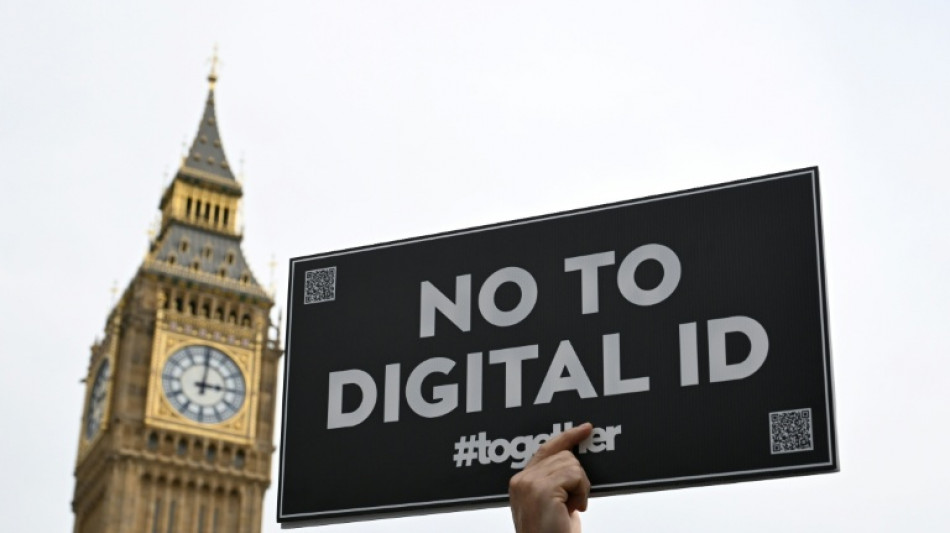
UK far-right figures stoke digital ID fears with unproven claims / Photo: © AFP/File

 Hurricane Polo strengthens to top category 5 off Mexico

 11 hurt as teen opens fire outside school in western Turkey

 UN chief says 'Big Oil' treats atmosphere as open sewer

 Tunisia says 2026 summer hottest on record

 England's Rashid out of Sri Lanka ODIs with hand injury

 Houthis accuse Saudi Arabia of deadly strikes as thousands flee

 Stocks climb as oil slides, AI buzz returns

 India cricketers win in style as Afghan savours 'special' Games silver

 La Liga president hits out at Real Madrid refereeing 'conspiracy' claims

 MEXC Launches “Real Stocks, Real Friends” with Rewards for Bringing Friends to Wall Street

 Mbappe continues media push for Ballon d'Or recognition

 Stocks rise on AI buzz, oil prices cool

 India narrowly survive huge scare against minnows Japan

 Missing F-35 fighter parts 'not sensitive', says Australia minister

 Cambodia showcases scams crackdown with global conference

 Afghan cyclist who disguised herself as man wins Asian Games silver

 Typhoon Dujuan leaves four dead in Japan, 45,000 houses without power

 G7 leaders condemn Houthi strikes on Saudi Arabia

 Google data centre sparks protests in Austria

 Shin Ohashi: Junk food-loving teen and Japan's next big swimming hope

 Stocks rise on AI buzz, drop in oil prices

 China's robot dancers limber up for America's Got Talent final

 Despite military might, Saudi struggles to crush the Houthis
 Trump to tout deals, defend Iran war in UN speech
 Sri Lanka to issue verdict in landmark Easter attack trial

Plans for a new nationwide UK digital ID are sparking widespread public concern, but some critics including far-right politicians are fuelling fears with unproven claims that it will be used to boost government control over people's lives.
They warn that digital ID will be used to store data on vaccinations and carbon footprint and limit access to flying and food, which the government has vehemently denied.
British Prime Minister Keir Starmer in September said the ID card would be introduced by 2029. The government has said it will not be mandatory but will be required to prove the right to work.
Nigel Farage, the leader of anti-immigration party Reform, claimed on TV channel GB News that medical data would soon be added and those unvaccinated would be treated as "second-class citizens".
"Step out of line, say something they don't like and they will switch you off: no travel, no car, no spending, no life," said Renee Hoenderkamp, a doctor and commentator on GB News, a right-wing television channel.
A British government spokesperson told AFP: "None of these claims have any factual basis. We have been clear: digital ID will not be compulsory, and it will not be a crime not to have one."
"Digital ID will give people more control over how their data is used and ensure everyone can access the public services they need," the government spokesperson said.
But the plan is highly controversial in the UK -- one of the few European countries without any ID card and where the idea has long been resisted -- and the main opposition parties are against it.
Public support for digital ID fell after Starmer's announcement. Think tank More in Common in late September found 45 percent opposed it and 31 percent backed it, down from 53 percent support in late 2024.
Nearly three million people have signed a petition against the plan, triggering a debate in parliament's Westminster Hall on December 8.
"It is certainly not a fringe issue. This is a mainstream political issue with concerns shared by people in the highest echelons of politics," said Silkie Carlo, director of Big Brother Watch advocacy group, who addressed MPs about civil liberty fears.
Ryan Wain, executive director of politics and policy at the Tony Blair Institute think tank, told AFP the government needs to "make a broader case" for digital ID, which Blair has long backed.
"Otherwise, a vacuum is left", Wain said, adding this is filled by people "whose default is to think the worst of the best intentions".
- 'It will be like China' -
TikTok creators have posted AI-generated videos of huge demonstrations against digital ID in central London, racking up millions of views, although actual street protests have been relatively small.
Some opponents previously campaigned against public health restrictions and link digital ID to those measures.
A popular post showed an image of Chinese kindergarten pupils lined up with QR codes to take Covid tests in 2022, with the caption: "What happens when you say no?"
David Icke, a prominent British conspiracy theorist who dismissed Covid as a "hoax", took part in a march against digital ID in London in October.
Hundreds participated in the march whose organiser, law student Fiona Hine, was previously arrested at anti-lockdown demonstrations.
"This is entirely about freedom and freedom of choice: nothing should be imposed on us," Hine told AFP.
Digital ID was a topic during past anti-lockdown rallies, with protesters "talking about how it will be like China" and a "sign of an authoritarian state", said Ozge Ozduzen, a lecturer in digital media at Sheffield University.
Repeating popular conspiratorial tropes, Hine claimed digital ID is planned by an international "elite" -- including Blair and Klaus Schwab, the founder of the World Economic Forum -- who want people to be "robots and worker bees for the government".
S.Spengler--VB