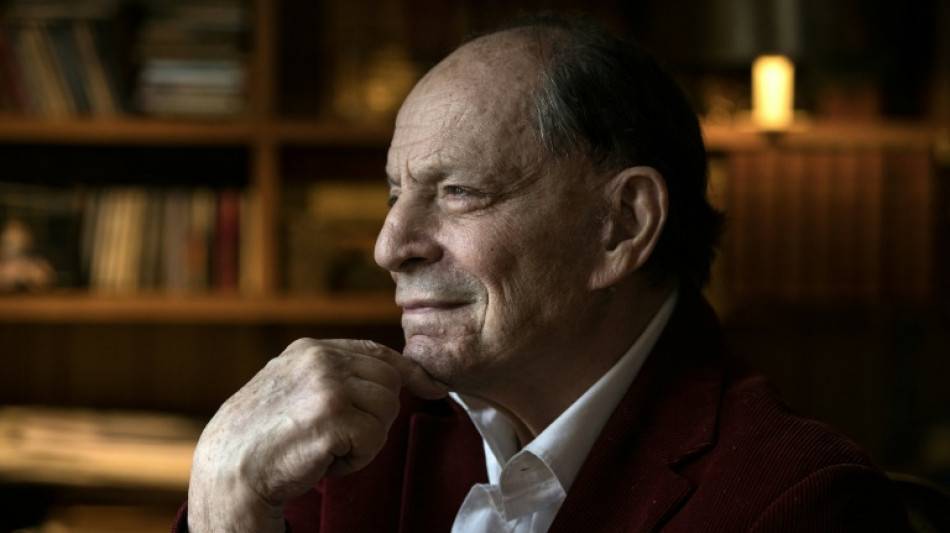
Composer of Piaf's 'Non, je ne regrette rien' dies aged 95 / Photo: © AFP/File

 Devan Ekambaram and Susha’s 'Varuvaaiy' Makes History as First Tamil Song Nominated for a Grammy

 Miranda Lambert Leads North Texans with Seven Grammy Nominations for 2027

 DiDi Advances Robotaxi Operations in China with New R2 Vehicle and Expanded Safety Infrastructure

 Smart Car Seats Tested: Do Sensors and Apps Actually Improve Safety?

 5 Strategies for Fort Worth Households to Reduce Summer Electricity Costs

 Central Bank of Malta Links Energy Subsidies to Middle East Conflict and Price Volatility

 Shomari Figures Defies Redistricting in Alabama Amid Disaster Relief Crisis

 BYD Dolphin G Leasing Deal: Plug-in Hybrid Supermini Available from £174 a Month

Songwriter and singer Charles Dumont, who composed the song "Non, je ne regrette rien" ("No, I do not regret anything") made world famous by Edith Piaf, has died aged 95, his partner told AFP Monday.
Dumont, who had also collaborated with American singer Barbra Streisand and French-Italian 1960s star Dalida, died at home after a long illness.
French Culture Minister Rachida Dati called Dumont "a towering figure of French chanson".
A trumpeter by training, Dumont saw his career transformed at the turn of the 1960s when he convinced the star singer Piaf to perform one of his compositions, after having been forcefully refused several times.
"We turned up at her home, and she let us in," Dumont told AFP in 2018 about the day in 1960 when he managed to see Piaf together with his lyricist, Michel Vaucaire.
"I played the piece on the piano, and ... we became inseparable," he said, adding that the song -- which he had written in 1956 aged 27 -- revived Piaf's career that he said had been flagging.
"Non, je ne regrette rien" has since become an unforgettable classic of Piaf, who died in 1963.
"My mother gave birth to me, but Edith Piaf brought me into the world," Dumont told AFP in a 2015 interview.
"Without her, I would never have done everything I did, neither as a composer nor as a singer," he added.
For Dumont, this meeting marked the beginning of a fruitful working relationship with Piaf, resulting in his writing more than 30 songs for her.
- 'Goodbye young man' -
On occasion she straightened him out, like one night after a concert when he complained to her that the audience had not been good.
"She looked me straight in the eye and said: 'It's not them who are bad. It's you who was no good'," he remembered.
The collaboration with Piaf gave Dumont the confidence to approach Streisand, who was already a star in the 1960s and well on her way to becoming one of the biggest-selling recording artists ever.
A music publisher suggested he should offer her his services, advice he later described as "destiny" giving him "a kick in the behind".
He went to New York, and played for her on a piano in her dressing room in a Broadway theatre. "She said to me 'I like this very much. I'll make the record. Goodbye young man'," he said.
Streisand released a single with Dumont's "Le Mur" sung in French on the A side, and its English version "I've Been Here" on the B side, in 1966.
Dumont's last appearance on stage was in 2019 in Paris.
"When you come back in front of an audience, who come to see you as they came 20, 30 or 40 years ago and give you the same welcome, then they give you back your 20s," he said.
burs/jh/sjw/rl
B.Baumann--VB