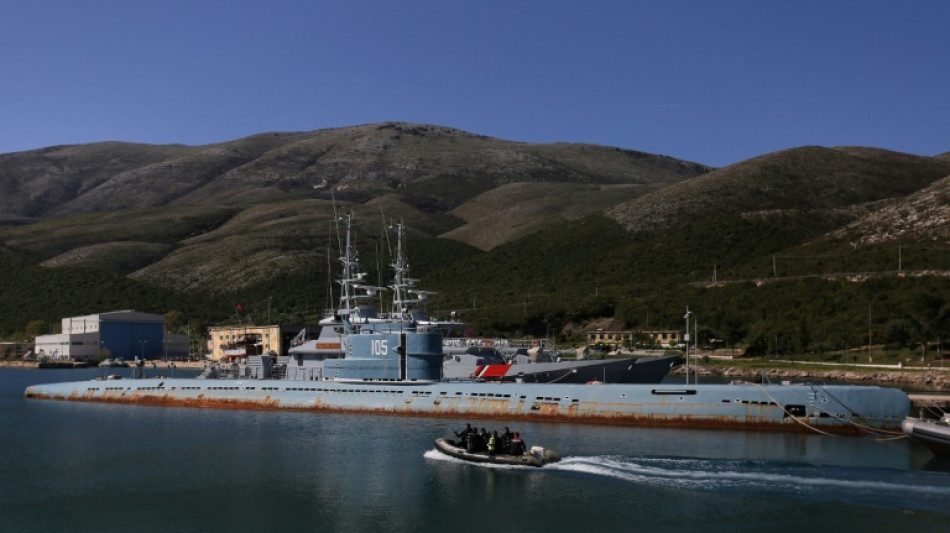
Albania's Soviet-era sub awaits its fate, refusing to sink / Photo: © AFP

 UK agrees support for Saudi in struggle with Houthis: reports

 EU foreign policy chief calls for continued sanctions on Russia

 Flights scrapped, evacuations urged as Typhoon Dujuan wallops Japan

 Fonseca to take break from tennis
 A Cuban zoo, and its animals, in epic battle for survival

 Infantino proposes consulting federations to reform FIFA

 El Nino weather pattern enters record territory: scientist
 OpenAI calls for US to lead global effort on AI standards
 South African ostriches plucked alive for luxury fashion: report
 US networks halt Trump coverage in revolt over White House ban

 Paramount settles with US states to clear Warner Bros. mega-merger

 Climate crisis a job for world leaders, not just activists: UK FM
 US networks halt Trump coverage over White House ban
 French singer accuses Miley Cyrus of plagiarism

 EU fines Google 403 mn euros for location data breach

 'Best is yet to come,' says De la Fuente after Spain extension

 Why diesel prices are rising more than crude oil

 COP31 host says AI's climate footprint to be a summit priority

 Renewables hit record in 2025, but world must move faster: report

 US media outlets to sue Trump administration after White House ban
 Global stocks rally on lower oil prices, US-China hopes

 EU proposes energy rating for data centres
 Schoolgirl Yu scorches to second gold as doping case rocks Games

 Putin's party secures record score in Russia election

 Haupt Koleksiyonu: Paranın Biz İnsanlar Hakkında Anlattıkları

Retired sergeant Neim Shehaj spends his days repairing a Soviet-era submarine, a witness to Albania's tumultuous communist past that is now rusting, half-submerged, at an Adriatic naval base.
The fate of the Cold War submarine at the Pashaliman base -- from where Moscow once hoped to control the Mediterranean -- hangs in the balance as authorities remain undecided over what to do.
"This submarine is like a church to me... I arrived here as a young sailor and now my hair is grey," Shehaj, 63, who served on it for about three decades, tells AFP.
If the submarine is not taken out of the sea soon "it risks sinking to the bottom, and all its history with it", he warns.
The vessel was part of the so-called Project 613 consisting of the first submarines that the Soviet Union built after World War II.
It is the only remaining one out of 12 that Moscow deployed at the Pashaliman base in Vlora Bay in the late 1950s when Albania and the USSR were still close allies.
"From there I could control the Mediterranean to Gibraltar," retired submarine commander Jak Gjergji recalls Soviet leader Nikita Khrushchev as saying in 1959 during a visit to the base.
Khrushchev hoped to install long-range missiles, warships and an airport at the base in Albania's southwest.
- 'Tore it with rage' -
But Albania's paranoid communist dictator Enver Hoxha eventually broke off close ties with the USSR, accusing Moscow of deviating from true Marxism.
That complicated matters for the mixed Albanian-Russian submarine crews.
"The sailors of the two countries no longer spoke to each other and incidents were frequent," recalls the 87-year-old Gjergji.
"When a Russian sailor wanted to raise (his country's) red flag with the hammer and sickle, an Albanian one immediately tore it with rage."
After the 1961 split between Tirana and Moscow, the latter recalled eight submarines.
In 1997 almost a decade after the fall of communism, as unrest swept Albania after several bogus savings schemes collapsed, the base was looted and submarines were stripped of their weapons, engines and even the sailors' beds.
The authorities dismantled three of the four remaining submarines and sold them for metal in 2009.
Just one survived -- thanks to literature.
Albania's most famous writer Ismail Kadare in his 1973 novel "The Winter of Great Solitude", about the break between Moscow and Tirana, arbitrarily assigned the submarine the number 105.
- Saved by a novel -
"This is the only number that came to my mind while I was writing" the novel, Kadare tells AFP.
"Ever since, the submarine is known by this number. It is also thanks to this number... that it is alive today!"
Through the book, the sub's historical notoriety and cultural significance took on symbolic value.
Its fame was further cemented when a film based on the novel was made, for which the number 105 was painted on the submarine and still remains.
But its survival is also largely down to the determination of Shehaj, who for years has been refurbishing the 76-metre (250-foot) submarine, its electrical network, ventilation system, command post and torpedo room.
He tends to the tiniest of details, while also filling holes in the hull to stop the submarine from sinking for good.
"The authorities have to decide quickly what to do with it, the risks are major, the sea water accelerates the corrosion considerably," the 63-year-old warns.
The culture ministry, which pledged for years to restore the submarine, told AFP that it would "forward the file" to the defence ministry, which could include it in a future Cold War museum.
- Submarine tunnel -
Albania embraced the West after the fall of communism in 1990, joined NATO and aspires to join the European Union.
The base has been of "great importance since antiquity due to its geostrategic position... all maritime traffic in the Adriatic Sea but also in the Mediterranean can be controlled" from it, flotilla commander Sabri Gjinollari says.
At the nearby base of Porto Palermo, an abandoned vast anti-atomic submarine tunnel, dug into the rock in the late 1960s, was intended for Chinese missile boats that never arrived.
Hoxha broke ties with Beijing in 1978 and the tunnel, accessed by AFP, was used for a while as a shelter for submarines and other vessels.
Now, a giant red star painted on a dilapidated wall is the only hint of its past under communism.
Some would also like the site, in one of the most beautiful corners of the Albanian coast, to be turned into a museum.
But, the base commander Shkelqim Shytaj disagrees.
"We would prefer it to be used by the army, even in a reduced capacity."
R.Adler--BTB