'One of the last': handmade bagpipes a dying art in Scotland / Photo: © AFP

 French fishermen block ports over petrol prices

 AFP photo shows Trump examining image of Kennedy Center apparent demolition

 Andersson vows to take Sweden in 'new direction' after election win

 Turkey's Erdogan to run again in early 2028 vote, top adviser says

 Sweden's Andersson: a trusted, no-nonsense political operator

 Canada's Carney pushes 'new alliance' with EU despite Trump threats

 Ireland to boycott Eurovision 2027 over Gaza
 India's Tata Sons reappoints N. Chandrasekaran as chairman

 Sweden's left-wing wins election thriller

 Germany urges EU action against China to defend carmakers
 Stocks mostly rise after US Fed rate hike, oil eases
 Palestinians turn rugged caves into homes after Israeli demolitions
 Two unseen Monet paintings to be sold in Paris: auction house

 Klopp wants German team to help reclaim national pride from far-right

 Ninth woman found dead in South Africa killing spree

 Smog scuppers Japan force helping fight Indonesia wildfires

 King Charles to call on tech giants for 'reassurances' over AI

 Lebanon security talks in Paris focus on replacing UN mission

 Most stocks rise as Fed hikes and oil prices drop

 'Vande Mataram': Why is India's freedom song in spotlight?
 Counterculture pop artist Peter Max dies at 88: US media
 Asian Games chief defends 'functional' rooms after backlash

 Leader's sister says only 'idiots' think N. Korea to give up nukes

 World's water cycle becoming more unpredictable, UN warns

 Where the US-China tariff row stands ahead of White House summit

The Highland bagpipe is an integral part of Scottish culture and history, famous for its distinctive, powerful sound that even accompanied troops as they landed in northern France on D-Day.
But the wind instrument is slowly growing silent as demand dwindles and machine-made bagpipes replace traditionally crafted ones, consigning their use to largely ceremonial occasions.
Just off Edinburgh's historic Royal Mile, which sweeps down from the city's imposing castle to the Palace of Holyroodhouse, is a faded storefront sign for artisan bagpipe maker Kilberry Bagpipes.
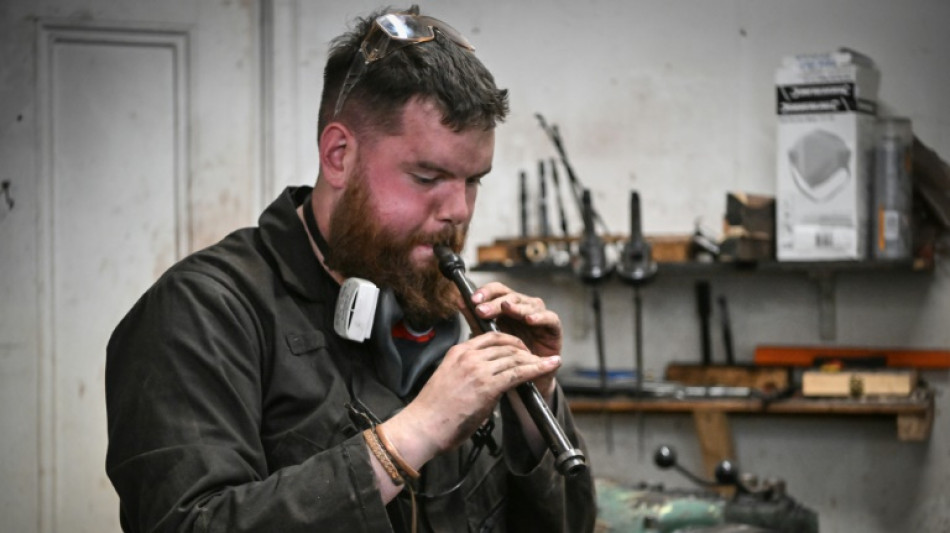
Inside, Ruari Black is one of only a few remaining craftsmen in Edinburgh who knows how to make the instrument by hand.
"At Kilberry, we're one of the last artisan bagpipe makers -- certainly in Edinburgh, the capital of Scotland -- but probably all around the world," Black told AFP as he shaped a pipe with a lathe.
"It's got a big sound, it'll fill a room," said Black, describing the nine stages it takes to make the intricate instrument.
After boring and shaping the pipes, they are fitted with mounts and ferrules before adding the finishing touches and setting up the components.
The whole process takes around a week, with the craftsmen working on multiple bagpipes at the same time.
The finished product has "our distinct sound", according to Black. "Every set, we're striving to have that consistency across, to make sure they're sounding the same."
Each handmade set also has "its own character, in terms of looks, in terms of feel", making it attractive to customers from around the world, he added.
The current wait time for an artisan Highland bagpipe is two years on Kilberry's website.
- Best-known form -
"Customers are coming to us for a set of handmade pipes, they're generally coming for the handmade aspect," Black explained.
"They're wanting the sound we strive to produce -- the thing we want to be known for."
Clients include experienced pipers as well as newcomers looking to buy their "first practice chanter" -- the part of the bagpipe with finger holes, where the melody is played.
While bagpipes have been recorded in Scottish history for some 600 years, the origins remain unclear.
Different variations found around the world include the Irish bagpipe, the Northumbrian smallpipes and the Turkish tulum.
In Brittany, northwest France, a band called a bagad is composed of Breton bagpipes, or biniou, and drums.
However, the Highland bagpipe remains the best-known form, and has had significant influence in the military music of Britain and Commonwealth countries.
Every year, the Royal Edinburgh Military Tattoo -- a series of military musical performances with massed pipe bands -- takes place at the top of the Royal Mile.
The last song played at Queen Elizabeth II's funeral in 2022 was a rendition of the lament "Sleep, Dearie, Sleep", played by her personal piper.
- 'Means a lot' -
Despite its enduring cultural significance, the traditionally handmade Highland bagpipe is vanishing. Unlike Kilberry, most other producers now use machinery.
However, Black said it is easy to differentiate the instruments, with machine-made ones missing the "hand-turned" shapes and decorative designs that his bagpipes have.
Despite having fewer workers and taking longer to make each bagpipe, they "try and keep the cost down for customers to still have a handmade instrument", said Black.
"So it's kind of up to the customer to choose us over mass-produced."
Some mass-manufactured bagpipes can also be told apart by their use of imitation ivory for the mounts, according to Black.
The artisans are trying to be more sustainable without compromising on quality.
For Black, there is no alternative to making bagpipes by hand.
"Keeping it handmade means a lot to me -- it's the way it's always been done. It just feels right," he added.
"For something that's completely dying out, it's not nice to be one of the last... but it's nice to be carrying that on."
S.Spengler--VB