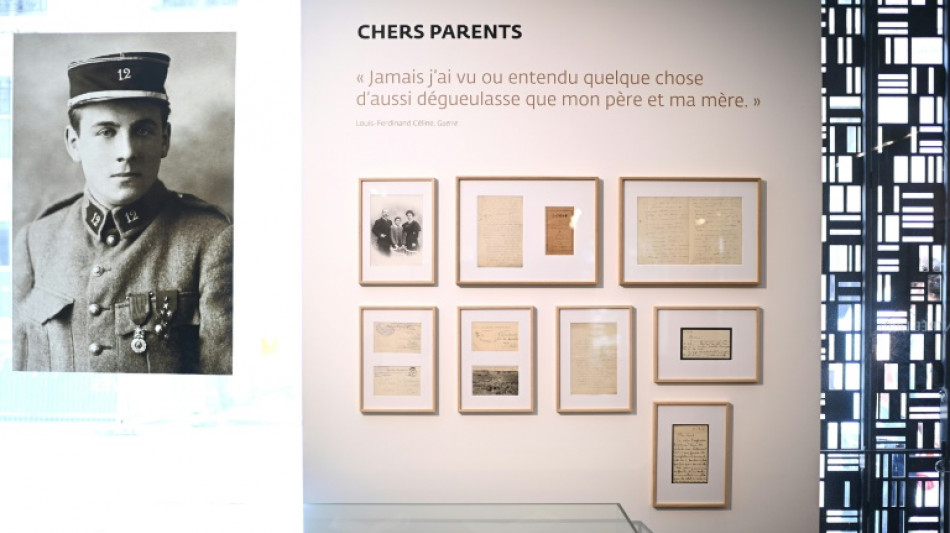
France's famed pro-Nazi writer returns 78 years on / Photo: © AFP

 UK agrees support for Saudi in struggle with Houthis: reports

 EU foreign policy chief calls for continued sanctions on Russia
 Flights scrapped, evacuations urged as Typhoon Dujuan wallops Japan

 Fonseca to take break from tennis

 A Cuban zoo, and its animals, in epic battle for survival

 Infantino proposes consulting federations to reform FIFA

 El Nino weather pattern enters record territory: scientist
 OpenAI calls for US to lead global effort on AI standards

 South African ostriches plucked alive for luxury fashion: report

 US networks halt Trump coverage in revolt over White House ban

 Paramount settles with US states to clear Warner Bros. mega-merger

 Climate crisis a job for world leaders, not just activists: UK FM
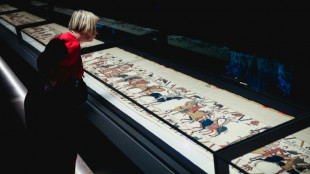
 US networks halt Trump coverage over White House ban

 French singer accuses Miley Cyrus of plagiarism

 EU fines Google 403 mn euros for location data breach

 'Best is yet to come,' says De la Fuente after Spain extension

 Why diesel prices are rising more than crude oil

 COP31 host says AI's climate footprint to be a summit priority

 Renewables hit record in 2025, but world must move faster: report

 US media outlets to sue Trump administration after White House ban

 Global stocks rally on lower oil prices, US-China hopes

 EU proposes energy rating for data centres

 Schoolgirl Yu scorches to second gold as doping case rocks Games

 Putin's party secures record score in Russia election

 Haupt Koleksiyonu: Paranın Biz İnsanlar Hakkında Anlattıkları

It is a rare thing when the story of a book's publication is as fascinating as the plot of the novel itself.
But that might be said of "Guerre" (War) by one of France's most celebrated and controversial literary figures, Louis-Ferdinand Celine, which arrives in bookstores on Thursday, some 78 years after its manuscript disappeared.
Celine's reputation has somehow survived the fact that he was one of France's most eager collaborators with the Nazis.
Already a superstar thanks to his debut novel "Journey to the End of the Night" (1932) -- which is still taught in schools -- Celine became one of the most ardent anti-Semitic propagandists even before France's occupation.
In June 1944, with the Allies advancing on Paris, the writer was forced to abandon a pile of his manuscripts in his Montmartre apartment.
Celine expected rough treatment, having spent the war carousing with the Gestapo, fingering Jews and foreigners to the authorities and publishing racist pamphlets about Jewish world conspiracies.
For decades, no one knew what happened to his papers, and he angrily accused resistance fighters of burning them.
But at some point in the 2000s, they ended up with retired journalist Jean-Pierre Thibaudat, who passed them -- completely out of the blue -- to Celine's heirs last summer.
- 'A miracle' -
Despite this unsettling history, the reviews of the resulting 150-page novel, published by Gallimard, have been unanimous in their praise.
"The end of a mystery, the discovery of a great text," writes Le Point; a "miracle," says Le Monde; "breathtaking," gushes Le Journal du Dimanche.
Gallimard is expecting blockbuster sales: 80,000 copies have been printed for Thursday's release.
The publishing house has yet to say whether there will be translations.
Like much of Celine's work, "Guerre" is deeply autobiographical, recounting his terrible experiences during World War I.
It opens with 20-year-old Brigadier Ferdinand finding himself miraculously alive after waking up on a Belgian battlefield, and follows his treatment and hasty departure for England -- all based on Celine's real experiences.
His time across the Channel is the subject of another newly discovered novel, "Londres" (London), to be published this autumn.
If French reviewers seem strangely reluctant to focus on Celine's anti-Semitism, it is partly because his early writings ("Guerre" is thought to date from 1934) show little sign of it.
"Journey to the End of the Night" was actually a hit among progressives for its anti-war message, as well as a raw, slang-filled style that stuck two fingers up at bourgeois sensibilities.
Celine's attitude to the Jews only revealed itself in 1937 with the publication of a pamphlet, "Trifles for a Massacre", which set him on a new path of racial hatred and conspiracy-mongering.
He never back-tracked. After the war, he launched a campaign of Holocaust-denial and sought to muddy the waters around his own war-time exploits -- allowing him to worm his way back into France without facing any repercussions.
- 'Divine surprise' -
Many in the French literary scene seem keen to separate early and late Celine.
"These manuscripts come at the right time -- they are a divine surprise -- for Celine to become a writer again: the one who matters, from 1932 to 1936," literary historian Philippe Roussin told AFP.
Other critics say the early Celine was just hiding his true feelings.
They highlight a quote that may explain the gap between his progressive novels and reactionary feelings: "Knowing what the reader wants, following fashions like a shopgirl, is the job of any writer who is very financially constrained," Celine wrote to a friend.
Despite his descent into Nazism, he was one of the great chroniclers of the trauma of World War I and the malaise of the inter-war years.
An exhibition about the discovery of the manuscripts opens on Thursday at the Gallimard Gallery and includes the original, hand-written sheets of "Guerre".
They end with a line that is typical of Celine: "I caught the war in my head. It is locked in my head."
In the final years before his death in 1961, Celine endlessly bemoaned the loss of his manuscripts.
The exhibition has a quote from him on the wall: "They burned them, almost three manuscripts, the pest-purging vigilantes!"
This was one occasion -- not the only one -- where he was proved wrong.
R.Adler--BTB