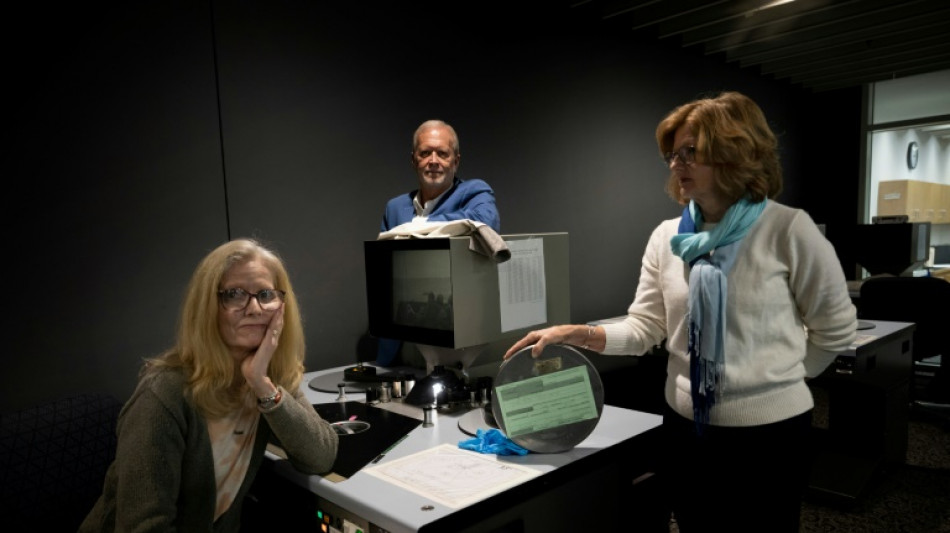
Forgotten D-Day cameramen out of shadows, 80 years on / Photo: © AFP

 UN approves resolution on dealing with rising sea levels
 Yalcouye makes dream debut as Ivory Coast beat Ghana in AFCON qualifier

 Chicago's White Sox and Cubs book MLB playoff berths
 Last-gasp Gakpo strike snatches Dutch draw to sour Klopp debut

 Global stocks mostly fall as oil prices and bond yields rise
 Israel's Netanyahu denounces enemies, allies in fiery UN speech

 Hollywood stars among arrests in NY anti-Netanyahu protest

 Losing start in AFCON qualifying for 78-year-old coach Le Roy

 Italy bans burqas in schools, caps numbers of foreign students per class
 Israel policies threaten 'life and existence' of Palestinians, Abbas says

 Paolini steers Italy past China in BJK

 Zidane admits emotion on eve of first game as France coach
 Breetzke and Maharaj sink Australia in first one-day international
 Zelensky broke confidentiality with North Korea POWs disclosure: South's president
 Former Liverpool star Carroll reveals he was sexually assaulted
 Dominican Republic calls for Haiti force to be strengthened
 Dolly Parton's nephew ordered to stay away from estate staff, properties

 Early exit for Philippine darling Eala at Singapore Open

 Hurricane Polo triggers huge waves in coastal Mexican city
 What happens if the US bans diesel exports

 Macklemore hits back with 'Free Palestine Tour' after Sheeran split
 Met Opera to give New Yorkers free tickets in affordability push
 Top ECB official to resign to take up IMF role

 Xi and Trump call for peace in lavish White House state visit
 Five up-and-coming players looking to make mark in Nations League

Seated side by side behind an antiquated viewer, the sisters run and rerun the 35 mm black-and-white film reel, whispering to each other about the images captured by their father, the only cameraman on Omaha Beach on D-Day.
In the footage taken on June 6, 1944 in northern France, a handful of US soldiers advance on shore. One falls to the ground, a victim of German bullets. And even though he suffered a wound to his left arm, Sergeant Richard Taylor kept filming.
Ahead of the 80th anniversary of the Allied beach landings in Normandy, Taylor's daughters are working hard to honor his memory, one of the many stories largely lost in the dustbin of history.
Jennifer Taylor-Rossel, 66, and Patricia Spae, 65, have come to a darkened room at a National Archives facility outside Washington for the first time to look at the film, at the invitation of French documentarian Dominique Forget.
Taylor-Rossel will be in Normandy in June to retrace her father's footsteps.
"It's going to be emotional," Spae told AFP, which accompanied Forget to the meeting.
Taylor-Rossel struggled to hold back tears.
"What he saw..." she said, trailing off.
- 'Resentful' -
The world's collective memory of D-Day is often summarized by the work of Robert Capa -- 11 indelible yet blurry photos of Omaha Beach that have become legendary.
But, under German fire, Taylor was also documenting history.
His unit was meant to take images of the landings, but he was the only one to bring home video footage of American troops that day in Colleville-sur-Mer.
His reels, like millions of other military documents from World Wars I and II, are kept in the massive cement National Archives facility in College Park, Maryland.
These records are at the heart of an upcoming two-part television documentary by Forget, who has been tracing the images for years until he found the descendants of Taylor and others who were in Normandy that fateful day.
"They're the ones that went in. And they're the ones that took the risk of their lives, and went in and filmed and continued to film when they got shot," said Taylor-Rossel, admitting she was a "little resentful" about the aura around Capa's work.
"I think it's time that these photographers got the recognition that they so deserve."
Taylor-Rossel has been digging through her father's souvenirs and belongings for several years. He died in 2002 at the age of 95.
She showed AFP a German beret with a swastika. She found it in an inside pocket of her father's uniform, which bore a patch on the sleeve that read: "Official US Army photographer."
- 'Bits and pieces' -
Taylor, who had worked as a photographer in New York, enlisted in December 1942, and then insisted on being sent to the front as a combat photographer.
After being wounded on D-Day, he returned to the battlefield to document the advance of Allied forces into Germany -- a journey he detailed in about 200 letters sent to his family.
Page by page, Taylor-Rossel came to know, posthumously, her father, who she remembered as "tough" and "difficult to love."
He dismissed the scar on his left arm simply by saying "I got shot on D-Day," Taylor-Rossel recalled, over the din of the film reel spooling out.
"He didn't elaborate, never did elaborate," said Spae.
Taylor-Rossel replied: "No, it would just come out in bits and pieces. (...) He's like, 'Yeah, I was on the third wave.' Okay, but then that was it."
For Spae, his letters to his family made clear that his war experiences were "just so emotional, and just devastating."
- Jack Lieb: the other forgotten one -
In another featureless room at the Archives facility, the sisters find rare pictures from that era. The US Army extracted still shots from their father's video footage.
On the back of some of them was typed "Taylor."
"To see his name on the back..." Taylor-Rossel said. "All these stories that he told us about the war... I was trying to find the proof, and now we have the proof."
"I don't know, it's like I'm touching him back then," she said, her voice choked with emotion.
A few steps away, Robert Neal Marshall was also perusing some images -- those taken by his grandfather Jack Lieb at Utah Beach.
"I'd never seen that, that's new," the 63-year-old said in French as he looked at the rare color footage. Lieb shot both black-and-white footage for American newsreels and personal images in color.
"It's like looking through my grandfather's eyes," he then said in English, visibly moved as he gazed at the screen.
"I wish I could talk to him and tell him how powerful this is."
E.Burkhard--VB