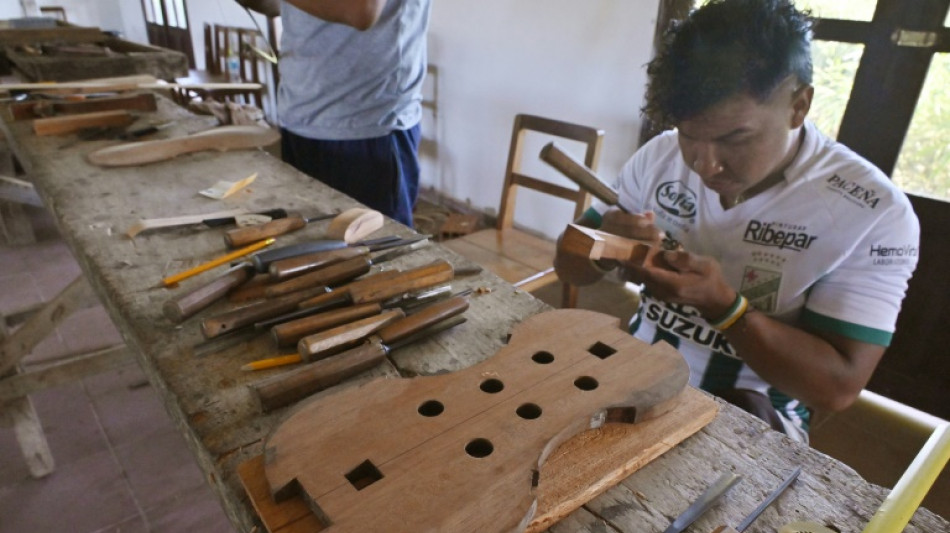
Violin village: Artisanal hub in Bolivian Amazon / Photo: © AFP

 UN approves resolution on dealing with rising sea levels

 Yalcouye makes dream debut as Ivory Coast beat Ghana in AFCON qualifier
 Chicago's White Sox and Cubs book MLB playoff berths

 Last-gasp Gakpo strike snatches Dutch draw to sour Klopp debut

 Global stocks mostly fall as oil prices and bond yields rise

 Israel's Netanyahu denounces enemies, allies in fiery UN speech
 Hollywood stars among arrests in NY anti-Netanyahu protest

 Losing start in AFCON qualifying for 78-year-old coach Le Roy

 Italy bans burqas in schools, caps numbers of foreign students per class

 Israel policies threaten 'life and existence' of Palestinians, Abbas says

 Paolini steers Italy past China in BJK

 Zidane admits emotion on eve of first game as France coach

 Breetzke and Maharaj sink Australia in first one-day international

 Zelensky broke confidentiality with North Korea POWs disclosure: South's president

 Former Liverpool star Carroll reveals he was sexually assaulted

 Dominican Republic calls for Haiti force to be strengthened

 Dolly Parton's nephew ordered to stay away from estate staff, properties

 Early exit for Philippine darling Eala at Singapore Open

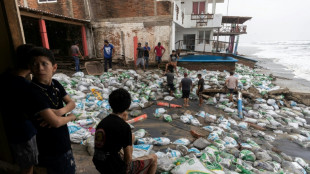 Hurricane Polo triggers huge waves in coastal Mexican city

 What happens if the US bans diesel exports

 Macklemore hits back with 'Free Palestine Tour' after Sheeran split
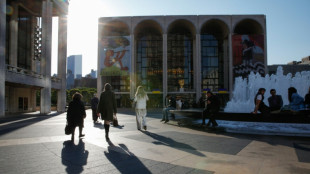 Met Opera to give New Yorkers free tickets in affordability push

 Top ECB official to resign to take up IMF role

 Xi and Trump call for peace in lavish White House state visit

 Five up-and-coming players looking to make mark in Nations League

Nestled in the Bolivian Amazon, the small, majority-Indigenous town of Urubicha has become an unexpected hub of violin makers, also known as luthiers.
Out of a population of some 8,000 people, most of whom are native Guarayos, some 40-50 work directly in the trade, local resident Waldo Papu tells AFP.
"I have not seen a place where so many violins are made," he said.
Papu heads up the Urubicha Institute of Artistic Training, Choir and Orchestra -- one of the most well-known baroque music schools in Bolivia with about 600 students.
About 20 or so students are learning to make violins, carrying on the tradition practiced by elders such as Hildeberto Oreyai.
The master craftsman, 76, tells AFP he was led into the practice by his father.
He takes two weeks to make a classical four-stringed instrument.
"You have to work with the instrument. It is done with patience, so that it comes out well," he said in a mixture of Spanish and Guarayo, one of Bolivia's 37 official Indigenous languages.
Each violin is made from cedar or mara -- a local hardwood -- and sells for the equivalent of about $580.
- Roots in tradition -
A widower with five children and several grandchildren, Oreyai speaks little and has had hearing problems for a while.
With his luthier's ear impaired, he tunes practically by heart.
"I really like to play," he says, sitting outside his rustic workshop.
Unlike some others in the town, Oreyai has been unable to convince any descendants to take up the violin-making trade he first learned from his grandfather.
Urubicha lies over 300 kilometers (200 miles) north of the departmental capital Santa Cruz.
In the early 19th century, Franciscan missionaries arrived in the area of current-day Guarayo and noticed that the Indigenous peoples were skilled artisans and, above all, musically talented.
Anthropologists believe that may be rooted in the Guarayos' beliefs around death.
For one's soul to reach the Great Ancestor, as they identify their god, it must sing and play the "tacuara" or bamboo flute, historian Juan Uranavi says.
The soul rides on a caiman to the ancestor, but if it does not know how to play the tacuara well, "because of some carelessness in his life," the caiman tips him over into the river to devour him, Uranavi told AFP.
Taking advantage of their musical proclivities, the Franciscans used the violin as a tool to evangelize the local population.
At first, the instruments could only be played in church, but later "the natives themselves learned from the missionaries" to make and play them, Papu said.
One student learning the violin-making trade is 38-year-old Hernan Yarita, who is soon to graduate as a luthier.
He tells AFP he wants his violins to reach his fellow villagers first.
"There are children who do not have a violin and we have this vision of making them for ourselves, for our relatives," Yarita says.
F.Stadler--VB