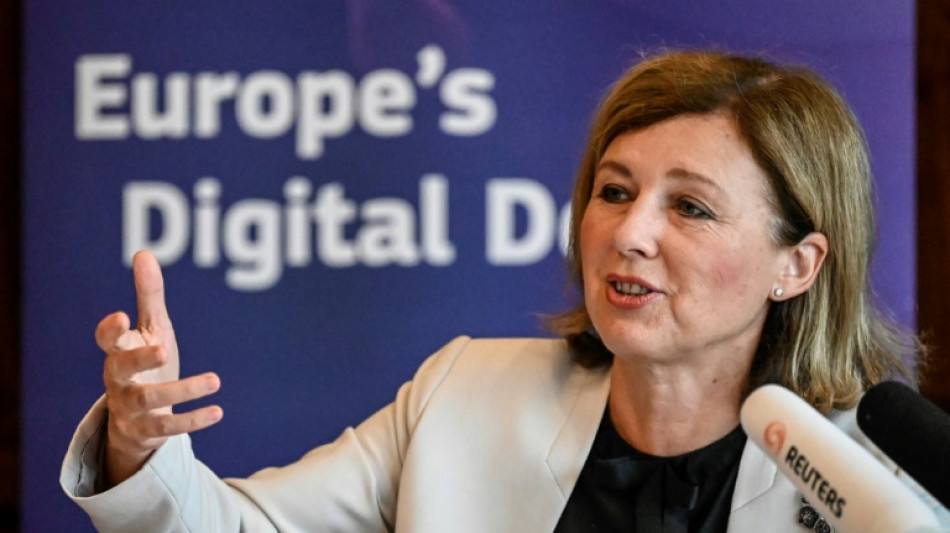
Top EU official says 'unpredictability' of Chinese law worries foreign firms / Photo: © AFP

 Thailand slams chaotic Asian Games organisation as 'musical chairs'
 North Korea to keep nuclear weapons 'forever': foreign minister

 Markets mixed as China's Xi arrives for US talks

 Swiss voters expected to shun stricter neutrality

 Rapper-turned-PM faces first big test after Nepal disaster

 Tuchel seeks tonic to England World Cup 'scar' in Spain showdown

 'Helps me cope': Catholic baptisms rise among French youth

 Colombians in Santa Marta stay inside after violence wracks the city

 Iran airlines cancel flights as US sanctions hit
 Meta launches camera-free AI glasses amid privacy pushback
 Australian PM says OpenAI hacked government health website

 Xi arrives in US to personal Trump welcome

 Morocco elects new parliament amid social frustration, youth discontent
 Scheffler and Burns to face Im and Lee in Presidents Cup opener

 Crushing wins for Lyon and Barca in women's Champions League
 Rio breaks record for rainiest September amid powerful El Nino
 At UN, tech chiefs urge caution in AI development
 Russian strikes kill seven in Ukraine, Zelensky vows winter campaign
 Venezuelan shot by ICE needs urgent medical care, mother tells AFP

 Zelensky says Putin using fighters from 47 countries in Ukraine war

 Klopp calls on Germany to 'rise above ourselves' as new era begins

 Russian strikes kill seven in Ukraine as Russia vows no 'pause' to war

 ArcPoint Expands Globally with Institutional Intelligence Platform for Modern Investors

 Ronaldo focussing on 'present' ahead of Wales test

 Outgoing UN chief makes final climate push at New York summit
The European Commission's digital chief said Tuesday that murky Chinese laws were fuelling concerns among foreign firms in the country, following discussions with Beijing officials about critical areas such as AI and data governance.
Vera Jourova, who is also the commission's vice president, made the comments after talks on Monday with Chinese counterparts including Vice Premier Zhang Guoqing in the second "High-level Digital Dialogue" between the two sides.
Among the concerns Jourova said she had heard about from European businesses in China was the "unpredictability of the decisions and interpretation of the laws by the regulators".
Beijing has recently implemented expansive new regulations covering cybersecurity, counterespionage and data management, citing the need to shore up national security measures.
But the new regulations have worried some foreign firms, unsure of how their enforcement will affect their business operations in the world's second-largest economy.
"First thing is the not very clear wording of the laws, especially missing definitions of, for instance, what is 'important data', and what... the companies could be confronted with when transferring the data outside," Jourova told reporters.
Jourova also criticised the "lengthy procedures" foreign firms must undergo to conduct business in the country.
"I think it's 45 days for one process -- it lasts very often a much longer time," she said.
"Nobody is criticising the Chinese laws, we just want them to be clear and relatively easy to comply with."
The EU official and Czech politician's visit to Beijing comes just days after Brussels announced a probe into Chinese subsidies for electric vehicles, which it said had resulted in unfair competition.
China warned that the investigation would have a negative impact on its trade relations with the bloc, accusing it of "naked protectionism".
Jourova said she emphasised during her meetings with Chinese officials the concerns of European firms over increasingly difficult business conditions in the country, as well as the implications of AI on human rights in the country's northwestern Xinjiang region.
China is accused of incarcerating more than a million Uyghurs and other Muslim minorities in a network of detention facilities across Xinjiang, although Beijing insists its actions have helped to combat extremism and enhance development.
Deteriorating ties between China and the West in recent years have given rise to concerns in Brussels over the potential vulnerabilities posed by AI, misinformation, and data security.
European Commission President Ursula von der Leyen has called on the EU to define its own approach to Beijing, although some of Europe's larger powers want to be cautious to avoid severing business ties.
"The EU does not seek to de-couple from China," Jourova said.
"But we need to improve our resilience and competitiveness by de-risking our economic interdependencies and advancing our technology security agenda in order to remain competitive and protect our essential European interests."
China has pushed back on the "de-risking" strategy espoused by Washington and its European allies.
A foreign ministry spokesperson said in June that "anyone seeking to 'de-risk' against China is getting their target wrong and will only create real risks".
A.Kunz--VB