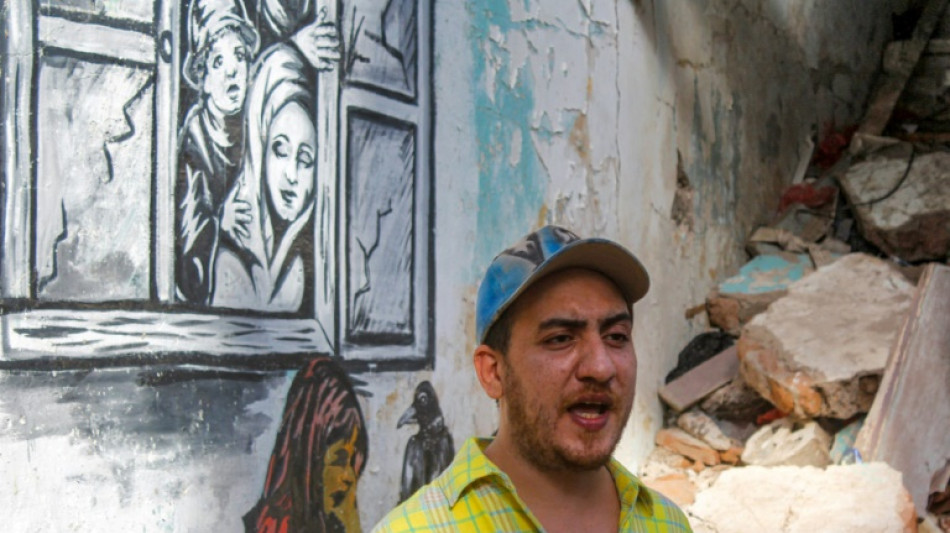
Yemen street artist chronicles war on battle-scarred walls / Photo: © AFP

 South African election results renew debate over identity-based voting

 South African voters report smoother local election but declining IEC trust

 Dolly Parton museum and Nashville hotel open after singer’s death

 George and Amal Clooney attend New York political-comedy reading

 British buyers pay substantial premiums for period-home appearance

 Thomas Markle released to house arrest after child-abuse-image charge

 Dawn of War 4 developers chose Adeptus Mechanicus for tactical variety

 Italy face unbeaten South Africa in Turin Nations Championship match

 ChatGPT interactive interface feature tested across six custom tools

 Freshways milk-price cut deepens pressure on UK dairy farms

 Labour and National remain virtually tied as New Zealand vote count advances

 The Good Daughter adapts Karin Slaughter thriller with Rose Byrne and Meghann Fahy

 Heavy-lift drone evacuates wounded Ukrainian soldier from frontline kill zone

 Morrison says West Brom recovered after pressure from successive derby losses

 Britain considers 2027 state visit for Ukraine’s Zelensky

 Arizona Democrats Secure Historic Trifecta with New Legislative Leadership

 Carney Welcomes U.S. Trade Reversal After Democratic Midterm Victory

 Armenian FM Discusses EU Accountability for Palestinian Rights in Madrid
Yemeni artist Alaa Rubil uses the shell-pocked buildings of his hometown as canvas, painting images of death and despair to shine a light on the horrors and victims of war.
Not long after the start of the bloody conflict between Yemen's internationally recognised government and Huthi rebel forces, the southern port city of Aden, where Rubil lives, became the scene of brutal fighting.
For several months in 2015, artillery rained down on Aden, and Huthi rockets and mortars fired into densely populated areas killed dozens of civilians, Human Rights Watch reported at the time.
Rubil, now 30, has been painting murals since we has a teenager, but found his voice in the aftermath of that round of violence.
"I saw that the government was not aware of the people who were displaced," he told AFP.
"I wanted to communicate my message to the world by drawing people who lost their homes and families," he said.
"By using the walls, I could reach the world."
Today, the rubble-strewn streets of Aden double as a semi-permanent exhibition of Rubil's work -- and a testament to what the city's inhabitants have lived through.
- 'Feel the people' -
On the wall of one shop in a particularly hard-hit area, he painted a large outline of a man's face, but obscured the eyes, nose and mouth with a cupped palm holding up three sticks of dynamite.
Across the street, on the interior wall of a bombed-out apartment building, a piece he calls "Silent Suffering" depicts a skeleton playing a violin as peace signs float around its skull.
In another work, a girl in a red dress sits on the ground with her head resting in her left hand, next to a black crow perched on a missile.
Behind her, the girl's deceased relatives, rendered in black and white, peer down from an open window.
The image is based on the true story of a girl who lived in the area and lost her family in the fighting, Rubil said.
"She thinks that war is a game. She thinks that her family is returning," he said. "So she is waiting for them."
Amr Abu Bakr Saeed, 42, who lives nearby, told AFP the paintings were a dark but necessary tribute to the dead.
"When we pass through this place, we feel pain, we feel the people who were here," he said.
"These paintings express the tragedies of the people whose homes were destroyed and who were displaced, and prove that war really took place in Yemen."
- 'No one cares' -
A little more than eight years ago, neighbouring Saudi Arabia mobilised a coalition to topple the Huthis, who had seized Yemen's capital, Sanaa, in 2014.
The war has killed hundreds of thousands of people either through combat or knock-on effects such as hunger and disease. Millions remain displaced, their homes and communities destroyed.
A truce that went into effect in April 2022 officially expired in October, but has still significantly reduced fighting across the country, raising hopes for a durable peace.
Riyadh sent a delegation to Sanaa last month to meet with the Huthis, and the kingdom's ambassador to Yemen, Mohammed al-Jaber, told AFP this month he believed all parties were "serious" about bringing an end to the war.
Walking through the ramshackle streets of Aden, carrying his paint and brushes in a small basket so he could touch up several pieces, Rubil said he, too, was trying to be optimistic.
"I love the idea that this place could turn from a centre of destruction to a centre of peace," he said, adding he hoped art could help the city rebuild.
But he acknowledged that many Aden residents were still waiting to see tangible progress.
"For me, nothing has changed," said 53-year-old Yasmin Anwar Abdel Shakur, passing by on her way home from work in a government health office.
"We are threatened by buildings falling over on us at any time," she told AFP, describing how most buildings that were heavily damaged during the war remain unrepaired.
"Many people have died here, their lives are gone," she said. "No one knows and no one cares."
F.Pavlenko--BTB