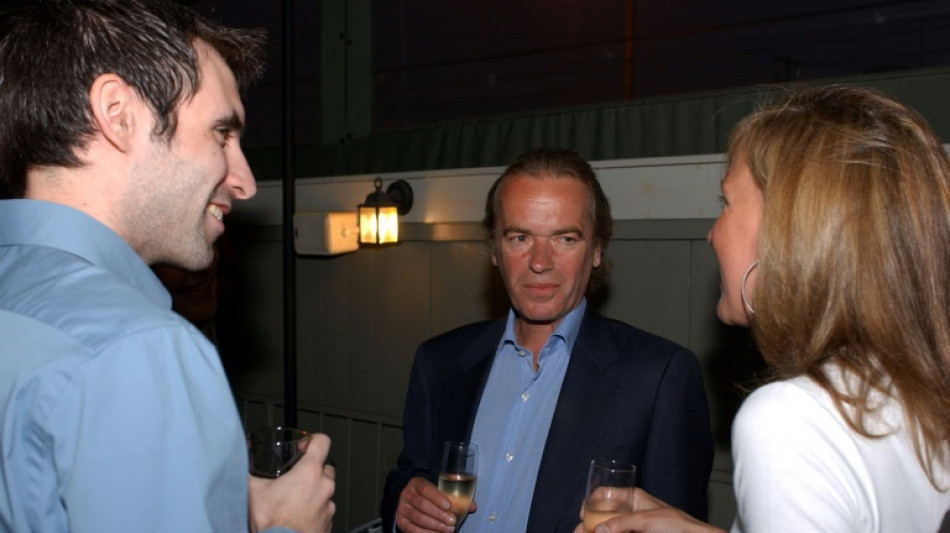
Martin Amis, a second-generation literary lion / Photo: © Getty Images North America/Getty Images/AFP

 Alex Bodi and Prof. Dr Stefan Haupt agree to collaborate on a legendary art collection in Romania

 Stocks dip, oil rises as traders eye chances of Iran deal

 Israel squeezing UN Palestinian refugee agency ahead of polls: chief

 Dutch to resume Eurovision with new broadcaster

 Man Utd losses jump despite record revenues

 Ethiopia's Tigray rebels seize airports, clash with govt forces

 China prodigy wins third Games gold as North Korea weightlifters roar

 China's Yu, 13, wins third Asian Games gold but has 'some regrets'
 Oil falls, stocks steady as Trump hails 'good' Iran talks

 UK sets up unit to combat disinformation from Russia, AI

 ICC convicts C.Africa rebel leader

 China's Yu, 13, wins third gold with latest Asian Games record

 UK says will revisit Chagos deal after latest Trump criticism

 In first, French presidential candidate gives birth during campaign

 Cambodia no 'safe haven' for cyberscams, PM says

 North Korea weightlifter sets three world records for Asian Games gold

 A Full Moon for Every Child: STARTRADER's STARCARES Brings Support to SOS Children's Village Ho Chi Minh City

 Meta leans into AI, smart glasses amid privacy pushback

 Battered Duerer masterpiece up for five-year revamp

 Trump met with Venezuela's interim leader at UN

 Malaysia furore after Najib wins conditional house arrest

 Italy hope for new dawn under Mancini

 Mongolian herders enlist new tech against harsher, drier climate

 Tata turmoil shines light on India succession woes

 World Cup 'not enough' as Spain begin next chapter

One of the burdens of having a famous father is trying to measure up to him in the same field.
British writer Martin Amis, who has died at the age of 73, not only matched his illustrious father, Kingsley, but for a while rose beyond him.
The influential author's 1984 novel "Money" became one of the books that summed up a generation.
"Money doesn't mind if we say it's evil, it goes from strength to strength. It's a fiction, an addiction, and a tacit conspiracy," he said, in the "Novelists in Interview" publication, a year after his book came out.
Depicting self-serving greed in Thatcherite Britain and the US under Ronald Reagan, "Money: A Suicide Note", to give it its full title, is regarded as one of the most searing, insightful and bitingly funny English-language novels of the 20th century.
It follows "a semi-literate alcoholic", John Self, an advertising executive with an appetite for pornography, drugs and fast food, as he dices between London and New York in a bid to make a movie.
The characters border on cartoonish but the language is sharp and vivid and the comedy is as darkly acerbic as anything his father wrote.
Arguably, it is the tour de force in the Amis canon, although some might argue for his 1989 novel "London Fields" or for 1991's "Time's Arrow" which has a backwards narrative -- including dialogue in reverse -- as it purports to be the autobiography of a Nazi concentration camp doctor.
"Time's Arrow" was short-listed for the Booker Prize, an award which eluded Amis throughout his career.
British director Jonathan Glazer's adaption of his novel "The Zone of Interest", set in a Nazi death camp, is currently receiving plaudits at the Cannes Film Festival.
"The novel is an incredibly intimate portrait of a writer," Amis once told the BBC, looking back at his career.
"Although I am not an autobiographical writer, I am all over my books."
- Literary roots –
Martin Louis Amis was born in Oxford on August 25, 1949, the second of three children that Kingsley Amis had with his first wife, Hilary Bardwell.
Kingsley was a huge figure in the literary world when Martin was growing up, riding high on the success of his 1954 novel "Lucky Jim". That took the family to Princeton in the US where he taught, where he lived up to the image of the acerbic curmudgeon that he carefully nurtured.
After graduating from Oxford University, Martin Amis published his first novel, "The Rachel Papers", in 1973. He followed up with "Dead Babies" two years later, which marked his first dalliance with morbid humour.
In the years that followed, he enjoyed some success with "Success" and "Other People", before hitting the big time with "Money", "London Fields" and "Time's Arrow".
It was the third of his "London" novels, "The Information", published in 1995, which launched him into the gossip columns.
The reason was money.
Amis was handed a £500,000 advance, which coincided with him leaving his agent, Pat Kavanagh, the wife of one of his best friends, fellow novelist Julian Barnes.
It caused a rift between the two writers.
By that stage Amis had already left his first wife Antonia Phillips, an American academic, with whom he had two sons, to begin a relationship with Isabel Fonseca, an heiress who had interviewed him for a British literary review. They married in 1996.
- Divided opinions -
The 1990s were the peak of Amis' literary powers, even when he was being accused of misogyny and, later, Islamophobia -- claims he firmly rejected.
"I not only think of myself as a feminist but as a gynocrat," he said in 2018. "I look forward to a utopia where women are in charge."
His 2003 novel "Yellow Dog" made the Booker Prize longlist but was largely derided, memorably by another British novelist Tibor Fischer, who said in a newspaper review that it was so bad it was "like your favourite uncle being caught in a school playground, masturbating".
Amis and Fonseca, who had two daughters, settled in Brooklyn, New York, where in 2010 they bought their house for $2.5 million. They also had homes in London and Uruguay.
As well as a string of novels, Amis wrote two collections of short stories, six non-fiction books and a memoir.
But, for many fans, the acerbic brilliance of "Money" makes it his standout novel, reflecting perhaps Amis's own views on the waning powers of the older writer.
"Age waters the writer down," he wrote in 2009 in a newspaper review of a John Updike book.
"The most terrible fate of all is to lose the ability to impart life to your creations."
H.Seidel--BTB