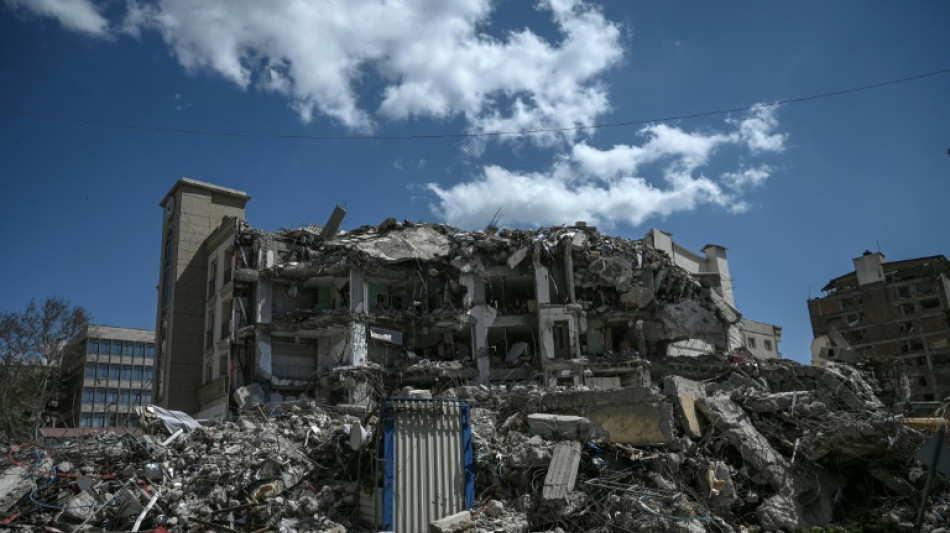
Quake anger ebbs in Erdogan stronghold ahead of vote / Photo: © AFP

 South African election results renew debate over identity-based voting

 South African voters report smoother local election but declining IEC trust

 Dolly Parton museum and Nashville hotel open after singer’s death

 George and Amal Clooney attend New York political-comedy reading

 British buyers pay substantial premiums for period-home appearance

 Thomas Markle released to house arrest after child-abuse-image charge

 Dawn of War 4 developers chose Adeptus Mechanicus for tactical variety

 Italy face unbeaten South Africa in Turin Nations Championship match

 ChatGPT interactive interface feature tested across six custom tools

 Freshways milk-price cut deepens pressure on UK dairy farms

 Labour and National remain virtually tied as New Zealand vote count advances

 The Good Daughter adapts Karin Slaughter thriller with Rose Byrne and Meghann Fahy

 Heavy-lift drone evacuates wounded Ukrainian soldier from frontline kill zone

 Morrison says West Brom recovered after pressure from successive derby losses

 Britain considers 2027 state visit for Ukraine’s Zelensky

 Arizona Democrats Secure Historic Trifecta with New Legislative Leadership

 Carney Welcomes U.S. Trade Reversal After Democratic Midterm Victory

 Armenian FM Discusses EU Accountability for Palestinian Rights in Madrid
Latif Dalyan offers shirts and sweatpants at knock-down prices to Turkey's earthquake victims from a storefront surrounded by piles of debris.
The last person the 58-year-old shopkeeper wants to blame for his ruined city's troubles is the country's president.
"If there is one man who can make this country stand up again, it is Recep Tayyip Erdogan," Dalyan said near the February quake's epicentre in the city of Kahramanmaras.
"May God give every country a leader like him."
Dalyan's fervour contrasts sharply with the cries of pain and anger that rang out when the 7.8-magnitude jolt and its aftershocks wiped out swathes of Turkey's mountainous southeast in February.
Anguished survivors listened to loved ones slowly perish under mounds of rubble in the freezing cold.
Many blamed the government and its stuttering response to Turkey's worst disaster of its modern era for a death toll that has now surpassed 50,000.
But that fury is gradually giving way to a mixture of fatalism and reviving trust in the man this province gave three-fourths of its votes to in the last general election in 2018.
That spells trouble for the opposition's hopes of ending Erdogan's two-decade domination of Turkey in new polls set for May 14.
"Nobody can be perfect and no government can be perfect," Dalyan said. "Everyone can make mistakes."
- 'We will not campaign' -
Aydin Erdem, director of the KONDA research firm, found something similar in polls conducted across Turkey's disaster zone.
"Our surveys do not support claims that the (ruling party's) vote dropped a lot because of what happened," Erdem told Turkish media this week.
"The electorate is consolidating around their respective parties."
The presidential and parliamentary votes next month are widely seen as the most important of Turkey's post-Ottoman history.
Erdogan and his Islamic-rooted party have shaped society in their image and tested the strength of Turkey's secular traditions.
Critics accuse them of mismanaging the economy and using the courts to silence critics and imprison political foes.
The government's sluggish search and rescue effort appeared to offer the united opposition a chance to capitalise on this discontent.
Cem Yildiz does not quite see it that way.
The 34-year-old deputy head of CHP, the main opposition party in the Kahramanmaras province, has done almost no campaigning to date.
He says he fears that pushing people to vote during a moment of profound grief is both indecent and self-defeating.
"We will not campaign because the people here are in pain," he said next to a container home that serves as his party's temporary headquarters.
"We visit people to help them with their problems. We don't ask for their votes."
- 'We had momentum' -
The main office for the CHP, created by the secular state's founder Mustafa Kemal Ataturk, was one of untold number of local buildings levelled or damaged by the quake.
Party officials decided to set up their new camp in a remote pocket of the city with a strong liberal lean.
Local men while away the hours in a teahouse on a street that witnessed a bloody attack by neo-Fascists on socialists and Alevi Kurds in 1978 that killed more than 100 people.
CHP supporter Mustafa Akdogan remembers those troubled days with queasy foreboding.
"Democracy, human rights and especially the rule of law have vanished in the past four or five years," the 67-year-old retired teacher said.
"So these elections are very important."
But the self-imposed pause in his local party's campaigning leaves Akdogan less certain of victory than he was before the disaster struck.
"We had momentum before the quake," he said. "Now, I am not sure."
- 'Afraid to say anything' -
The city of Kahramanmaras and the province had more than a million people before February 6.
Officials struggle to estimate how many remain today. Deserted streets are dotted with tent camps and families sitting outside crumbled homes.
Some locals said Kahramanmaras was filled mostly by poorer people who either never had the chance to move out or had spent their savings living in more intact parts of Turkey.
Yasemin Tabak, a housewife, said she had no complaints about returning to Kahramanmaras.
She recalled Erdogan's promise to rebuild homes within a year and smiled. "Our people have to be a little patient," the 40-year-old said.
"May God protect our government," her tent neighbour Ayse Ak agreed.
But two other women looking down from a hill at a vast empty space where blocks of apartments once stood suggested a quiet undercurrent of scepticism.
"People are afraid to say anything against the government here," the younger of them said.
"They will never do it on camera or give you their name. And I'm afraid too."
C.Meier--BTB