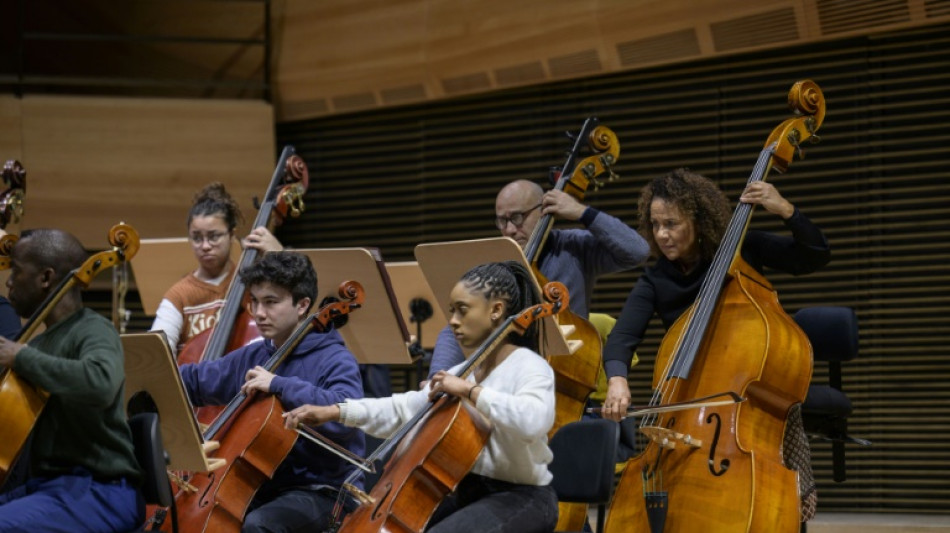
Europe's first majority Black orchestra debuts stateside / Photo: © AFP

 South African election results renew debate over identity-based voting

 South African voters report smoother local election but declining IEC trust

 Dolly Parton museum and Nashville hotel open after singer’s death

 George and Amal Clooney attend New York political-comedy reading

 British buyers pay substantial premiums for period-home appearance

 Thomas Markle released to house arrest after child-abuse-image charge

 Dawn of War 4 developers chose Adeptus Mechanicus for tactical variety

 Italy face unbeaten South Africa in Turin Nations Championship match

 ChatGPT interactive interface feature tested across six custom tools

 Freshways milk-price cut deepens pressure on UK dairy farms

 Labour and National remain virtually tied as New Zealand vote count advances

 The Good Daughter adapts Karin Slaughter thriller with Rose Byrne and Meghann Fahy

 Heavy-lift drone evacuates wounded Ukrainian soldier from frontline kill zone

 Morrison says West Brom recovered after pressure from successive derby losses

 Britain considers 2027 state visit for Ukraine’s Zelensky

 Arizona Democrats Secure Historic Trifecta with New Legislative Leadership

 Carney Welcomes U.S. Trade Reversal After Democratic Midterm Victory

 Armenian FM Discusses EU Accountability for Palestinian Rights in Madrid
After more than three decades in the classical music industry, British double bassist Chi-chi Nwanoku began grappling with the question that had troubled her for years: Why was she consistently the only Black musician onstage?
"Why did I never ask anyone about it? Why did we never talk about it?" she describes wondering. "Was I being tolerated, or were people just completely unaware?"
"Or were people okay with the status quo?"
In 2015 Nwanoku took a leading role in creating a more diverse future for classical music, which, from musicians to conductors to repertoire, traditionally skews heavily white.
She founded Chineke!, Europe's first majority Black and ethnically diverse professional orchestra, which this week played at the prestigious New York Philharmonic's David Geffen Hall in Manhattan's Lincoln Center.
The performance was part of their long-awaited North American debut tour -- it was among the many performances the pandemic pushed back -- which included stops in New York, Ottawa, Toronto, Boston, Worcester and Ann Arbor.
The New York show featured the pioneering composer Florence Price's Symphony No. 1, along with a rendition of Mozart's Clarinet Concerto featuring the New York Phil's principal clarinet Anthony McGill.
- 'Door-opener' -
The London-headquartered Chineke! echoes similar efforts in the United States, including the Detroit-based Sphinx organization that promotes representation of Black and Latino artists in classical music.
Yet the League of American Orchestras, which represents professional and amateur symphonies across the United States, found in a 2014 study on diversity that just 1.4 percent of orchestra musicians were Black -- and there's little reason to believe much has changed.
"Because the great majority of American orchestras are not individually transparent with racial and ethnic data on their artists, we do not know the percentage of Black orchestral artists in our orchestras today," writes the Black Orchestral Network, a collective of Black musicians from more than 40 orchestras launched in 2022.
"From our vantage point, however, we have seen little meaningful progress."
It's mind-boggling to Nwanoku, who told AFP during a rehearsal break that "it seems to me that the only colleagues of color that I see who have a job in an orchestra in this country are those who are exceptional."
"We have to be that much better to actually be given a job."
Nwanoku believes that especially for young people, seeing more diverse faces onstage is "an immediate door-opener."
"It's the most incredibly winning thing to feel represented on a stage," she said. "Even if when you walk through the front of house to buy a ticket, if you don't see anyone who looks like you, that is immediately uncomfortable."
"But when you see people that look like you in any place -- in the supermarket, at the train station, at the concert hall, at the cinema -- you immediately feel that is a place that I can walk into with confidence," Nwanoku continued.
"You can be what you can see."
M.Ouellet--BTB