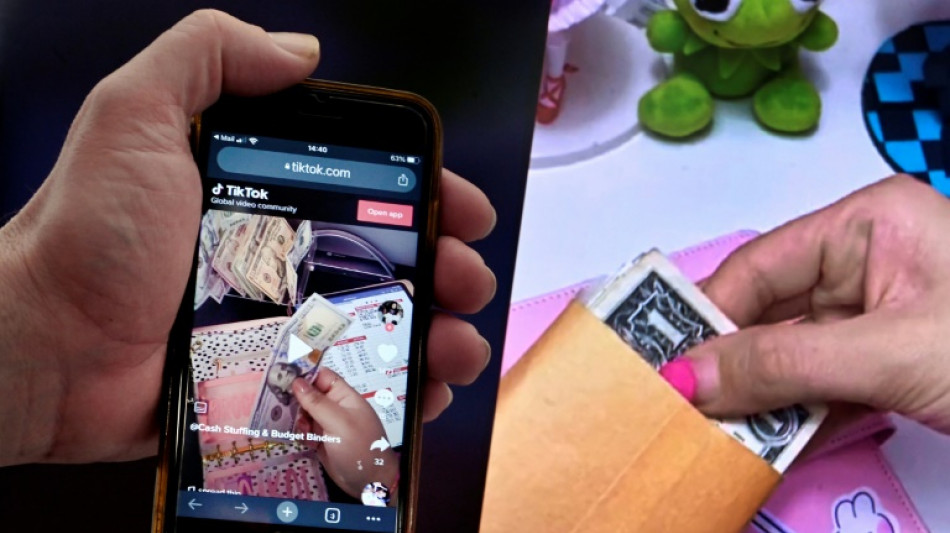
Spurred by TikTok, some Americans return to cash to curb spending / Photo: © AFP

 Cambodia no 'safe haven' for cyberscams, PM says

 North Korea weightlifter sets three world records for Asian Games gold

 A Full Moon for Every Child: STARTRADER's STARCARES Brings Support to SOS Children's Village Ho Chi Minh City
 Meta leans into AI, smart glasses amid privacy pushback

 Battered Duerer masterpiece up for five-year revamp

 Trump met with Venezuela's interim leader at UN

 Malaysia furore after Najib wins conditional house arrest

 Italy hope for new dawn under Mancini

 Mongolian herders enlist new tech against harsher, drier climate
 Tata turmoil shines light on India succession woes
 World Cup 'not enough' as Spain begin next chapter

 Meta acts against 3.7 mn scammers' accounts with Singapore police help
 Australia PM says draft social media rules about taking back control

 Voting opens in Alaska's annual Fat Bear Week
 MLS coach axed for telling female ref 'It's a man's game'

 US refuses to give Sudan's de facto leader visa for UN
 Man City hold Bayern to start Women's Champions League, Arsenal win late
 Trump threatens Iran with 'hell' but reveals fresh talks

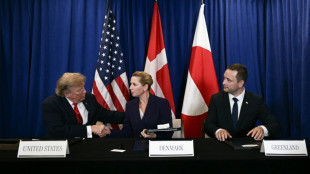 Trump signs security deal with Greenland, Denmark at UN
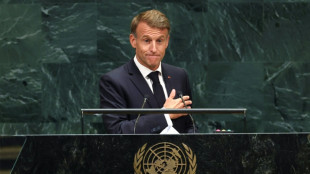
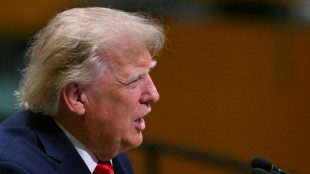 Trump threatens Iran with 'hell' but unveils fresh talks

 Chile's Atacama Desert blossoms with life after El Nino rains

 Sri Lanka hands 220-year jail terms to 15 convicted of Easter bombings
 Typhoon Dujuan leaves 7 dead in Japan from landslides, flooding: media
 Ganna and Borghini lead Italy to mixed relay gold at cycling worlds

 Drug cocktail killed former child star Hayden Panettiere: coroner
Manicured fingers meticulously place cash in transparent envelopes marked "food," "gas" and other categories, demonstrating in a TikTok video a retro technique for controlling what you spend that is newly popular with some money-conscious Americans.
Returning to cash to control spending may be old fashioned, but in an era of high inflation, a growing number of consumers find that it works.
Judia Griner, 25, started "cash stuffing" two years ago when she was a student at Old Dominion University in Virginia. Now, her TikTok account has more than 200,000 followers.
"I was like, I need to somehow use my own money to pay off the tuition so I won't be in too much debt," Griner told AFP.
"I realized that I had no idea how to do that, because I just didn't know how much money I had," she said.
"I would swipe my card, and I would just kind of cross my fingers and hope that it wouldn't be declined."
It was a similar situation for 31-year-old Jasmine Taylor, who launched her Tiktok channel in February 2021 and now has more than 620,000 followers.
"I had a degree but no outlook for a job. My finances were bad," Taylor, a Texan, said. "I was a pretty big impulse shopper."
Both women decided the way to turn around their spending behavior was to rely on the technique of paying cash for everything.
Once they cash in their pay checks, they separate it into different envelopes for specific expenses -- rent, shopping, etc.
On TikTok, the hashtag #cashstuffing has now reached more than 930 million views.
- Old method, proven results -
The method is reminiscent of the age-old piggy bank system, and was popularized in its current form 20 years ago by financial guru Dave Ramsey, before the era of smartphones and contactless payments.
Despite being outdated and at times inconvenient -- some businesses refuse to accept cash -- the method has allowed Griner to save $7,500 to finance her education.
"The card didn't feel like real money to me," Griner said.
But using cold cash made it very real.
"I could physically see myself spending all my cash and it just went away and that's what helped me curb my spending," she said.
Taylor, too, saw immediate results. She pays 95 percent of her expenses in cash, got rid of $32,000 in student debt, $8,000 in credit card debt and $5,000 in health care debt.
Wracking up debt is a national affliction in a country with abundant credit card offerings that goad households to take on more and more loans.
"It's a problem that my generation kind of suffers from: consumerism and just overspending everything," Griner said.
- Sense of comfort -
For Priya Malani, founder of Stash Wealth, a financial advisory service for young professionals, the economic downturn plays a role in the current success of the envelope system.
"With so many insane headlines -- crypto crashes, market pullbacks, looming recession, the list goes on -- it makes sense that people are looking for a little more control," Malani said.
"A dollar bill you hold in your hand provides that comfort."
But, Jason Howell, a wealth management professor at American University warned that "2023 is probably the worst time to keep your cash in your house" because it earns no interest and depreciates.
Taylor, who keeps her envelopes stuffed with small bills in a fireproof safe in her home, is well aware of this. She still deposits money in the bank when she saves $1,000 or more.
The two experts acknowledge that there is no broader movement back to cash in the United States, where the trend has been the gradual decline of cash in favor of card or mobile payments.
In 2022, about four in ten Americans (41 percent) said they would not make any cash purchases in a typical week, compared to only 24 percent in 2015, according to a recent Pew Research Center study.
According to Griner, the envelope method still represents "the perfect kind of system for a beginner" to manage a budget.
For her, the change has been dramatic: "I trust myself with money."
Howell said that sense of control is a notable achievement.
"It makes you think, it's the greatest benefit of this system," Howell said.
O.Bulka--BTB