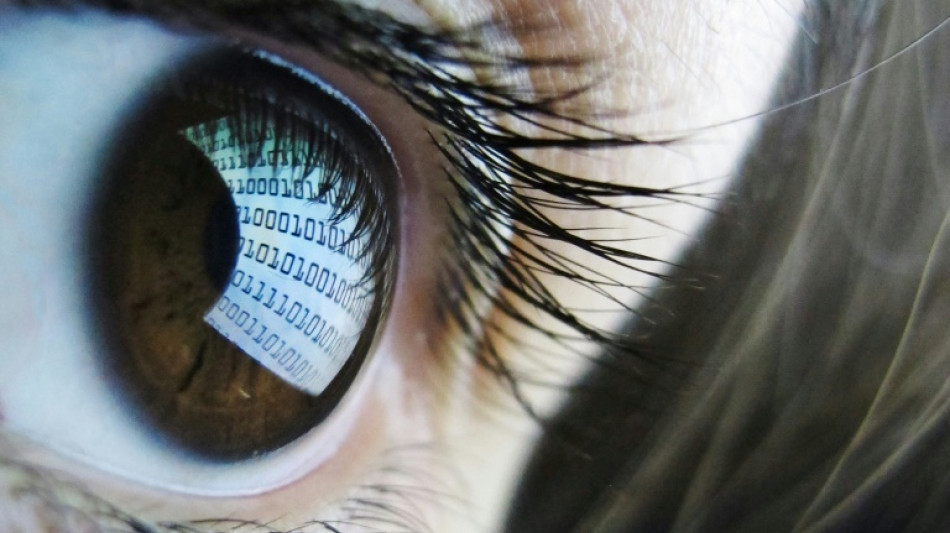
How AI 'revolution' is shaking up journalism / Photo: © AFP/File

 South African election results renew debate over identity-based voting

 South African voters report smoother local election but declining IEC trust

 Dolly Parton museum and Nashville hotel open after singer’s death

 George and Amal Clooney attend New York political-comedy reading

 British buyers pay substantial premiums for period-home appearance

 Thomas Markle released to house arrest after child-abuse-image charge

 Dawn of War 4 developers chose Adeptus Mechanicus for tactical variety

 Italy face unbeaten South Africa in Turin Nations Championship match

 ChatGPT interactive interface feature tested across six custom tools

 Freshways milk-price cut deepens pressure on UK dairy farms

 Labour and National remain virtually tied as New Zealand vote count advances

 The Good Daughter adapts Karin Slaughter thriller with Rose Byrne and Meghann Fahy

 Heavy-lift drone evacuates wounded Ukrainian soldier from frontline kill zone

 Morrison says West Brom recovered after pressure from successive derby losses

 Britain considers 2027 state visit for Ukraine’s Zelensky

 Arizona Democrats Secure Historic Trifecta with New Legislative Leadership

 Carney Welcomes U.S. Trade Reversal After Democratic Midterm Victory

 Armenian FM Discusses EU Accountability for Palestinian Rights in Madrid
Journalists had fun last year asking the shiny new AI chatbot ChatGPT to write their columns, most concluding that the bot was not good enough to take their jobs. Yet.
But many commentators believe journalism is on the cusp of a revolution where mastery of algorithms and AI tools that generate content will be a key battleground.
The technology news site CNET perhaps heralded the way forward when it quietly deployed an AI program last year to write some of its listicles.
It was later forced to issue several corrections after another news site noticed that the bot had made mistakes, some of them serious.
But CNET's parent company later announced job cuts that included editorial staff -- though executives denied AI was behind the layoffs.
The German publishing behemoth Axel Springer, owner of Politico and German tabloid Bild among other titles, has been less coy.
"Artificial intelligence has the potential to make independent journalism better than it ever was –- or simply replace it," the group's boss Mathias Doepfner told staff last month.
Hailing bots like ChatGPT as a "revolution" for the industry, he announced a restructuring that would see "significant reductions" in production and proofreading.
Both companies are pushing AI as a tool to support journalists, and can point to recent developments in the industry.
- 'Glorified word processor' -
For the past decade, media organisations have been increasingly using automation for routine work like searching for patterns in economic data or reporting on company results.
Outlets with an online presence have obsessed over "search engine optimisation", which involves using keywords in a headline to get favoured by the Google or Facebook algorithms and get a story seen by the most eyeballs.
And some have developed their own algorithms to see which stories play best with their audiences and allow them to better target content and advertising -- the same tools that turned Google and Facebook into global juggernauts.
Alex Connock, author of "Media Management and Artificial Intelligence", says that mastery of these AI tools will help decide which media companies survive and which ones fail in the coming years.
And the use of content creation tools will see some people lose their jobs, he said, but not in the realms of analytical or high-end reporting.
"In the specific case of the more mechanistic end of journalism -- sports reports, financial results -- I do think that AI tools are replacing, and likely increasingly to replace, human delivery," he said.
Not all analysts agree on that point.
Mike Wooldridge of Oxford University reckons ChatGPT, for example, is more like a "glorified word processor" and journalists should not be worried.
"This technology will replace journalists in the same way that spreadsheets replaced mathematicians -- in other words, I don't think it will," he told a recent event held by the Science Media Centre.
He nonetheless suggested that mundane tasks could be replaced -- putting him on the same page as Connock.
- 'Test the robots' -
French journalists Jean Rognetta and Maurice de Rambuteau are digging further into the question of how ready AI is to take over from journalists.
They publish a newsletter called "Qant" written and illustrated using AI tools.
Last month, they showed off a 250-page report written by AI detailing the main trends of the CES technology show in Las Vegas.
Rognetta said they wanted to "test the robots, to push them to the limit".
They quickly found the limit.
The AI struggled to identify the main trends at CES and could not produce a summary worthy of a journalist. It also pilfered wholesale from Wikipedia.
The authors found that they needed to intervene constantly to keep the process on track, so while the programs helped save some time, they were not yet fit to replace real journalists.
Journalists are "afflicted with the syndrome of the great technological replacement, but I don't believe in it", Rognetta said.
"The robots alone are just not capable of producing articles. There is still a part of journalistic work that cannot be delegated."
I.Meyer--BTB