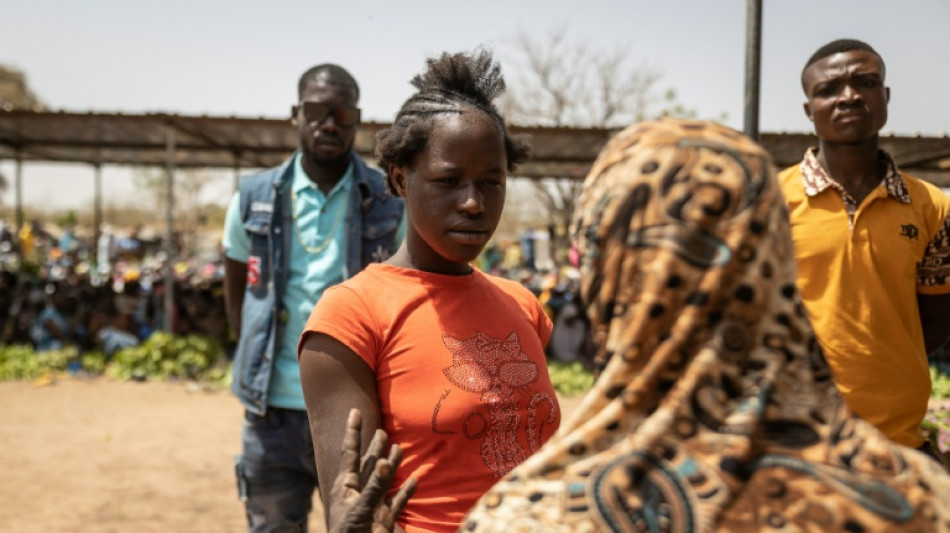
In troubled Burkina, a spiritual healer becomes a phenomenon / Photo: © AFP

 South African election results renew debate over identity-based voting

 South African voters report smoother local election but declining IEC trust

 Dolly Parton museum and Nashville hotel open after singer’s death

 George and Amal Clooney attend New York political-comedy reading

 British buyers pay substantial premiums for period-home appearance

 Thomas Markle released to house arrest after child-abuse-image charge

 Dawn of War 4 developers chose Adeptus Mechanicus for tactical variety

 Italy face unbeaten South Africa in Turin Nations Championship match

 ChatGPT interactive interface feature tested across six custom tools

 Freshways milk-price cut deepens pressure on UK dairy farms

 Labour and National remain virtually tied as New Zealand vote count advances

 The Good Daughter adapts Karin Slaughter thriller with Rose Byrne and Meghann Fahy

 Heavy-lift drone evacuates wounded Ukrainian soldier from frontline kill zone

 Morrison says West Brom recovered after pressure from successive derby losses

 Britain considers 2027 state visit for Ukraine’s Zelensky

 Arizona Democrats Secure Historic Trifecta with New Legislative Leadership

 Carney Welcomes U.S. Trade Reversal After Democratic Midterm Victory

 Armenian FM Discusses EU Accountability for Palestinian Rights in Madrid
A line of cars and motorcycles cuts across the arid West African landscape, kicking up clouds of dust on the unpaved road.
Their destination: Toeghin Peulh, a village 30 kilometres (18 miles) south of Burkina Faso's capital Ouagadougou that has become a magnet for the sick and the desperate.
Thousands of people have come to seek help, either for themselves or for a loved-one, from a 20-year-old woman named Adja whose reputation for healing powers has spread across the country.
At the end of track is a sea of parked motorbikes, tents and pilgrims, many dressed in white.
Among the rivers of humanity are men whose feet have been chained, people who have been crippled, others who are said to be possessed, cursed by bad luck or haunted by spirits.
They are the desperate of a nation buffeted by poverty and ravaged by a bloody jihadist insurgency, with only the thinnest social safety net.
"We tried every kind of treatment, but none of them worked," said Awa Tiendrebeogo, a relative of a man suffering from chronic dizziness.
"Then someone we know told us of Adja, and we came here."
Adja is the nickname for Amsetou Nikiema, a young woman who says that she was haunted by visions during her childhood in rural Burkina -- and suffered cruelly at the hands of her family as a result.
Three years ago, word spread that she had carried out a miraculous healing. From there, her reputation snowballed.
Today, drawing on traditional medicine and what she says is a spiritual guide, she practices in an open compound built in the bush with the help of wealthy donors -- she does not charge, but donations and other offerings are discreetly encouraged.
- Skirt and T-shirt -
On this Sunday, thousands had come for help.
They firstly gathered for prayers, repeating in a chorus, "There is no divinity but God."
After a while, Adja appeared -- a young woman with braided hair, simply dressed in a long skirt and an orange T-shirt, walking barefoot in the dust and whose only accessory is a cane stick.
Adja began by looking at the sun, her face contorted by spasms, and then looked around at the congregation.
"Him over there, wearing the pink sweatshirt, he will have an accident soon," she predicted. "Over there is a man who has come to investigate me," she added, without identifying the individual.
Officially, just nine percent of Burkina Faso's population say they are animist.
But this figure is widely considered to be an underestimate. Traditional beliefs run deep, often co-existing among the country's Muslim majority and Christians, and the authorities are tolerant of claimed healers.
"The saying here is that people criticise the tradition by day and practice it by night," said one of Adja's assistants.
Among those seeking her help are people said to have been victims of evil spirits, such as Fatoumata, a young woman who suddenly lost the use of her legs.
She lay motionless on the ground as Adja splashed her with holy water and slowly walked on her body, barefoot.
The prayers of the crowd rose a notch, mixing with the cries of other "possessed" people who were waiting their turn.
In Fatoumata's case, Adja failed. The patient did not get up, but the following case, also a woman, recovered the use of her legs.
- 'Suffer' -
Adja's believers say that her honesty in admitting failure to cure conditions that are beyond her powers is what attracts them to her.
"Adja's fame comes from her integrity," said Awa Tiendrebeogo, who said she had healed a relative from dizzy spells.
Experts in mental health says Burkina -- one of the poorest countries in the world -- can offer little support in conventional medicine for people with psychological problems.
A study by Burkinabe clinicians, published in the French-language medical journal l'Encephale in 2018, said 41 percent of the population could be described as having "mental disorders", but "only a small minority... received treatment."
Adja told AFP her powers came from a "spiritual" entity that commanded her life and forbade her to lie.
Her sensitivity to the spirit world, she added, meant that at night those who were jealous of her would cast spells on her. She pointed to what she said were painful, invisible wounds on her arms and legs and body.
She was surrounded by a host of bodyguards, assistants and biographers, but seemed cheerful and spontaneous.
"The reason why I laugh all the time is to ease people's plight," she said. "People used to hate me when I was a child, and so I wanted people to like me."
"Because of my family, because of the way I was mistreated by them, I became the person I am today, and I know how to take care of someone," she said.
"And if you don't suffer during your childhood, you will never succeed in life."
M.Ouellet--BTB