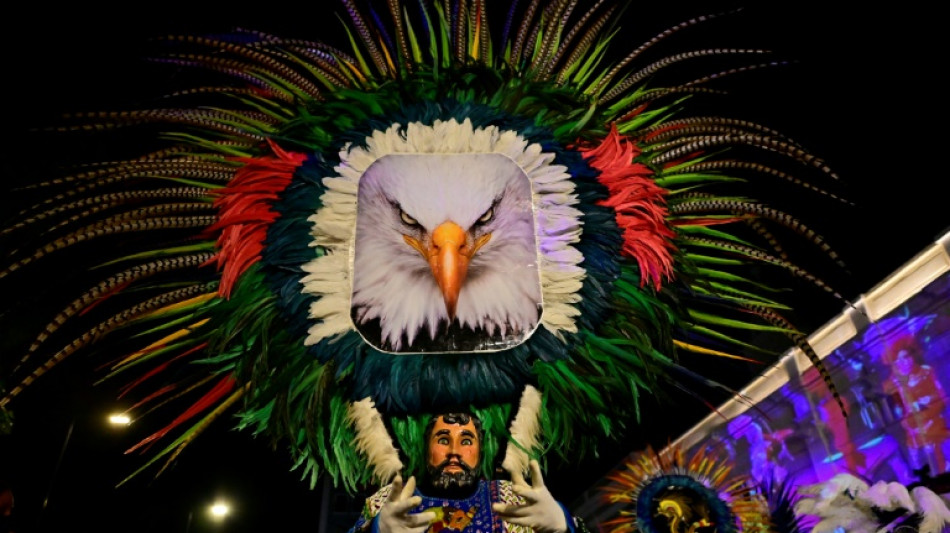
Mexican carnival mocks European colonizers / Photo: © AFP

 South African election results renew debate over identity-based voting

 South African voters report smoother local election but declining IEC trust

 Dolly Parton museum and Nashville hotel open after singer’s death

 George and Amal Clooney attend New York political-comedy reading

 British buyers pay substantial premiums for period-home appearance

 Thomas Markle released to house arrest after child-abuse-image charge

 Dawn of War 4 developers chose Adeptus Mechanicus for tactical variety

 Italy face unbeaten South Africa in Turin Nations Championship match

 ChatGPT interactive interface feature tested across six custom tools

 Freshways milk-price cut deepens pressure on UK dairy farms

 Labour and National remain virtually tied as New Zealand vote count advances

 The Good Daughter adapts Karin Slaughter thriller with Rose Byrne and Meghann Fahy

 Heavy-lift drone evacuates wounded Ukrainian soldier from frontline kill zone

 Morrison says West Brom recovered after pressure from successive derby losses

 Britain considers 2027 state visit for Ukraine’s Zelensky

 Arizona Democrats Secure Historic Trifecta with New Legislative Leadership

 Carney Welcomes U.S. Trade Reversal After Democratic Midterm Victory

 Armenian FM Discusses EU Accountability for Palestinian Rights in Madrid

 Trump and Vance Pursue Secret Diplomacy with Iran Amid Military Pressure

Wearing flamboyant costumes and masks imitating blue-eyed, bearded Europeans, carnival-goers in Mexico have turned mocking colonizers into an art form.
The colorful celebration stands out from hundreds of other carnivals in Latin America by rekindling the spirit of revenge against erstwhile invaders.
Each year, men in wooden masks playing the role of light-skinned Europeans dance through the streets of Tlaxcala, one of Mexico's smallest states, located 120 kilometers (75 miles) east of the capital Mexico City.
Many sport carefully-trimmed beards resembling those of Spanish conquistador Hernan Cortes, while others have mustaches.
Participants in the photogenic festivities recreate the dandy style of the people who crossed the Atlantic to the New World.
Women wear the flowing dresses and elaborate hats of European ladies centuries ago.
The aim is to "mock the invaders... especially their customs and habits, which for the people of Tlaxcala were very effeminate," tourist guide Eduardo Cuautle Xochitemotl said beneath a mural depicting local history.
The feather-topped masks, hand-embroidered clothes and European-style costumes are a celebration of the cultural collisions that have shaped the region.
The Tlaxcalans allied with Cortes to capture the Aztec capital Tenochtitlan -- today Mexico City -- in 1521.
While their collaboration assured them certain privileges, the Tlaxcalans still faced exclusion by powerful Spanish landowners.
"At the time when we were conquered, the big haciendas held huge parties with music and dance, which we, the indigenous people, could not enter," said dancer Carlos Gomez Vazquez.
Another target of the mockery is the French influence that took root in the late 19th century under general-turned-president Porfirio Diaz, whose legacy can be seen today in Mexico City's Parisian-style architecture.
And in modern-day Mexico, centuries-old foes are not the only subjects of ridicule.
"Nowadays the tradition is to mock today's politicians," Xochitemotl said.
pp-ce-st-dr/md
C.Meier--BTB