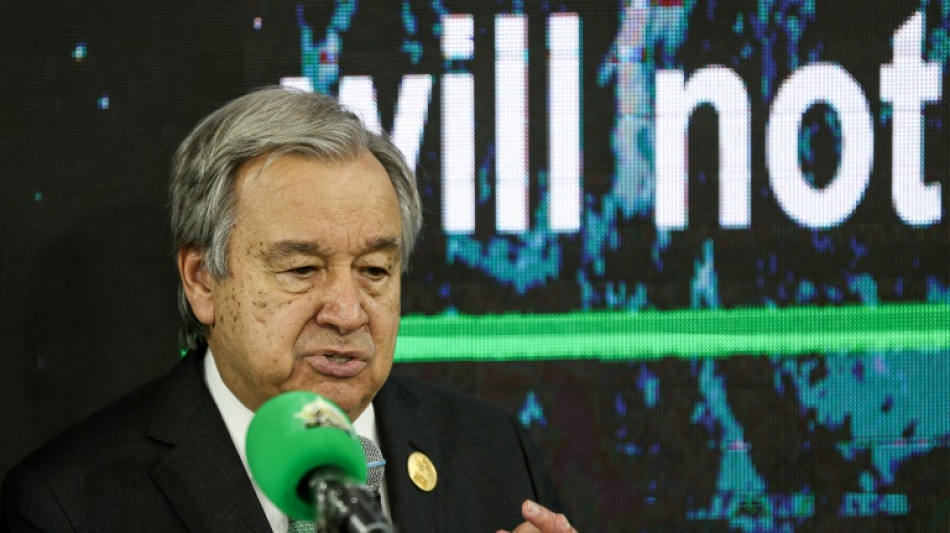
UN unveils global 'early warning' system for disasters at $3 billion / Photo: © AFP

 Messi v Salah in World Cup last-16 showdown

 Death toll from China storms rises to 15, hundreds injured

 Belgium boosted by Balogun furore: Tielemans

 Samsung expects 1,800% operating profit leap on AI boom

 Belgium thrash USA to end World Cup dream and set up Spain showdown

 France's Le Pen faces pivotal ruling in race for president

 NATO allies seek to win over Trump after Iran ire

 US leads international concern after China test-fires missile into Pacific

 Close to tears and on his own as Ronaldo's World Cup dream ends

 Argentina's gruelling World Cup schedule a concern for Scaloni

 Race to recover bodies ahead of Venezuela quake cleanup

 Egypt coach Hassan says Palestinian suffering 'a shame on the world'

 NBA Kings waive six-time All-Star forward DeRozan

 Greaves and Hope centuries usher West Indies towards safety

 'I celebrated in bed' -- Norway's Solbakken stays grounded after beating Brazil

 Canada chooses Germany's TKMS to build new fleet of submarines

 Mbappe condemns racist abuse by Paraguayan senator after World Cup clash

 FIFA chief forced to defend Balogun World Cup reprieve

 Antetokounmpo says goodbye to Milwaukee in video

 Fairytale Fery sinks Dimitrov to make Grand Slam history at Wimbledon

 Canadian Artemis II crew member to retire from space agency

 Prince Harry arrives in UK amid security spat

 'Agony' in Cuba amid third nationwide blackout in six months

 For Trump's World Cup, 'America First' collides with world's game

 England's World Cup campaign takes flight with Mexico win

The United Nations on Monday unveiled a five-year plan to build a global early warning system for deadly and costly extreme weather events amplified by climate change.
The price tag -- a relatively modest $3.1 billion, or less than 50 cents per person -- is a small price to pay for proven methods that can save thousands, if not millions, of lives, UN chief Antonio Guterres said at the COP27 climate summit in Egypt.
"I have called for every person on Earth to be protected by early warning systems within five years, with the priority to support the most vulnerable first," he said as world leaders gathered in the Red Sea resort of Sharm el-Sheikh for the 13-day talks.
Even as climate-enhanced extreme weather is multiplying, half the world's countries lack advanced early warning systems that can save lives.
Countries with inadequate infrastructure see, on average, eight times greater mortality from disasters than countries with strong measures in place, according to the UN.
Proper early warning systems for floods, droughts, heatwaves, cyclones or other disasters allow for planning that minimises adverse impacts.
And it works: the number of people affected by disasters has nearly doubled over the last two decades, but the number of people killed or missing has fallen by half.
When Cyclone Bhola hit what is present-day Bangladesh in 1970, it claimed hundreds of thousands of lives, prompting the country founded the following year to invest in weather forecasting technology, shelters and a network of volunteers along the coast.
A similarly strong Cyclone Amphan made landfall in 2020 in the same area, but left a death toll of just 26.
"Early warnings save lives and provide vast economic benefits," World Meteorological Organization chief Petteri Taalas said in a statement.
"Just 24 hours notice of an impending hazardous event can cut the ensuing damage by 30 percent."
The Global Commission on Adaptation found that spending just $800 million on such systems in developing countries would avoid losses of $3 billion to $16 billion per year.
Starting with science-based observation networks and forecasting technology, a complete early warning infrastructure also requires national and community-based response capabilities, along with ways to rapidly communicate information to a population.
F.Müller--BTB