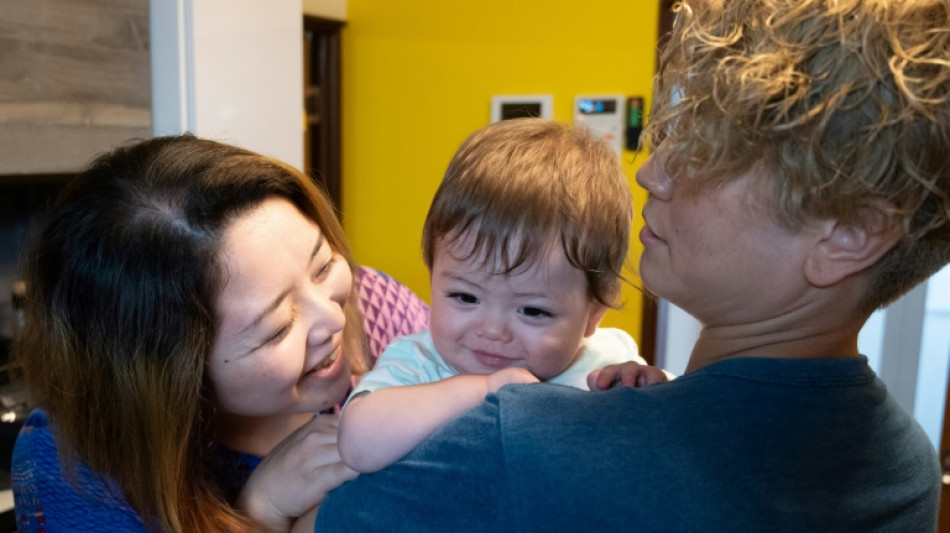
'Robbing women': Japan's sperm donation law spurs controversy / Photo: © AFP

 Stocks mixed tracking AI concerns, as oil rises on tanker attack

 Paris FC confirm Rosenior taking over as coach

 Thousands without power in US Pacific islands after super typhoon

 Prince Harry to discover outcome of UK tabloids case

 Messi v Salah in World Cup last-16 showdown

 Death toll from China storms rises to 15, hundreds injured

 Belgium boosted by Balogun furore: Tielemans

 Samsung expects 1,800% operating profit leap on AI boom

 Belgium thrash USA to end World Cup dream and set up Spain showdown

 France's Le Pen faces pivotal ruling in race for president

 NATO allies seek to win over Trump after Iran ire

 US leads international concern after China test-fires missile into Pacific

 Close to tears and on his own as Ronaldo's World Cup dream ends

 Argentina's gruelling World Cup schedule a concern for Scaloni

 Race to recover bodies ahead of Venezuela quake cleanup

 Egypt coach Hassan says Palestinian suffering 'a shame on the world'

 NBA Kings waive six-time All-Star forward DeRozan

 Greaves and Hope centuries usher West Indies towards safety

 'I celebrated in bed' -- Norway's Solbakken stays grounded after beating Brazil

 Canada chooses Germany's TKMS to build new fleet of submarines

 Mbappe condemns racist abuse by Paraguayan senator after World Cup clash

 FIFA chief forced to defend Balogun World Cup reprieve

 Antetokounmpo says goodbye to Milwaukee in video

 Fairytale Fery sinks Dimitrov to make Grand Slam history at Wimbledon

 Canadian Artemis II crew member to retire from space agency

Satoko Nagamura and her girlfriend conceived their son with donated sperm, but new legislation in Japan could effectively outlaw the procedure for lesbian couples and single women.
For decades, anonymous sperm donation has existed in a legal grey zone in Japan, with no law explicitly prohibiting it, but no framework to govern it either.
Legislation expected to be presented this year would regulate the procedure, including protecting the rights of children to know their biological parents and capping recipients from a single donor.
But a draft seen by AFP shows the law would only authorise the process for legally married couples, mostly those affected by male infertility. Japan does not recognise same-sex marriage, so lesbian couples and single women would be excluded.
To Nagamura, the draft is "tantamount to robbing women -- whether same-sex couples or single -- of their reproductive rights, and their desire to give birth to and raise children".
For nearly two decades, the 39-year-old dreamed of being a mother and the chance to "give birth with my body".
She and her partner Mamiko Moda, 42, initially considered overseas sperm banks, before turning to a male friend, encouraged by his willingness to have a relationship with the future child.
They are now the proud parents of a 10-month-old son, who smiles freely as his parents spoonfeed him with encouraging exclamations of "well done", as the family's two dogs look on jealously.
Institutions that offer sperm donation and insemination generally follow the guidelines of the Japan Society of Obstetrics and Gynaecology (JSOG) -- which serve as the basis for the new legislation restricting the process to married couples.
JSOG's guidelines are non-binding, but already carry enough weight that only a handful of doctors defy them to accommodate lesbians and single women.
If the law is enacted, "the few hospitals that have accepted us will no longer be able to do so", said Nagamura.
"There is a big difference between just going against the guidelines and doing something illegal", added Moda.
The couple also fears the new legislation could mean their child, conceived through artificial insemination using a sperm donor, could be stigmatised.
"Even though the way we achieved our pregnancy was not illegal at the time, the impression that we did something wrong, that this kid is somehow 'illegal', could emerge if that's how the law sees it," Moda said.
- 'Double-edged sword' -
Kozo Akino, a ruling-coalition lawmaker involved in drafting the legislation, argues that children's rights are most easily protected by "legally married parents with joint custody".
"Assisted reproductive technology should not be pursued at the expense of the well-being of children," he told AFP.
And some doctors think the law could help make the unregulated treatment more socially accepted, despite being limited to heterosexual married couples.
"My hope is that with the law, our treatment will be seen as more legitimate and become mainstream," said Mamoru Tanaka, an obstetrics professor at Tokyo's Keio University Hospital.
Keio is thought to have been the first medical institution in Japan to perform donor insemination in 1948, but it is no longer accepting new patients because of a donor shortage that followed an internal policy shift.
Since 2017, it has warned donors that their anonymity could be waived if children conceived from their sperm file legal suits. The resulting shortage of applicants means it carried out just 481 procedures for existing patients in 2019, down from 1,952 in 2016.
Patients would "hopefully be able to benefit from (a legal framework), but it's easier said than done", Tanaka said.
"There is a possibility that more people will be pushed underground, and in that sense, it's a double-edged sword," he told AFP.
- 'Whatever it takes' -
Already, some women and couples turn to unvetted sperm donors to avoid the complexities and restrictions of the existing system.
A casual Twitter search turns up hundreds of accounts touting the handsomeness, college degrees and athletic talent of would-be donors, who typically offer recipients either cups of semen for self-insemination, or impregnation via intercourse.
Many do not expect payment beyond transport costs, which has helped fuel debate over their motives, including claims they are simply after sex.
One man advertising his services online told AFP he considered it like donating blood.
"I happen to have a healthy body, so why not put it to good use?" said the 34-year-old freelance illustrator, declining to be named.
The man's wife, a 32-year-old doctor, told AFP she supported her husband's donations, in part because as a bisexual person she wants to help others in the LGBTQ community conceive.
But social media sperm donation raises health and safety issues in terms of verifying donor profiles.
And Nagamura fears that these riskier donations will only become more common if legislation excludes single women and lesbians.
"There will be those who do whatever it takes to have children," she said.
"It's not that easy, giving up on childbirth."
M.Furrer--BTB