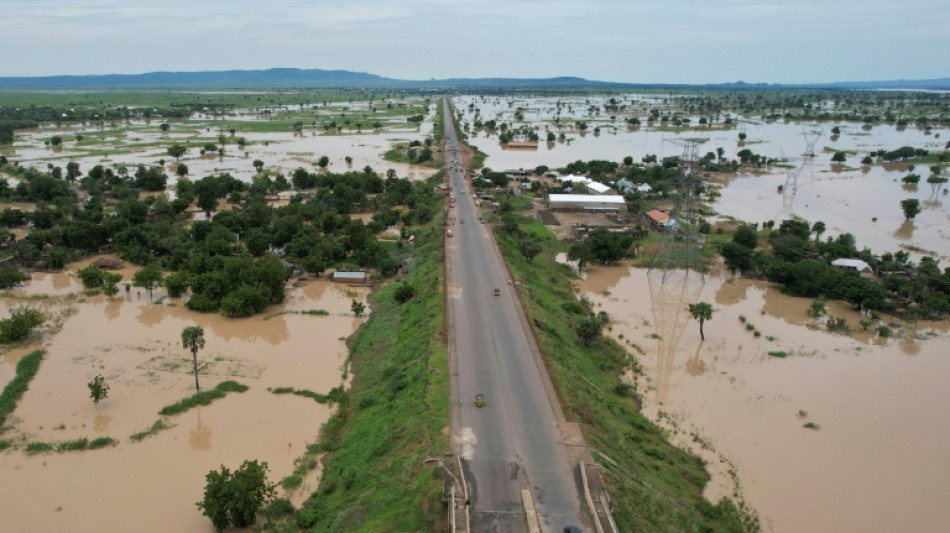
Food crisis looms in Nigeria as floods destroy crops / Photo: © AFP

 Stocks mixed tracking AI concerns, as oil rises on tanker attack

 Paris FC confirm Rosenior taking over as coach

 Thousands without power in US Pacific islands after super typhoon

 Prince Harry to discover outcome of UK tabloids case

 Messi v Salah in World Cup last-16 showdown

 Death toll from China storms rises to 15, hundreds injured

 Belgium boosted by Balogun furore: Tielemans

 Samsung expects 1,800% operating profit leap on AI boom

 Belgium thrash USA to end World Cup dream and set up Spain showdown

 France's Le Pen faces pivotal ruling in race for president

 NATO allies seek to win over Trump after Iran ire

 US leads international concern after China test-fires missile into Pacific

 Close to tears and on his own as Ronaldo's World Cup dream ends

 Argentina's gruelling World Cup schedule a concern for Scaloni

 Race to recover bodies ahead of Venezuela quake cleanup

 Egypt coach Hassan says Palestinian suffering 'a shame on the world'

 NBA Kings waive six-time All-Star forward DeRozan

 Greaves and Hope centuries usher West Indies towards safety

 'I celebrated in bed' -- Norway's Solbakken stays grounded after beating Brazil

 Canada chooses Germany's TKMS to build new fleet of submarines

 Mbappe condemns racist abuse by Paraguayan senator after World Cup clash

 FIFA chief forced to defend Balogun World Cup reprieve

 Antetokounmpo says goodbye to Milwaukee in video

 Fairytale Fery sinks Dimitrov to make Grand Slam history at Wimbledon

 Canadian Artemis II crew member to retire from space agency

Usman Musa had spent more than $1,300 on his 10-hectare rice farm in Nigeria's Kogi state, now submerged by the country's worst floods in a decade.
In a wooden canoe, the 38-year-old father of four paddled his way through the murky waters, passing by his and relatives' houses, the local hospital and school.
Only the roofs were visible.
Across Africa's most populous country, communities and crops of sorghum, maize, rice and vegetables are under water, with farmers and aid workers warning of a possible food crisis.
The country, home to more than 200 million people, was already grappling with high inflation and worrying levels of food insecurity.
Now the situation will worsen, with nearly 110,000 hectares (272,000 acres) of farmland completely destroyed by flooding since August according to the latest government figures.
"Flooding is still ongoing but we can safely say that between 60 to 75 percent of the yield we expected is going to be lost," Kabir Ibrahim, president of All Farmers Association of Nigeria, told AFP this week.
"It's monumental. So many people are crying."
More than 600 people have died and 1.3 million others were forced to leave their homes according to the latest figures given by the Minister of Humanitarian Affairs Sadiya Umar Farouq.
- Risk of hunger -
Floods are not uncommon in Nigeria during the rainy season from May to November but they have been extreme this year.
Officials and residents blame climate change but also poor planning and the release of excessive water from dams, a process that is meant to ease pressure.
"If you don't open the water through the spillways, then dams will break," said Ibrahim, and then "it would be like Pakistan. All of Nigeria would be under water like Pakistan."
Farmers were warned ahead of time but it wasn't enough.
"We used the predictions and avoided planting along flood-prone areas," said Ibrahim, "but now you can see that the devastation is all over."
As a result, Ibrahim, whose organisation represents 20 million farmers, believes "there will be more hardship towards the end of the year and beginning of next year."
Food inflation year-on-year was already at 23.3 percent last month, in part because of ripple effects on the import-dependent country from the coronavirus pandemic and the Russia-Ukraine war.
Rampant insecurity with gunmen repeatedly attacking rural communities also forced many farmers to abandon their fields.
The World Food Programme and the UN's Food and Agriculture Organization (FAO) said last month that Nigeria was among six countries facing a high risk of catastrophic levels of hunger, even before the floods.
Now, "the impact of the floods on food production is a real threat to the country and could lead to a major food crisis," said Hussaini Abdu, Nigeria director of the CARE charity.
The FAO representative in Nigeria, Fred Kafeero, said he was "deeply concerned" as food supplies were expected to be low "due to anticipated reduction in household production".
The aid official said the floods were also affecting livestock and had increased the risk of vector-borne disease outbreaks such as cholera.
- Preventive measures -
The floods have not just destroyed farmlands, they have also prevented the transport of trucks and damaged roads and bridges, further pressuring the food supply.
"We were hoping inflation would get a break with the (upcoming) harvest but now with the floods, it puts a big question mark on our forecast on inflation," said Ari Aisen, the IMF's Resident Representative for Nigeria.
"It looks very serious but it's difficult to judge at this point," he told AFP, adding that while it was early to assess, "there is an upside risk for inflation, for food price increases."
The last massive floods in Nigeria in 2012 cost nearly $17 billion, according to the World Bank.
While immediate assistance is now needed, the International Monetary Fund said it would be less costly to invest in preventive measures and policies.
Countries should invest to "help populations adapt to these types (of) events rather than using resources after the fact," said Aisen.
But in the meantime, the government said it was ramping up support to affected communities.
President Muhammadu Buhari approved the release of 12,000 metric tons of assorted grains from a national strategic reserve stock.
But farmers are not sure it will be enough.
Buhari restricted the import of rice in 2015, to increase local production and self-sufficiency.
For Ibrahim, resuming those imports "should not be ruled out, if the situation becomes dire".
Weather forecast agencies have warned there could be more floods until the end of November.
Y.Bouchard--BTB