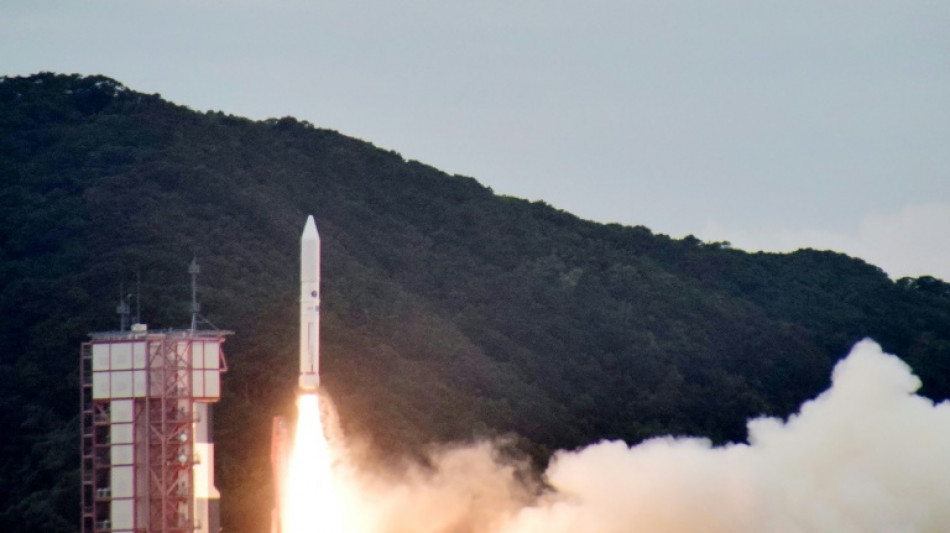
Japanese rocket launch fails in blow for space agency / Photo: © JIJI Press/AFP

 Sinner eyes Djokovic showdown after moving into Wimbledon semis

 Sinner conquers heat, sets up potential Djokovic clash at Wimbledon

 'Veteran' Gauff completes Slam semi-final set with Wimbledon fightback

 UK hard-right leader resigns as MP to force snap vote in finances row

 US trade gap in May widens to biggest in over a year

 France's Le Pen cleared to run for president but with ankle tag

 This year's El Nino likely to become record-breaker: top expert

 Kenya, Tanzania shut down protest anniversaries

 Women pushed back to Afghanistan pin hopes on rare private sector jobs

 Bomb attacks wound 18 in Damascus as Macron visits

 Cuba slowly gets power back after third nationwide blackout in six months
 NATO summit showcases arms deals in push to win over Trump

 Seoul dives on tough day for Asia as Samsung fails to ease tech woes

 Democrats push key US Senate candidate to quit over sex assault claim

 As South Korean Buddhism woos Gen Z, how hip is too hip?

 'Disappointed' Pochettino says Balogun row no excuse for US World Cup exit
 Seoul dives on mixed day in Asia as Samsung fails to ease tech woes

 Belgium dump US out of World Cup after Balogun row

 How US is using cash and threats to dump migrants in Africa

 Democrat in key US Senate race denies sex assault claim

 Samsung expects 1,800% leap in quarterly operating profit on AI boom

 Russian strikes kill at least 26 in Kyiv region on eve of NATO summit

 Ronaldo 'won't make rash decisions' following last World Cup game

 Paraguay govt slams lawmaker for racially abusing France's Mbappe

 US embraces Balogun World Cup reprieve as world seethes

The launch of a Japanese rocket taking satellites into orbit to demonstrate new technologies failed after blast-off on Wednesday because of a positioning problem, the country's space agency said.
It was Japan's first failed launch in nearly two decades, and the only one for an Epsilon rocket, a solid-fuel model that has flown five successful missions since its 2013 debut.
The unmanned craft took off from Uchinoura Space Center in the southern Kagoshima region, with its lift-off livestreamed by the Japan Aerospace Exploration Agency (JAXA).
But a self-destruct signal was sent to the rocket less than 10 minutes later because of "positioning abnormalities", said Yasuhiro Funo of JAXA, who led the project.
The livestream was halted and presenters wearing hard-hats told viewers there had been a problem with the launch.
Funo explained at a press conference that a technical issue was detected before the third -- and final -- stage of the launch, just as the last powerful booster was about to be ignited.
"We ordered the rocket's destruction because if we cannot send it into the orbit that we planned, we don't know where it will go," he said, leading to safety concerns about where the machinery could fall.
After the mission was aborted, the rocket's parts were assumed to have landed in the sea east of the Philippines, he added.
Japan's last failed space launch was of a pair of spy satellites to monitor North Korea in 2003, and the only other time JAXA has sent a destroy order to a rocket was in 1999.
- 'Pulsed-plasma thruster' -
The 26-metre (85-foot) Epsilon-6 rocket had been carrying a box-shaped satellite due to orbit Earth for at least a year to carry out experiments, as well as eight micro-satellites.
Researchers and private companies had engineered new technologies to be tried out in space as part of the agency's third Innovative Satellite Technology Demonstration programme.
Their gadgetry ranged from a "pulsed-plasma thruster" to an experiment in "harvesting energy with (a) lightweight integrated origami structure", according to a JAXA fact sheet.
JAXA describes Epsilon as "a solid-fuel rocket designed to lower the threshold to space... and usher in an age in which everyone can make active use of space".
It is smaller than the country's previous liquid-fuelled model, and a successor to the solid-fuel M-5 rocket that was retired in 2006 due to its high cost.
JAXA president Hiroshi Yamakawa apologised for Wednesday's failure, saying the agency was "terribly sorry that we couldn't meet the Japanese people's expectations".
"We will pour efforts into finding out the cause and will take counter-measures" to prevent a recurrence, Yamakawa said.
Japan's space programme is one of the world's largest, and last week JAXA astronaut Koichi Wakata flew to the International Space Station as part of the Crew-5 mission.
JAXA has also been in the spotlight after its mission to the asteroid Ryugu by a space probe named Hayabusa-2, which collected pristine material from the celestial body that is now being analysed for clues to the origins of life.
I.Meyer--BTB