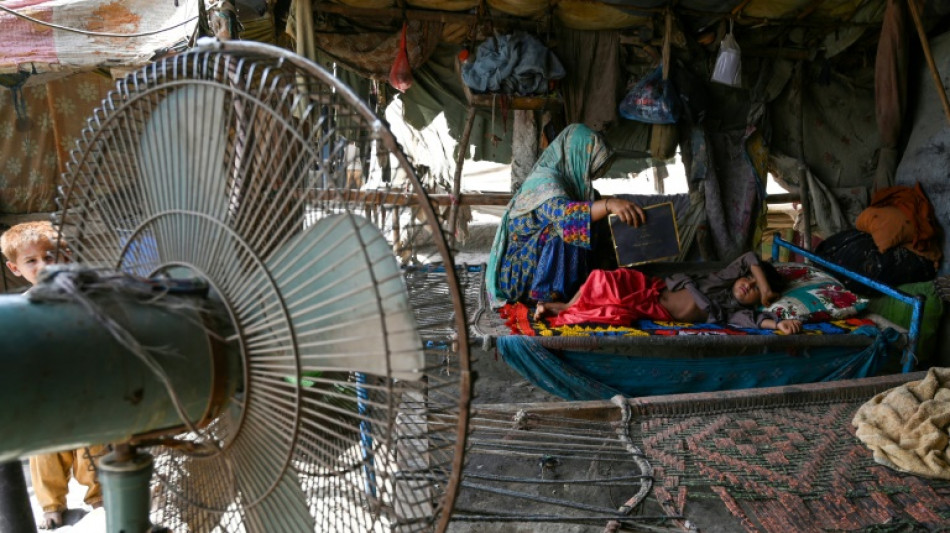
Heatwaves will make regions uninhabitable within decades: UN, Red Cross / Photo: © AFP

 Sinner eyes Djokovic showdown after moving into Wimbledon semis

 Sinner conquers heat, sets up potential Djokovic clash at Wimbledon

 'Veteran' Gauff completes Slam semi-final set with Wimbledon fightback

 UK hard-right leader resigns as MP to force snap vote in finances row

 US trade gap in May widens to biggest in over a year

 France's Le Pen cleared to run for president but with ankle tag

 This year's El Nino likely to become record-breaker: top expert

 Kenya, Tanzania shut down protest anniversaries

 Women pushed back to Afghanistan pin hopes on rare private sector jobs

 Bomb attacks wound 18 in Damascus as Macron visits

 Cuba slowly gets power back after third nationwide blackout in six months
 NATO summit showcases arms deals in push to win over Trump

 Seoul dives on tough day for Asia as Samsung fails to ease tech woes

 Democrats push key US Senate candidate to quit over sex assault claim
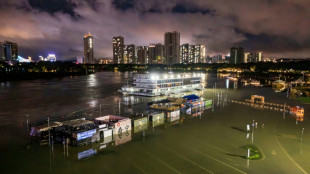
 As South Korean Buddhism woos Gen Z, how hip is too hip?

 'Disappointed' Pochettino says Balogun row no excuse for US World Cup exit

 Seoul dives on mixed day in Asia as Samsung fails to ease tech woes

 Belgium dump US out of World Cup after Balogun row

 How US is using cash and threats to dump migrants in Africa

 Democrat in key US Senate race denies sex assault claim

 Samsung expects 1,800% leap in quarterly operating profit on AI boom

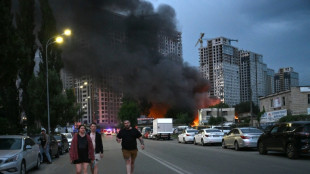 Russian strikes kill at least 26 in Kyiv region on eve of NATO summit

 Ronaldo 'won't make rash decisions' following last World Cup game
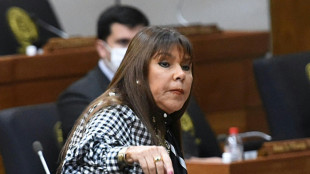 Paraguay govt slams lawmaker for racially abusing France's Mbappe

 US embraces Balogun World Cup reprieve as world seethes

Heatwaves will become so extreme in certain regions of the world within decades that human life there will be unsustainable, the United Nations and the Red Cross said Monday.
Heatwaves are predicted to "exceed human physiological and social limits" in the Sahel, the Horn of Africa and south and southwest Asia, with extreme events triggering "large-scale suffering and loss of life", the organisations said.
Heatwave catastrophes this year in countries like Somalia and Pakistan foreshadow a future with deadlier, more frequent, and more intense heat-related humanitarian emergencies, they warned in a joint report.
The UN's Office for the Coordination of Humanitarian Affairs (OCHA) and the International Federation of Red Cross and Red Crescent Societies (IFRC) released the report in advance of next month's COP27 climate change summit in Egypt.
"We don't want to dramatise it, but clearly the data shows that it does lead towards a very bleak future," said IFRC secretary-general Jagan Chapagain.
They said aggressive steps needed to be taken immediately to avert potentially recurrent heat disasters, listing steps that could mitigate the worst effects of extreme heat.
- Limits of survival -
"There are clear limits beyond which people exposed to extreme heat and humidity cannot survive," the report said.
"There are also likely to be levels of extreme heat beyond which societies may find it practically impossible to deliver effective adaptation for all.
"On current trajectories, heatwaves could meet and exceed these physiological and social limits in the coming decades, including in regions such as the Sahel and south and southwest Asia."
It warned that the impact of this would be "large-scale suffering and loss of life, population movements and further entrenched inequality."
The report said extreme heat was a "silent killer", claiming thousands of lives each year as the deadliest weather-related hazard -- and the dangers were set to grow at an "alarming rate" due to climate change.
According to a study cited by the report, the number of poor people living in extreme heat conditions in urban areas will jump by 700 percent by 2050, particularly in west Africa and southeast Asia.
"Projected future death rates from extreme heat are staggeringly high -- comparable in magnitude by the end of the century to all cancers or all infectious diseases -- and staggeringly unequal," the report said.
Agricultural workers, children, the elderly and pregnant and breastfeeding women are at higher risk of illness and death, the report claimed.
"As the climate crisis goes unchecked, extreme weather events, such as heatwaves and floods, are hitting the most vulnerable people the hardest," said UN humanitarian chief Martin Griffiths.
"The humanitarian system is not equipped to handle crisis of this scale on our own."
- 'Previously unimaginable' -
Chapagain urged countries at COP27 to invest in climate adaptation and mitigation in the regions most at risk.
OCHA and the IFRC suggested five main steps to help combat the impact of extreme heatwaves, including providing early information to help people and authorities react in time, and finding new ways of financing local-level action.
They also included humanitarian organisations testing more "thermally-appropriate" emergency shelter and "cooling centres", while getting communities to alter their development planning to take account of likely extreme heat impacts.
OCHA and the IFRC said there were limits to extreme heat adaptation measures.
Some, such as increasing energy-intensive air conditioning, are costly, environmentally unsustainable and contribute themselves to climate change.
If emissions of the greenhouse gases which cause climate change are not aggressively reduced, the world will face "previously unimaginable levels of extreme heat".
O.Bulka--BTB