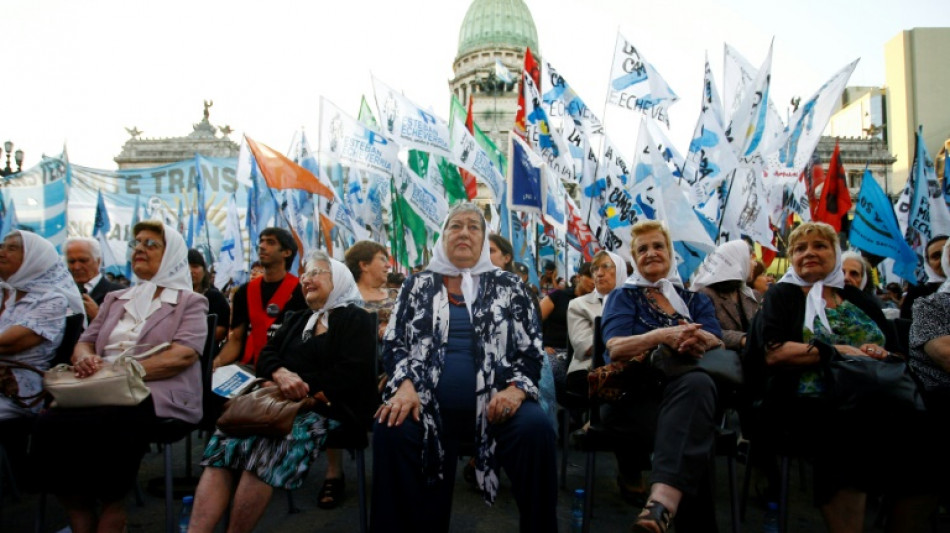
Decades on, search continues for Argentina's 'stolen' children / Photo: © AFP/File

 Sinner eyes Djokovic showdown after moving into Wimbledon semis
 Sinner conquers heat, sets up potential Djokovic clash at Wimbledon

 'Veteran' Gauff completes Slam semi-final set with Wimbledon fightback
 UK hard-right leader resigns as MP to force snap vote in finances row

 US trade gap in May widens to biggest in over a year

 France's Le Pen cleared to run for president but with ankle tag

 This year's El Nino likely to become record-breaker: top expert

 Kenya, Tanzania shut down protest anniversaries
 Women pushed back to Afghanistan pin hopes on rare private sector jobs

 Bomb attacks wound 18 in Damascus as Macron visits

 Cuba slowly gets power back after third nationwide blackout in six months
 NATO summit showcases arms deals in push to win over Trump

 Seoul dives on tough day for Asia as Samsung fails to ease tech woes

 Democrats push key US Senate candidate to quit over sex assault claim

 As South Korean Buddhism woos Gen Z, how hip is too hip?

 'Disappointed' Pochettino says Balogun row no excuse for US World Cup exit

 Seoul dives on mixed day in Asia as Samsung fails to ease tech woes

 Belgium dump US out of World Cup after Balogun row

 How US is using cash and threats to dump migrants in Africa

 Democrat in key US Senate race denies sex assault claim

 Samsung expects 1,800% leap in quarterly operating profit on AI boom
 Russian strikes kill at least 26 in Kyiv region on eve of NATO summit

 Ronaldo 'won't make rash decisions' following last World Cup game
 Paraguay govt slams lawmaker for racially abusing France's Mbappe

 US embraces Balogun World Cup reprieve as world seethes

The Grandmothers of Plaza de Mayo are getting old. Every day the hopes of finding their grandchildren, who were stolen and given up for adoption under Argentina's dictatorship, are fading.
As many as 500 children were taken from their imprisoned mothers, most of whom then disappeared under the country's brutal 1976-1983 military rule.
Most of the children were gifted to people close to the dictatorship, keen to have them raised as regime loyalists.
Only about 130 have so far been found, and the search for the others -- now adults in their 40s and 50s -- continues.
The Grandmothers of Plaza de Mayo is an organization founded in 1977 by women trying to find their arrested daughters -- and the babies they bore in captivity.
These "abuelas" take their name from the Plaza de Mayo square in Buenos Aires where brave women held protests to demand information on the whereabouts of their loved ones. They did so in vain.
As the original grandmothers get older, the organization has since been populated by a younger generation of researchers and councillors.
The rights body holds regular public meetings in the hopes of reaching people who may have questions about who they are -- questions that can be difficult to confront -- and convincing them to come forward.
Those who successfully go through a verification process can have their stolen identities "restituted."
But it is an increasingly difficult endeavor. As time goes on, those who think they may be the children of disappeared women are ever less likely to come forward.
"They come to us in various stages of doubt, some have carried the burden in silence for 20 years, sometimes more, without talking to anyone -- not even their spouse," Laura Rodriguez, coordinator of the Grandmothers' identity project told AFP.
Doubts can be triggered by a lack of physical resemblance to their parents, the absence of photos of their mothers while pregnant, or holes in the family history.
Some make several appointments for a consultation, but never show up.
Since June 2019, there have been no new restitutions, due in large part to the coronavirus pandemic putting the brakes on the Grandmothers' activities -- research and interviews with potential victims.
Six of the original grandmothers died during the pandemic.
- 'Leap into the unknown' -
At Moron, some 40 kilometers (25 miles) from Buenos Aires, six outreach meetings are planned by the Grandmothers and Argentina's human rights ombudsman for the coming weeks.
But taking that first step is not easy.
"It is a leap into the unknown," said Guillermo Amarilla Molfino, once known as "Grandson No 98" who said it took him years to seek help and then go through the restitution process.
He was reunited with his brothers, and has acted as an adviser to the Grandmothers outreach team.
"There are many fears, there is guilt, this guilt that makes us stay quiet: 'Why do I doubt my parents, why do I betray those who gave me food, a roof over my head?'" he remembers of his own experience.
"Silence can become an ally with which one lives," added Molfino. And finally accepting you are not who you thought you were can "feel like handing over your life" to someone else.
It is a difficult task for the researchers too, said Luciano Lahiteau, one of the Grandmothers team.
One needs to carefully balance an empathetic shoulder, he explained, with the "duty, not necessarily pleasant, of... picking out the reliable information from what a person tells us."
- Lottery, or loss -
Lahiteau and other researchers take the volunteers' stories and documentation, when available, and check these against civil and hospital registers, and evidence gathered from military trials.
If evidence for a match turns up, DNA can be cross-checked with a data bank holding genetic information on many, though not all, of the families searching for a missing grandchild.
When a match is found, "it is like winning the lottery!" said Rodgriguez.
But more often than not, hopes are dashed.
"We receive a lot of people who are not children of disappeared" women, said Rodriguez.
Yet, even for those who go through the process in vain, "it does a lot for identity," said Lahiteau.
"It makes it possible to recognize: 'OK, I am someone who has doubts about my identity; I have the right to try and find out where I come from," he explained.
"Really, every person comes out of the process better than they entered," added Rodriguez.
T.Bondarenko--BTB