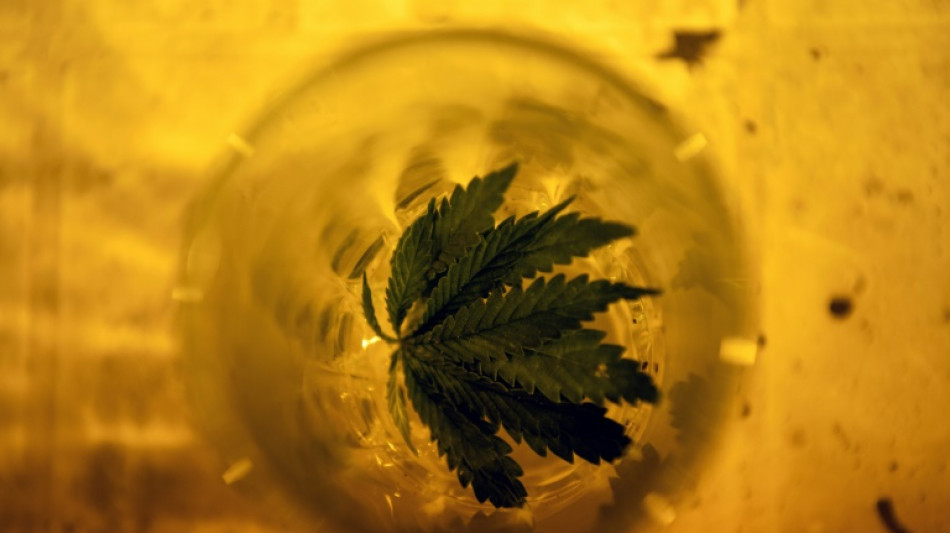
Legal marijuana, but Uruguayans still prefer black market / Photo: © AFP

 Cavs agree on Mitchell deal as LeBron watches: report

 Turkish delight: Trump revels in Erdogan's lavish welcome
 Nigeria's Dangote confirms Lamu, Kenya for east Africa mega-refinery

 Study points to likely route for Hannibal's legendary Alpine crossing

 Australia's Mooney back at No 1 in batting rankings after World Cup heroics

 Traeen takes yellow, Pedersen wins Tour de France 4th stage

 UK hard-right leader Farage resigns as MP to force snap vote in finances row
 Harry Kane calls for calm after England's World Cup epic against Mexico

 Beleaguered Prince Harry loses lawsuit against UK tabloid
 Sinner eyes Djokovic showdown after moving into Wimbledon semis

 Sinner conquers heat, sets up potential Djokovic clash at Wimbledon

 'Veteran' Gauff completes Slam semi-final set with Wimbledon fightback
 UK hard-right leader resigns as MP to force snap vote in finances row

 US trade gap in May widens to biggest in over a year

 France's Le Pen cleared to run for president but with ankle tag
 This year's El Nino likely to become record-breaker: top expert
 Kenya, Tanzania shut down protest anniversaries

 Women pushed back to Afghanistan pin hopes on rare private sector jobs

 Bomb attacks wound 18 in Damascus as Macron visits

 Cuba slowly gets power back after third nationwide blackout in six months
 NATO summit showcases arms deals in push to win over Trump

 Seoul dives on tough day for Asia as Samsung fails to ease tech woes

 Democrats push key US Senate candidate to quit over sex assault claim
 As South Korean Buddhism woos Gen Z, how hip is too hip?

 'Disappointed' Pochettino says Balogun row no excuse for US World Cup exit

Uruguay was a pioneer in the legalization of recreational cannabis use, a move that helped to push many drug traffickers out of the domestic market.
But a bland and insufficient state supply has meant most consumers still prefer the diversity of the black market.
In 2013, Uruguay became the first country in the world to legalize recreational marijuana use -- which came into effect four years later -- even permitting its sale in pharmacies.
There are three legal ways for registered users to get hold of marijuana: purchasing it at pharmacies, through home growing for personal use, and by belonging to an official cannabis-producing club.
The most sought after legal method is membership of one of the 249 consumer clubs, which offer a greater variety to their 7,166 members than pharmacies do.
But many clubs have long waiting lists to join as they are limited by law to between 15 and 45 members.
Pulla, the treasurer and technical manager of a cannabis club in Montevideo -- who uses a nickname to avoid falling foul of the ban on promoting cannabis use -- explained that the waiting list "is an indicator that demand is not satisfied."
"Many more people want to access the legal market who still cannot," he said.
There are just over 14,000 registered home growers and another 49,600 people are registered to purchase marijuana at one of the country's 28 approved pharmacies at around $10 for five grams -- below the black market rate.
According to a study by the local IRCCA institute that regulates cannabis, only 27 percent of Uruguayan consumers buy their drugs through approved channels, a figure that reaches 39 percent when taking into account sharing with friends.
- 'Main objectives met' -
Joaquin, a cannabis user who purchases on the black market and goes by an alias, explained that one problem with the legal supply is the need to make an appointment at the pharmacy.
The black market is quicker and simpler. You "have a contact, talk to him and in the day, or the next day, coordinate and buy," he said.
Buying on the black market does not necessarily mean getting involved with dangerous drug traffickers, though.
Organized drug traffickers selling "Paraguayans", a cheaper quality marijuana imported from nearby Paraguay, represent just 30 percent of the illegal market, says Marcos Baudean, a professor at ORT University and researcher at the Monitor Cannabis project.
"There are many more domestic growers who are simply not registered" but have already overtaken trafficking networks in the sale of cannabis.
In that respect, "the main objective has been met: people can consume cannabis without needing to be linked with criminal organizations," said Daniel Radio, secretary general of the National Drug Board.
The perception of the illegal market has also changed.
Agus, 28 and using an alias, said she originally registered to buy cannabis from pharmacies but now acquires it on the black market while growing her own plants despite not being registered.
"I don't see it as the black market," she said. "It has good prices for what is sold and you don't feel like you're making use of drug trafficking."
There is "a friend or an acquaintance who passes you a contact from someone who has flowers and sells them."
Some people simply prefer to avoid registering, even though the information is used only for the study of consumption.
- Cannabis tourism 'potential' -
"The regulation of cannabis has been more effective than repression in terms of the blow to drug trafficking," explained Mercedes Ponce de Leon, director of the Cannabis Business Hub, a platform charged with developing the drug's ecosystem in the country.
However, Radio acknowledges that the black market preference of some users demonstrates limits to the current system.
Radio said users tend to be after a higher percentage of THC -- tetrahydrocannabinol, the main psychoactive substance in the drug, which is limited to 10 percent in the pharmacy product -- or more variety such as variants that produce different psychoactive effects.
"That conspires against the effectiveness of the system," said Radio.
The government now plans to increase the THC percentage and offer greater variety in pharmacies by the end of the year to attract more recreational consumers to the formal market.
Legalization, introduced by leftist guerrilla-turned president Jose Mujica, in power from 2010-15, created an industry of medicinal cannabis exports that have brought more than $20 million to Uruguay's economy since 2019.
Uruguay sells mainly to the United States, Switzerland, Germany, Portugal, Israel, Argentina and Brazil.
Although current center-right President Luis Lacalle Pou insists the legalization move was a mistake, the left-wing opposition wants Uruguay to go even further.
Currently reserved for residents, they want the market to be opened up to tourists.
"It's a simple formula: if tourism increases, spending increases, employment increases and investments increase. Models like that in California demonstrate the potential" for cannabis tourism, said Eduardo Antonini, an opposition politician and vice-president of the tourism commission in congress.
Other than Uruguay, 15 American states have legalized recreational marijuana use, as well as Canada.
J.Bergmann--BTB