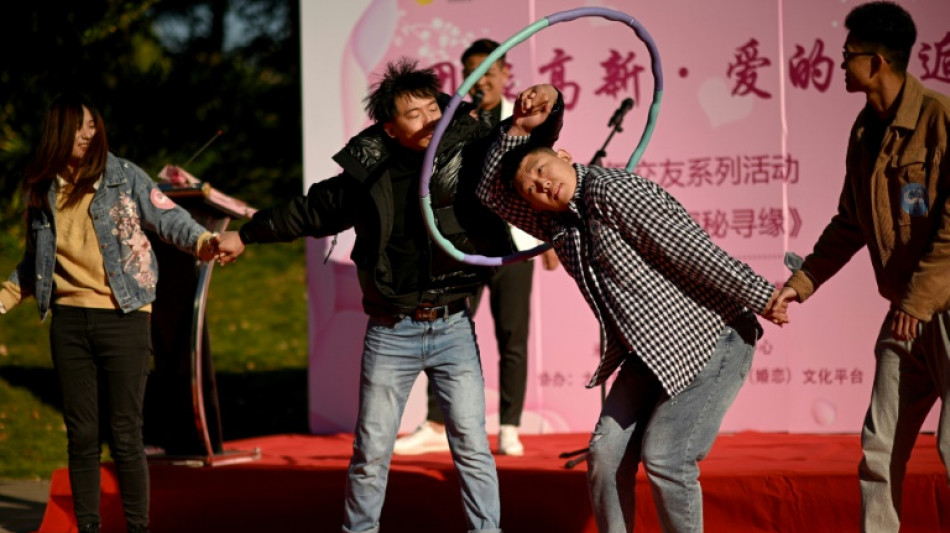
Can't find love? China's party cadres lend a hand / Photo: ©

 South Korea economy grows three times faster than expected in Q3

 Ballon d'Or: Harry Kane's crowning moment

 Harry Kane wins men's Ballon d'Or

 Lula win rattles Brazil markets over spending spree fears

 De la Fuente wins men's Ballon d'Or coach of year

 Trump slams 'rigged' Brazil election after ally loses to leftist Lula

 Nadal returns for Vegas hardcourt event

 Fainga'anuku named as loose forward for All Blacks northern tour

 Anthropic points to AI dangers, soaring sales in IPO filing

 Sinner to play rescheduled Saudi Six Kings in December

 Brazilian lawmaker Andre Janones, Lula's social media 'general'

 Swiss Ebola patient repatriated from Nigeria

 Nations far from a deal as UN nature talks enter final stretch

 Brazil markets battered, tech in focus elsewhere

 French court adjourns trial over 2020 death of delivery driver

 Serbian student movement eyes power after election triumph

 Machado ready to meet Venezuela leader after shock return

 Lula celebrates election win as Brazil markets tumble

 France's Macron accuses social media of sowing discord ahead of election

 Anthropic unveils IPO filing showing soaring sales and AI risks

 US singer Chris Brown avoids jail over London nightclub brawl

 US singer Chris Brown avoids jail over UK nightclub brawl

 Man Utd crisis deepens as Carrick faces axe

 Serbian student movement eyes power after resounding snap poll victory
 Eala breezes past world number 411 in Tokyo opener

Zhang Shaoge wants to get married, but after struggling to meet the right woman through friends and work -- he has put his heart in the hands of China's Communist Party.
As concerns grow over the nation's falling birth and marriage rates, and the knock-on effect of economic stagnation and an ageing workforce, local officials from the CCP's youth branch are increasingly taking on the role of matchmakers.
Some are organising more events and introductions for singles struggling to find love.
"It's about time to date and get married at this age. There isn't anyone suitable around me at the moment, so I wanted to expand my social circle," 30-year-old Zhang says of his decision to attend an officially-organised event.
Marriage rates have slumped across the nation. 8.14 million couples registered for marriage in 2020 compared with 13.47 million in 2013 according to China’s National Bureau of Statistics(NBS).
Birth rates in the world's most populous nation plunged to 7.52 births per 1,000 people last year, according to NBS data -- the lowest figure since 1949 when Communist China was founded.
Due in part to China's notorious "one-child policy" and a long-standing preference for sons over daughters that led to sex-selective abortions and infanticide, there are tens of millions more men than women.
This gender imbalance for the generation between 1980 and 2016, when the rules were relaxed, is particularly stark in rural areas, adding to a shortage of potential brides.
Zhang, a city-dweller, explains: "I don't come across many women because of my job."
He added that he joined the dating event as he is also facing mounting pressure from his family to settle down.
He is not alone.
- 'Mass matchmaking events' -
More than 100 singles attended a party-backed event in Jinan in China's eastern province of Shandong. Held in a city park, written profiles of guests detailing ages, fields of work and income were strung up between trees.
A master of ceremonies helped to introduce ice-breaking team games as pop music played in the background.
"I feel more secure (with official events)," says engineer Li Changle.
"There are many matchmaking websites, but if you fill in your information, you wind up receiving harassing calls," the 26-year-old adds.
Another participant Xu Feng, 40, concedes he signed up as his family had been "hurrying" him to get married.
"The older I get, the more pressure there is," he says.
In Anhui province, local officials have turned to technology to connect young people: they have launched a mini programme in China's ubiquitous social media platform WeChat.
Registered members can view information like a person's surname, height, company and income.
"If you like someone, you can add them as a friend," explains Communist Youth League representative Li Heng, adding there were "organisational advantages" to its involvement as their notices can reach singles across major companies and industries.
This youth branch of the CCP has in recent years taken on a "key role in sponsoring mass matchmaking events" said Leta Hong Fincher, author of "Betraying Big Brother: The Feminist Awakening in China".
"It's not just the raw birth rate that the government is concerned about," she says, adding that authorities target college-educated women with propaganda to encourage them into the "politically stabilising institution" of marriage in order to ensure a "higher quality population".
- Capping 'bride prices' -
Beijing is unwinding decades of strict family planning controls -- announcing last May that couples can have three children -- and rolling out cooling-off periods for divorce to slow separations.
But rural matchmakers told AFP the gender imbalance -- especially stark in the countryside means love and marriage may be out of reach for some.
"Sometimes it's beyond a 10-to-one ratio," says Henan province matchmaker Quan Baoyong of the higher proportion of men.
Officials are prioritising the issue but campaigns can backfire. Last year, a county's proposal to urge rural women to stay in their hometowns and marry local bachelors sparked a firestorm of criticism online.
Authorities had to clarify they were not trying to force people to stay.
"If I were in my 20s now... I wouldn't be looking for a wife," says delivery driver Zhao Liang, noting that the process was "very materialistic now" compared to when he was married.
The CCP is targeting "unhealthy" marriage customs by launching pilot reforms to curb "extravagance" such as costly betrothal gifts.
Also known as "bride prices", they are given by the groom's family and in some Henan villages can be as high as 160,000 yuan ($25,034) as the gender imbalance sees families battle for suitable women, according to matchmakers.
Some officials have begun to cap the figure at 66,000 yuan in order to make marriage more affordable in rural areas.
"People want you to have a house and a car, even if there is no betrothal gift. That's at least 500,000 to 600,000 yuan," Zhao says.
"For a rural family, it's not easy."
R.Adler--BTB