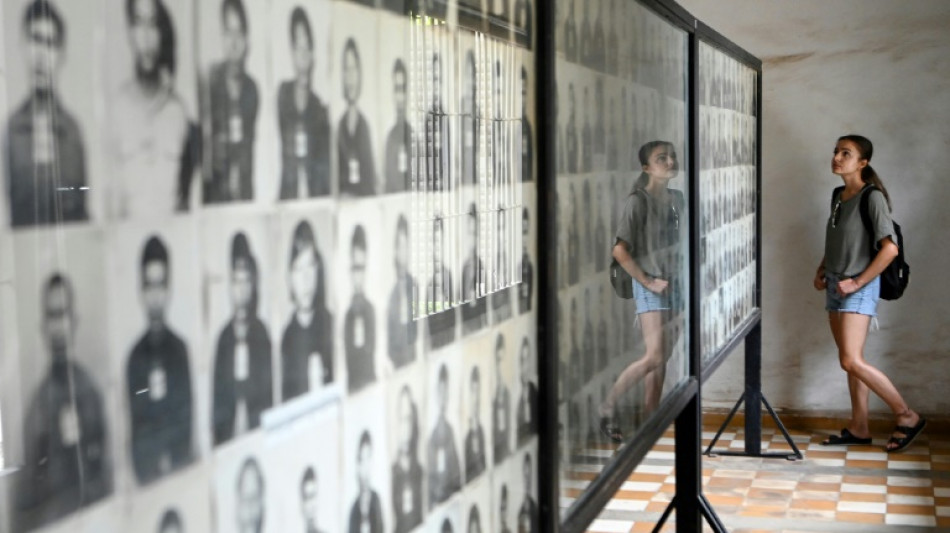
Khmer Rouge war crimes court winds up with survivors still hurting / Photo: © AFP

 Afghanistan opium poppy cultivation surges despite Taliban govt ban: UN

 No World Series miracle for weary Rays
 Miami Heat earn first win of NBA season with Antetokounmpo

 Brewers beat Rays 4-1 to capture first World Series title

 Philippine island fights rising seas with nature, not concrete

 Bangladesh presses India before Ganges water treaty expires

 Trump accuses Alaska Democrats of fraud over same-name scandal

 Spain mourns after latest train tragedy kills 68

 Trump's border: quiet, but few people are happy

 Australian defence chief says China military buildup creating 'pressure' in SE Asia
 No penalty practice? No problem for Man City in shoot-out win

 Microsoft beats expectations fueled by Azure cloud business
 Chelsea win as Bayern draw with Madrid in Women's Champions League

 Kane watches as Bayern cruise into German Cup last 16

 Bayern boss Kompany out of hospital after meningeal irritation

 Shares in Google owner Alphabet sink on profit miss, ad slowdown
 Chelsea win as Bayern and Madrid draw in Women's Champions League
 Made with munitions from the Falklands War, a 'Chalice of Peace' for the pope
 Pioneering US labor leader Dolores Huerta dies at 96

 Italian PM slams 'shameful' release of alleged protest organiser

 Hollywood producer Kennedy to head LA28 Olympic ceremony plans

 Djokovic wins Basel opener to boost ATP Finals bid

 US Fed holds interest rates steady despite surging inflation
 Chiefs sign ex-Ravens kicker suspended over sex allegations

 Inglis and Carey put Australia in command of South Africa decider
Cambodia's UN-backed court set up to try Khmer Rouge leaders finishes its work this week, ending a 16-year process that has helped national reconciliation but brought only limited solace to survivors of the genocidal regime.
The Extraordinary Chambers in the Courts of Cambodia (ECCC) will on Thursday give its judgment in the appeal by 91-year-old former head of state Khieu Samphan against his 2018 conviction for genocide and crimes against humanity.
It will be the last verdict given by the tribunal, which has cost more than $330 million and been dogged by complaints about the slowness of its work as well as allegations of interference by Cambodia's ruling party.
For Chum Mey, one of only a handful of survivors of the notorious S-21 torture prison, nothing will erase the trauma of the Khmer Rouge butchering his wife and four children.
"Only when I die, then I can forget everything," Chum Mey told AFP inside S-21, once a school and now a museum chronicling the atrocities of the Khmer Rouge.
Under leader Pol Pot, two million Cambodians died from starvation, torture, forced labour and mass execution -- nearly a quarter of the kingdom's population wiped out by the ultra-communist regime as it sought to create an agrarian utopia.
Khieu Samphan is one of only three top leaders convicted by the special court, along with "Brother Number Two" Nuon Chea -- considered the regime's chief ideologue -- and S-21 prison chief Kaing Guek Eav, better known as Duch.
Two previous appeals have been unsuccessful -- in fact, the court increased Duch's sentence on appeal.
- Difficult start -
The court had a difficult birth. In 1997 the Cambodian government asked for UN help in judging Khmer Rouge leaders.
But it rejected the idea of another International Criminal Tribunal along the lines of those created for the former Yugoslavia and Rwanda, insisting on a sovereign court run by Cambodian and international judges.
Eventually an agreement was reached in 2003, but the first hearing -- in the case against Duch -- was not held until 2009.
In total, five senior Khmer Rouge cadres, all elderly, faced trial at the court, but two died during proceedings and two others -- Duch and Nuon Chea -- died after conviction.
Regime leader Pol Pot died in 1998 before the court was established, while three other figures charged with genocide and crimes against humanity will not face trial due to disagreements between Cambodian and international judges.
S-21 survivor Chum Mey, who gave evidence in 2009, said the court had given only "about 70 percent of justice" but its work was still valuable.
"The most important point is that the court prosecuting the Khmer Rouge leaders makes people know nationwide... about the killings by Pol Pot, so they won’t let this happen again," the 91-year-old said.
Another source of controversy was the court's limited remit, which allowed it to prosecute only senior Khmer Rouge leaders.
Exiled opposition leader Sam Rainsy says this decision effectively shielded Prime Minister Hun Sen -- a former Khmer Rouge commander who has ruled the country since 1985.
The strongman premier has repeatedly warned against broadening the scope of the trials, saying it could threaten national stability.
- 'Mixed legacy' -
"The court has a decidedly mixed legacy, a mix of solid accomplishments and disappointing failures," said Craig Etcheson, author of several books on Cambodia including one on the special court.
However, the tribunal helped "super-charge the process of national reconciliation," Etcheson said.
"Parents feel more free to talk to their children about what happened to them... schools have incorporated new materials about the Pol Pot time into their curricula, neighbours began to talk to neighbours about their experiences," he said.
Nearly a quarter of a million people attended the hearings, which took evidence from more than 300 witnesses, civil parties and experts.
Etcheson argues the court was "a relative bargain" compared with other international tribunals, and donors were "far too stingy", causing delays in the proceedings.
Youk Chhang, director of the Documentation Center of Cambodia, which conducts research on the Khmer Rouge regime, believes it is a mistake to focus on the court's financial issues.
"It confirms that we can live after genocide -- that we can move on, that we can rebuild, we can put back what has been lost," he said.
Back at S-21, the sombre black-and-white photos of over 18,000 murdered detainees are displayed in the exhibition halls.
Survivor Bou Meng, 85, still bearing the physical and mental scars from his time here, calls for handcuffs and chains to encircle the graves of dead Khmer Rouge leaders.
"I will remember everything for my whole life," he said. "They beat me up, they tortured me, I can never forget these things, it's still fresh and vivid."
C.Kovalenko--BTB