
Hong Kong court convicts five of sedition over children's books / Photo: © AFP

 Brewers beat Rays 4-1 to capture first World Series title

 Philippine island fights rising seas with nature, not concrete

 Bangladesh presses India before Ganges water treaty expires

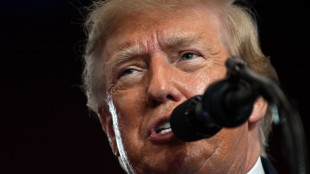 Trump accuses Alaska Democrats of fraud over same-name scandal

 Spain mourns after latest train tragedy kills 68

 Trump's border: quiet, but few people are happy

 Australian defence chief says China military buildup creating 'pressure' in SE Asia

 No penalty practice? No problem for Man City in shoot-out win

 Microsoft beats expectations fueled by Azure cloud business

 Chelsea win as Bayern draw with Madrid in Women's Champions League

 Kane watches as Bayern cruise into German Cup last 16

 Bayern boss Kompany out of hospital after meningeal irritation

 Shares in Google owner Alphabet sink on profit miss, ad slowdown

 Chelsea win as Bayern and Madrid draw in Women's Champions League

 Made with munitions from the Falklands War, a 'Chalice of Peace' for the pope

 Pioneering US labor leader Dolores Huerta dies at 96

 Italian PM slams 'shameful' release of alleged protest organiser

 Hollywood producer Kennedy to head LA28 Olympic ceremony plans

 Djokovic wins Basel opener to boost ATP Finals bid

 US Fed holds interest rates steady despite surging inflation

 Chiefs sign ex-Ravens kicker suspended over sex allegations

 Inglis and Carey put Australia in command of South Africa decider

 92-year-old US judge handling Maduro case dies

 Perez extends Cadillac deal to 2029
 Arab Israelis proud of high election turnout, uncertain for future

Five Hong Kong unionists were found guilty of sedition on Wednesday for producing a series of illustrated children's books that portrayed the city's democracy supporters as sheep defending their village from wolves.
The convictions are the latest using a colonial-era sedition offence which authorities have deployed alongside a new national security law to stamp out dissent.
The prosecution focused on members of a speech therapists' union who produced three illustrated e-books aimed at explaining Hong Kong's democracy movement to children.
In one book, called "Defenders of the Sheep Village", a group of wolves try to occupy a village of sheep, who fight back and drive their attackers away.
In another, the wolves are portrayed as dirty and bringing disease to the sheep's village.
Lai Man-ling, Melody Yeung, Sidney Ng, Samuel Chan and Fong Tsz-ho, all founding members of the union, were charged with sedition and held in jail for more than a year ahead of their verdict.
After a two-month trial Kwok Wai-kin, a District Court judge handpicked by the government to try national security cases, found the five guilty of conspiring to spread seditious content.
"The seditious intention stems not merely from the words, but from the words with the proscribed effects intended to result in the mind of children," Kwok wrote in his judgement.
"Children will be led into belief that the PRC (People's Republic of China) Government is coming to Hong Kong with the wicked intention of taking away their home and ruining their happy life with no right to do so at all," he added.
- 'Unrelenting repression' -
Amnesty International, which recently left Hong Kong because of the national security law, described the convictions as "an absurd example of unrelenting repression".
"Writing books for children is not a crime, and attempting to educate children about recent events in Hong Kong's history does not constitute an attempt to incite rebellion," Amnesty's China campaigner Gwen Lee said.
During the trial, prosecutors argued the books contained "anti-China sentiment" and were aimed at "inciting readers' hatred against the mainland authorities".
They also said the books were meant to encourage Hong Kongers to discriminate against "mainland Chinese people living in Hong Kong".
The defence argued that the sedition offence was vaguely defined and that each reader should be allowed to make up their own mind about what the characters in the books represent.
They also warned that a guilty verdict would further criminalise political criticism and have a chilling effect on society.
- Political crackdown -
Until recently Hong Kong was a bastion of free expression within China and home to a vibrant and outspoken publishing industry.
But Beijing has unleashed a sweeping political crackdown on the city in response to huge and sometimes violent democracy protests three years ago.
Sedition was originally a law from the British colonial era and carries a sentence of up to two years in prison.
Until recently, it had not been used for decades.
But it has been embraced by police and prosecutors over the last two years, alongside the national security law which Beijing imposed on Hong Kong in 2020.
Since then the city's once-popular democracy movement has been dismantled.
Most prominent local democracy activists either are in jail, are awaiting trial or have fled overseas.
Dozens of civil society groups, including multiple trade unions, have folded while a mainland-style censorship rule has been created for the film industry.
Books have been removed from libraries and curriculums rewritten with authorities ordered to instil patriotism into the city's children.
Only people deemed "staunch patriots" are now allowed to run for office.
Even before the latest crackdown, publishing had become a key target for Chinese authorities.
In 2015, five Hong Kong publishers behind a bookstore that put out salacious tomes on leaders of the Chinese Communist Party went missing, later reappearing in mainland custody.
The missing bookseller case was itself a partial catalyst for the 2019 democracy protests, which began as a movement against a law allowing extraditions to the mainland's party-controlled court system.
F.Müller--BTB