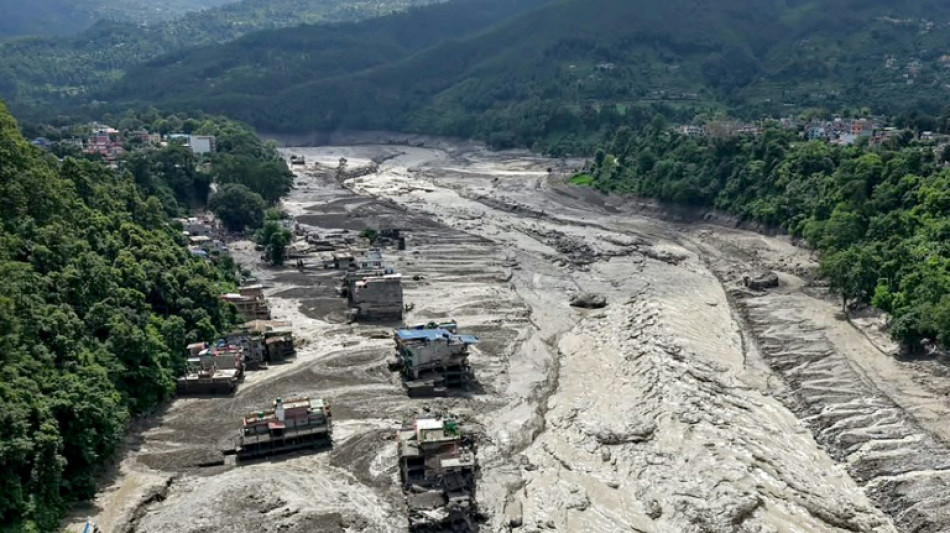
How a glacier collapse may have caused Nepal-Tibet disaster / Photo: © AFP

 Macron condemns 'racist terrorist attack' after deadly shooting near Paris
 Shiffrin sidesteps slalom in 'exploration' season

 Bayern Munich coach Kompany in hospital after collapsing: club

 Alonso sees Courtois similarities in Chelsea's Penders

 Melania Trump announces truce in Ukrainian city 'on brink of disaster'

 Saka to be carefully managed after latest injury setback, says Arteta
 Goodell says NFL's France debut 'just the beginning'

 Singapore widens haze probe to local firms linked to Indonesian fires

 Hundreds of Syrians protest repeated Israeli incursions

 El Salvador sends troops to Haiti to find 4 missing soldiers
 Liverpool must go 'full gas' despite injury issues, says Iraola

 Oil hits $115 with stocks mixed on earnings, AI

 Casualties feared as multi-storey building collapses in Nairobi

 Man Utd defeat to Como 'unacceptable', says Carrick

 Hurzeler 'focused' on Brighton job despite Man Utd links
 Hammer blow for Kenya as world marathon champ Jepchirchir suspended for doping

 Latin America's right-wing swing looms large over nature summit

 European, Mideast foreign ministers hold talks in Istanbul

 World marathon champion Peres Jepchirchir suspended for doping: AIU
 Romania blames Russia for new deadly attack on ship
 Waze rejects Malaysia's data security claims after civil servant ban

 'Call of Duty' seeks to win back fans with warfare spectacle

 Volvo Cars shares plunge on losses, job cuts

 France braces for new protests as Macron seeks to restore order

 Kering shares tumble as Gucci fails to reassure investors
A huge piece of ice that fell thousands of metres from a glacier into a river below may have unleashed the disaster in Nepal and Tibet that killed at least 180 people.
Here is what experts believe happened so far:
- Glacier collapse -
A glacier collapse in Nepal's mountains near Tibet appears to have triggered the disaster.
"A large chunk of glacier fell from about 5,200 metres (about 17,600 feet)... into a valley," said Simon Cox, principal scientist at New Zealand's GNS Science.
It "transformed into this raging mass of debris... where it picks up rocks and sediment and trees and anything in the way and fires it on down through the canyon," he told AFP.
The wall of water first impacted a border post, as documented in terrifying CCTV footage showing mud and debris engulfing the area as people fled before it.
It then travelled downstream into Nepal, flooding villages and bringing down bridges and buildings.
- Seismic activity -
The glacier collapse was large enough to register as a seismic event, initially mistaken for an earthquake.
But after further analysis, the US Geological Survey determined "that the seismic event was instead a glacial collapse and debris flow, and that no earthquake had occurred.
The collapse registered as a 5.2-magnitude "seismic event", which took place at 8:37 am local time (0252 GMT).
Estimating just how much of the glacier collapsed will take time, Cox said, but it could range from "half a million cubic metres to tens of million cubic metres."
- Detective work -
With the affected area largely inaccesible, experts are using satellite imagery and any available measurements on the ground to reconstruct the disaster.
"We can look at satellite imagery taken before and after the event, and try and see what has changed, essentially looking for what is missing from the mountains in the 'after' imagery," said Lauren Vargo, a glaciologist at New Zealand's Victoria University of Wellington.
Soon after the seismic activity was recorded, a nearby water monitoring station stopped transmitting, Nepali authorities said.
Stations downstream began going offline one by one, though water was registered reaching up to 12.3 metres high in Kalikhola, near the Tibet border at 2:14 pm, they added.
- GLOFs -
Early speculation suggested a glacial lake outburst flood, or GLOF, a growing risk as glaciers melt due to climate change.
A GLOF occurs when a fragile debris wall holding back a lake of glacier melt suddenly collapses, unleashing the water behind it.
Some experts suggested a GLOF might have been involved.
"Water does flow within glaciers and flows beneath glaciers," said Adrian McCallum, a glaciologist at the University of the Sunshine Coast.
"But to my mind, the only reason why a large volume of water should all of a sudden flow down a valley is because it has been released," he told AFP.
Other experts said they did not detect existing glacial lakes near the site of the glacier collapse, and theorised that water collected under the glacier might have cascaded down with the falling chunk.
The falling glacier ice could also have briefly dammed the river, collecting water behind it that was released when it dislodged.
Summer glacier melt upstream and monsoon rains would mean the rivers were already high, and the volume of water was also swelled by debris and mud picked up as it travelled kilometres from the initial collapse, added Cox.
- Warnings -
Nepali authorities first received word of a flood around 9:00 am local time, and began alerting areas along the Bhote Khoshi river to "stay on high alert and stay in safe areas".
But is is unclear how many people received the warning, or how much time they would have had to respond.
"The reality is, if you are in a community underneath a large glacier and potentially a glacier lake where a GLOF could occur, then to some extent, it's a ticking time bomb," said McCallum.
And even for those receiving a warning, options would be limited, said Hatim Sharif, a hydrologist at the University of Texas San Antonio.
"Running will not help," nor will trying to flee by vehicle, he told AFP, because the mud and water moving at high speed form a lethal combination "like liquid concrete."
The only solution is to climb up a hill, at least 20 feet (six meters), he estimated.
- Climate change -
While it is hard to immediately attribute any individual glacial event to climate change, the warming planet is a constant background stress on these ancient ice rivers, expert say.
Glaciers are retreating globally, creating disaster risks but also depriving downstream communities of vital water sources.
"The biggest way to mitigate the risk would be to reduce our greenhouse gas emissions to limit warming," said Vargo.
burs-sah/jm
C.Kreuzer--VB