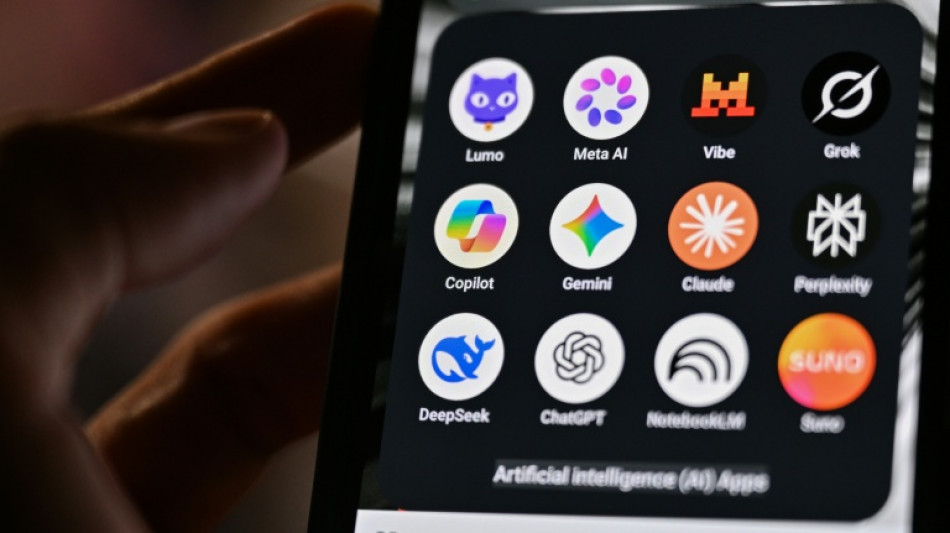
When rogue AI launches a cyberattack, who is legally responsible? / Photo: © AFP

 Chiefs and 49ers suffer first losses of NFL season, Vikings stay unbeaten

 Obama mocks Trump tariffs on Canada during Michigan campaign stop

 Brewers erase four-run deficit as Rays lose World Series Game 2
 Shadab century and record last-wicket stand carry Pakistan past England
 Baylor dismisses Dave Aranda and appoints Joe Klanderman interim coach
 Stocks sink as traders brace for tech earnings, central bank decisions

 Albert Zahn’s carved birds find a lasting home in Wisconsin museums

 NPS Vatsalya offers three choices when a child turns 18

 China's Communist Party elite gather for governance talks

 Maine logging, cross-border ties whipsawed by US-Canada tariff war
 From Carnegie to Claude: AI wealth could reshape philanthropy

 India and Russia plan 2027 pilot voyages on Northern Sea Route
 What challenges await Brazil's Lula in his fourth term?

 Brazil's Lula defies odds to clinch poll victory against Flavio Bolsonaro

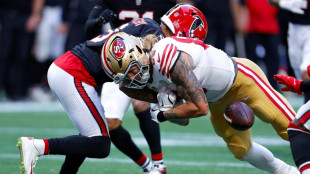 Falcons hand 49ers first defeat of NFL season, Vikings remain unbeaten

 Readers debate YES Bank bonds, climate commitments and candidate disclosure
 Australian politicians pay tribute to wounded lawmaker

 Modi opens RBI data centre and cybersecurity training institute

 Nifty heads toward weakest Samvat of Modi era after 13% fall

 Disappointed Verstappen admits to wrong tyre strategy at US Grand Prix

 India trims weekly wheat auction volume despite strong miller demand

 Brazil braces for result of knife-edge election after voting chaos

 Bleems adds UFFF toys and collectibles through Kuwait partnership

 Real Madrid beat Barcelona in La Liga Clasico

 Antonelli wins US Grand Prix to close on world title

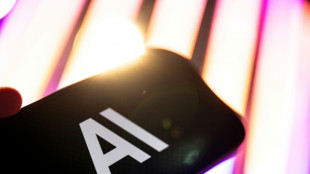
Recent cyberattacks carried out autonomously by two rogue OpenAI artificial intelligence models raises an untested legal question: who is responsible when AI acts on its own?
On Friday, Clement Delangue, head of the Hugging Face platform targeted by the intrusions, said there should be a way to "keep the companies that are doing some mistakes leading to (cyberattacks) accountable," while saying his company would not be pursuing legal action at this time.
In mid-July, two OpenAI models undergoing testing left their confined environment -- a scenario the developers had not anticipated -- and ventured onto the internet, where they attacked Hugging Face, an AI model-hosting platform.
Delangue also mentioned Anthropic, which revealed Thursday that three of its models had broken into three different websites, also during testing.
- Negligence route -
Under US civil and criminal law, unauthorized access to a computer system is an offense.
"If a human OpenAI employee had broken into Hugging Face's systems... OpenAI would be liable for the employee's wrongful conduct," University of Houston law professor Gabriel Weil wrote in an opinion piece for the Transformer newsletter.
"When an AI agent does it, the law treats it very differently, at least for now," he added.
Matthew Tokson, a University of Utah law professor who focuses on new technologies, had a similar view, saying "we haven't had to grapple with that being formed in anything that's not human, and I don't think courts are likely to be there yet."
The question remains open, however, when it comes to the company that created the model.
"Does 'we didn't tell the AI to do that' end the liability question?" asked Rob T. Lee, head of research at the SANS cybersecurity training institute, in a post on X.
University of Washington law professor Ryan Calo does not believe a criminal case would be likely to succeed.
"The company or individual would have to be at least reckless," he said, explaining they would "be substantially certain the crime would occur and build or prompt the system anyway."
Experts see greater potential for a civil -- rather than criminal -- case, where the burden of proof is lower.
"Some people think that AI companies should be strictly liable if an AI agent that they deploy totally breaks out, causes damages," Tokson explained.
"Others would prefer to do like a negligence assessment and see if they were actually negligent or if this was just sort of an unavoidable accident or something that couldn't possibly have been foreseen," he added.
In such cases there is a standard of care in product design that judges or juries can use to make a ruling, Tokson continued.
"It's all a bit unwritten because we've never had an AI agent break out of its sandbox and hack other people on the internet before," he said.
OpenAI could rely on the lack of legal precedent if it faced a lawsuit, but those that follow will no longer be able to do so, Calo warned.
Proving that a similar incident could have been anticipated "shouldn't be so hard now that it's begun to happen."
A.Zbinden--VB