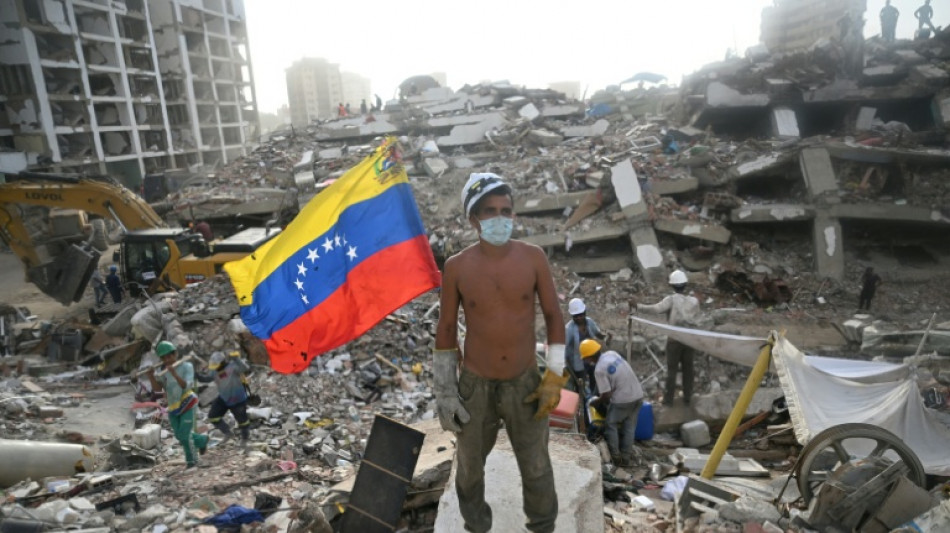
Buried in 1967 quake, Venezuelan now scrambles to help new victims / Photo: © AFP/File

 Israel opposition holds narrow edge over Netanyahu in first projections

 Floriani hits maiden goal as Lazio go top
 Trump set to drastically loosen oil and gas sector's methane rules

 Storied Paris department store seeks bankruptcy protection
 Xhaka, Embolo can return to Swiss squad after fake Covid docs affair
 Allegri suspended for two Serie A games after red card
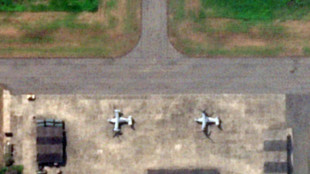 Flight data, satellite images reveal growing US role at Ecuador base
 McInnes feels 'guilt' ahead of Hearts return with Rangers
 Brazil's Lula turns 81, vows to work '24 hours a day'
 Boeing releases cautious growth plan as shares fall sharply
 Exiled Russian dissident Navalnaya warns dictators becoming 'more cunning'
 Bayern 'risk' reaps huge reward for Ballon d'Or winner Kane
 Record turnout as Israeli voters deliver verdict on Netanyahu
 Iraola says Isak 'feels the trust' after Liverpool scoring streak

 French media protest manhandling of journalists at far-right party rally

 EU seeks deportation powers for beefed up border agency
 Two charged with UK security offences over airbase plot: police
 Maresca defends Donnarumma, Guehi after Man City defeat
 Nordic leaders call Putin as local truce begins in Ukraine
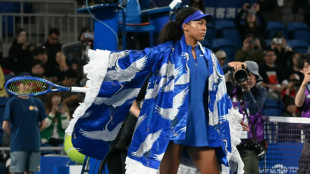 Osaka unveils crane outfit in Tokyo before win over Paolini

 Ronaldo in line for Portugal return after fallout with coach

 Norway media take legal action to block Meta from using content

 Bayern praise 'humble' Kane after Ballon d'Or win

 Colts retain Daniel Jones as starter despite continued offensive struggles

 Madushanka wrecks Pakistan as Sri Lanka press for final slot
As an infant a lifetime ago, Maria Elena Paez Pumar was buried under the rubble of an earthquake in Venezuela and it was her crying that led rescuers to save her.
That ordeal -- she and her family spent almost four days trapped -- unfolded in 1967 in a northern coastal state called La Guaira. And when the earth roared and rumbled there again on June 24 in devastating twin quakes, Paez Pumar sprang into action in the United States to help.
She joined others of Venezuelan origin to raise money and other aid for people back home who were hit by the tragedy. It meant more pain for a country already suffering from decades of economic decline and new political turmoil after the US ouster of Nicolas Maduro and effective takeover of the oil-rich nation.
"Anyone in that situation needs help from anywhere they can get it," Paez Pumar said of the quake victims. The death toll now surpasses 4,800 after buildings fell like houses of cards. Many thousands more Venezuelans remain missing.
"And having been in those shoes and received so much help from my family, my friends or people I did not even know, it was the least I can do," Paez Pumar told AFP.
Now 59, she was seven months old when a quake hit northern Venezuela on July 29, 1967. It killed more than 200 people.
The tremor knocked down the upper floors of an apartment building where she and her family was spending the weekend in the town of Vargas, trapping them in the rubble.
They later told her that her cries alerted rescue crews.
"Thanks to that crying they managed to get to my mother, my siblings and finally to me," Paez Pumar said.
Her brother died but after a painstaking operation the crews saved Paez Pumar's mother and sister and her -- almost four days after the quake.
They survived but suffered tremendously, and bear scars, and worse, to this day.
Paez Pumar's sister, who was about to turn three years old that day, had a foot amputated during the rescue, and later both legs because gangrene had set it.
Paez Pumar herself was crushed by the crib she had been lying in and had to have her right forearm cut off.
Their mother survived intact but needed a year and a half to regain the use of her hands.
- Like any other kid -
Paez Pumar said that all things considered, her childhood was a happy one, with support from her family and friends, and she never felt mistreated by other kids because of her disfigurement.
And now with so many thousands of people in need in Venezuela she said she hopes they can also be treated with kindness.
"There are going to be many, many families like ours and I think the people of Venezuela as a society -- parents, educators, have to realize this," she said.
"We are not weird. We are just people who had something happen to them. But nonetheless we are going to be happy, live and achieve our dreams."
From a tender age Paez Pumar had to adapt to her body, learning for example to write with her left hand even though she was born right-handed.
She said she emerged from her personal struggles as a woman with strong faith in God, as someone who is perfectionist, methodical and strong.
"I have developed ways of making my disability not be a disability but rather the exact opposite, to be able to do everything I want to in life," she said.
After working as an attorney in Venezuela, Paez Pumar settled in Florida 11 years ago and is now a teacher.
Her advice for young people injured in the recent quakes is to be patient as they try to overcome their physical and emotional injuries.
"Every day we move forward. Even if it is a tiny step, it is an achievement," she said.
"With patience, love and support this can be achieved, because I have had a very happy life and I am eternally grateful."
R.Fischer--VB