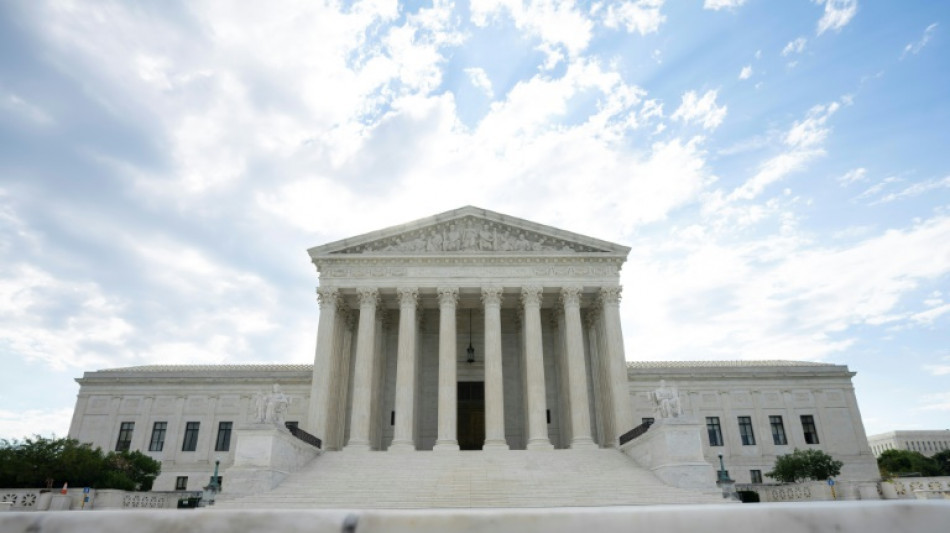
US Supreme Court rejects Trump bid to limit birthright citizenship / Photo: © GETTY IMAGES/AFP/File

 French Senate weighs bill to make protesters pay for unrest damage
 'A very sad day': Arteta despair as Arsenal stunned by Fleetwood

 Charles tackles thorny legacy of slavery on Caribbean trip

 Former Grand Slam winner Wawrinka ends tennis career

 Brazil's Flavio Bolsonaro flees to US after election loss
 'Faerie' nights: 'ACOTAR' fans finally get their book
 American woman convicted of getting military training from Islamic State
 Israel opposition holds narrow edge over Netanyahu in first projections

 Floriani hits maiden goal as Lazio go top

 Trump set to drastically loosen oil and gas sector's methane rules

 Storied Paris department store seeks bankruptcy protection
 Xhaka, Embolo can return to Swiss squad after fake Covid docs affair
 Allegri suspended for two Serie A games after red card
 Flight data, satellite images reveal growing US role at Ecuador base
 McInnes feels 'guilt' ahead of Hearts return with Rangers
 Brazil's Lula turns 81, vows to work '24 hours a day'
 Boeing releases cautious growth plan as shares fall sharply

 Exiled Russian dissident Navalnaya warns dictators becoming 'more cunning'

 Bayern 'risk' reaps huge reward for Ballon d'Or winner Kane
 Record turnout as Israeli voters deliver verdict on Netanyahu
 Iraola says Isak 'feels the trust' after Liverpool scoring streak

 French media protest manhandling of journalists at far-right party rally
 EU seeks deportation powers for beefed up border agency
 Two charged with UK security offences over airbase plot: police

 Maresca defends Donnarumma, Guehi after Man City defeat

The US Supreme Court on Tuesday rejected President Donald Trump's bid to restrict birthright citizenship in a blow to one of his signature anti-immigration initiatives.
The court, in an eagerly awaited decision on the final day of its term, ruled 6-3 to maintain the right to American citizenship for nearly everyone born on US soil.
Trump signed an executive order last year on the first day of his second stint in the White House decreeing that children born to parents in the United States illegally or on temporary visas would not automatically become US citizens.
Lower courts blocked the move by the Republican president, ruling that under the Citizenship Clause of the 14th Amendment to the US Constitution nearly everyone born on US soil is an American citizen.
The Supreme Court agreed in a majority opinion penned by Chief Justice John Roberts that was joined by two other conservative justices and the three liberals on the top court.
"Children born in the United States to parents unlawfully or temporarily present are 'subject to the jurisdiction' of the United States and are citizens at birth under the Fourteenth Amendment's Citizenship Clause," Roberts wrote.
In an unprecedented move for a sitting US president, Trump personally attended oral arguments on birthright citizenship at the Supreme Court in April.
Trump stayed for the presentation by his solicitor general, John Sauer, but did not remain for the arguments of American Civil Liberties Union (ACLU) attorney Cecillia Wang, who defended birthright citizenship.
Wang welcomed Tuesday's ruling, saying the court's decision "reaffirms a fundamental American promise -- if you are born here, you are a citizen."
"A president cannot change the Constitution by executive fiat," she said.
Trump called the decision upholding birthright citizenship "bad for our country."
He urged the Republican-controlled Congress in a Truth Social post to "start TODAY to work on ending expensive and unfair to our Country, Birthright Citizenship."
"They will have my Complete and Total Support!" he said.
- 'Birth tourism' -
Trump's bid to end birthright citizenship was part of his wider campaign to limit immigration, which includes expelling millions of undocumented migrants and removing deportation protections from nationals of more than a dozen countries.
During oral arguments before the Supreme Court, Sauer argued that unrestricted birthright citizenship encourages illegal immigration and "birth tourism," in which foreigners come to the United States solely to give birth.
The 14th Amendment states that "All persons born or naturalized in the United States, and subject to the jurisdiction thereof, are citizens of the United States."
It does not apply to those not subject to US jurisdiction -- the children of foreign diplomats, for example.
The Trump administration argued that the 14th Amendment, passed in the wake of the 1861-1865 Civil War, addresses citizenship rights of former slaves and not the children of undocumented migrants or visitors.
Trump's executive order banning birthright citizenship was premised on the notion that anyone in the United States illegally, or on a visa, is not "subject to the jurisdiction" of the country and therefore excluded from automatic citizenship.
The Supreme Court rejected such a narrow definition in a landmark 1898 case involving a man named Wong Kim Ark, who was born in San Francisco in 1873 to parents who had come to the United States from China.
After a visit to China, Wong Kim Ark was denied reentry into the United States in 1895 under the Chinese Exclusion Acts.
The Supreme Court ruled, however, that he was a US citizen by virtue of being born in the United States and Roberts, in his birthright opinion, referred to the case.
"We have repeatedly understood the rule of Wong Kim Ark to guarantee citizenship to all children born in the United States and subject to its power," Roberts said.
The Supreme Court's rejection of Trump's bid to end birthright citizenship is the third major loss for him this term. The justices struck down most of his global tariffs in February and on Monday they blocked his bid to fire Federal Reserve governor Lisa Cook.
H.Gerber--VB