
Bulgaria's milk farmers falter in former yogurt empire / Photo: © AFP

 UK set for cautious budget as borrowing costs climb
 Anthropic's record IPO faces some big questions
 US Fed expected to hold rates steady ahead of key midterm elections

 Can this Latin Grammy-winner help Democrats win back Congress?

 Tuvalu has 'limited' power to halt its fossil fuel investments: NZ govt papers seen by AFP
 Palestinian activist Khalil returns to Columbia after US detention

 Trump drastically loosens oil and gas methane rules

 French Senate weighs bill to make protesters pay for unrest damage

 'A very sad day': Arteta despair as Arsenal stunned by Fleetwood
 Charles tackles thorny legacy of slavery on Caribbean trip

 Former Grand Slam winner Wawrinka ends tennis career

 Brazil's Flavio Bolsonaro flees to US after election loss
 'Faerie' nights: 'ACOTAR' fans finally get their book

 American woman convicted of getting military training from Islamic State

 Israel opposition holds narrow edge over Netanyahu in first projections

 Floriani hits maiden goal as Lazio go top
 Trump set to drastically loosen oil and gas sector's methane rules

 Storied Paris department store seeks bankruptcy protection
 Xhaka, Embolo can return to Swiss squad after fake Covid docs affair

 Allegri suspended for two Serie A games after red card

 Flight data, satellite images reveal growing US role at Ecuador base
 McInnes feels 'guilt' ahead of Hearts return with Rangers

 Brazil's Lula turns 81, vows to work '24 hours a day'

 Boeing releases cautious growth plan as shares fall sharply

 Exiled Russian dissident Navalnaya warns dictators becoming 'more cunning'
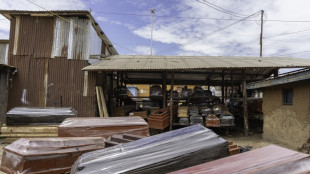
"When the city starts feeding the countryside, it means the country is done for," farmer Emil Deliev said from southern Bulgaria's mountains where small dairy farms are vanishing one after another.
Despite its long tradition, the farming output of Bulgaria -- the European Union's poorest member -- has been falling as production costs are eating into margins.
In shops, Bulgarian fruit and vegetables are gradually being replaced by imported products.
Milk production has taken a particularly hard hit, oddly enough in a country whose reputation is closely tied to yogurt.
"This will be our last year," Deliev said, driving his cows to pasture in the Rhodope mountains.
His farm in a meadow close by the village of Sofiytsi in southern Bulgaria backs onto the wooded slopes of the mountain range associated with the mythological musician Orpheus.
The 59-year-old Deliev raises nearly 100 cows there, but after almost 20 years spent with his animals, he too is thinking of giving up.
He blames the purchase price of milk, which is too low, and subsidies that are too small and mostly benefit large grain producers.
Data from the EU's statistical office, Eurostat, show the number of dairy cows in Bulgaria fell by around 40 percent between 2010 and 2024.
Local data has shown the same goes for production -- in 2024, Bulgaria produced 687.6 million litres of cow's milk, a drop of nearly 20 percent against 856.1 million litres churned out in 2020.
– 'The last in the village' –
In turn, the Bulgarian Commission for the Protection of Competition (CPC) said that imports of milk and dairy products have risen by 43 percent since 2020.
"The simplest explanation is the decline in the total number of cows and the closure of many small farms," economist Adrian Nikolov of the Institute for Market Economics (IME) told AFP.
Productivity has not been high enough to offset this decline, he said, notably because of rising fodder prices, workforce shortage and higher wage costs.
"The labels say 'Made in Bulgaria', but there is less and less Bulgarian milk in the country," said Deliev.
Deliev has held out until now, with the help of his wife and his son who has a degree in agronomy, but he no longer sees a future.
"It has become a pain," he said.
Deliev makes several thousand euros a month selling milk, but it is barely enough to cover production costs.
"We're the last in the village. There used to be three farms, now we're the only one left," he said.
- 'Food sovereignty' -
Deliev added that European Union aid redistributed by local authorities is destined largely for grain farms geared toward exports, which hurts livestock farmers.
There are no available data to show the extent to which yogurt sold as Bulgarian is made with imported milk.
It is however certain that dairy products, a central part of the Bulgarians' diet, have cost 20 to 30 percent more on average than in the rest of the EU for more than a decade, said economist Nikolov.
While the rest of the food basket as a whole remains cheaper than in other EU countries, Bulgaria's entry into the eurozone on January 1 has heightened concerns about purchasing power.
In May, the country posted the eurozone's highest annual inflation rate of 6.3 percent, according to Eurostat's flash estimate.
Prime Minister Rumen Radev, who won April's general election with a pledge to combat inflation, introduced discounts of at least 15 percent on certain basic foodstuffs in early June, in cooperation with major retail chains.
But Milena Dragijska, head of the Lidl Bulgaria supermarket chain, said this solution was only temporary.
She said the country needed "deep structural reforms" to strengthen national agricultural production and achieve some form of "food sovereignty".
G.Haefliger--VB